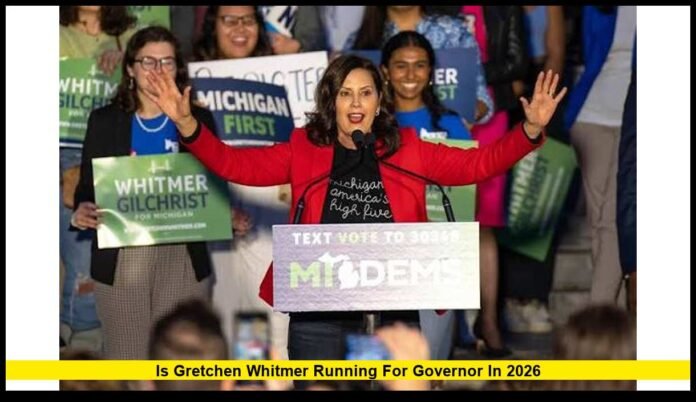

Is Gretchen Whitmer running for governor in 2026? No. Michigan Governor Gretchen Whitmer is barred from seeking another gubernatorial term because she has already won elections in 2018 and 2022, reaching the state’s constitutional limit. As of October 25, 2026, she is completing her second term while Democratic nominee Jocelyn Benson and Republican nominee John James compete to become Michigan’s next governor.
The November 3 election will decide who succeeds Whitmer when her administration ends in January 2027. Michigan voters chose the major-party nominees during the August 4 primary, setting up a competitive contest over the state’s economic future, education system, energy policies, and government priorities.
Whitmer’s absence from the ballot does not mean she has stepped away from politics. She remains governor and has continued to participate in Democratic political organizing. However, her role in the 2026 election differs from that of a candidate seeking another term.
The central question is no longer whether Whitmer can win reelection. Her term limit settles that issue. Instead, Michigan voters must decide which candidate should lead the state after eight years under her administration.
Why Gretchen Whitmer Cannot Run for Governor in 2026
Michigan’s constitution limits how many times a person can be elected governor. Whitmer has won two gubernatorial elections, making her ineligible to seek another term under the existing rules.
She first defeated Republican Bill Schuette in November 2018. Her victory brought her to the governor’s office in January 2019, beginning her first four-year term.
In November 2022, Whitmer defeated Republican Tudor Dixon to secure another four years. That victory placed her within the constitutional limit and made the 2026 election an open-seat contest.
Michigan does not allow a governor who has already been elected twice to return for another term simply by waiting for an election cycle to pass. Whitmer therefore cannot become eligible for a third term by sitting out the 2026 race.
The restriction applies to the office itself, not to a politician’s popularity or campaign resources. Even if Whitmer maintains strong support among Democratic voters, she cannot use that support to bypass the constitutional limit.
This rule explains why the state is preparing for a new governor in January 2027.
When Will Gretchen Whitmer Leave Office?
Whitmer’s second term ends in January 2027. Until the transition takes place, she remains Michigan’s governor and continues to exercise the responsibilities of the office.
The general election is scheduled for November 3, 2026. Voters will choose the next governor, but the election does not immediately remove Whitmer from office.
The winning candidate must complete the election process and take office according to Michigan’s established timetable. The new administration will then assume responsibility for the executive branch and the state departments under the governor’s authority.
This transition matters because Michigan faces decisions about its budget, roads, schools, economic development, energy, and public services. The incoming governor will help shape the state’s priorities for the next four years.
Whitmer’s final months in office are therefore important for both the outgoing administration and the candidates seeking to replace her.
Who Is Running to Replace Gretchen Whitmer?
The 2026 gubernatorial race features candidates from several parties. Jocelyn Benson won the Democratic primary, while John James secured the Republican nomination.
Other candidates on the general-election ballot include Douglas Campbell of the Green Party, Anthony Hudson of the Libertarian Party, and Donna Brandenburg of the U.S. Taxpayers Party. Independent write-in candidates are also part of the contest.
The major-party nominees bring different professional backgrounds and policy priorities to the race.
Jocelyn Benson: The Democratic Candidate
Jocelyn Benson serves as Michigan’s secretary of state, a position she won in 2018. She took office in January 2019 and won reelection in 2022.
Her responsibilities include overseeing elections, maintaining voter registration systems, administering driver services, and carrying out other duties assigned to the secretary of state.
Benson announced her campaign for governor in January 2025. She won the Democratic primary on August 4, 2026, and now seeks to succeed Whitmer.
Her campaign has emphasized affordability, education, individual rights, and improvements to government services. She has presented herself as a candidate who wants to build on Democratic leadership while addressing concerns about household costs and public institutions.
Whitmer endorsed Benson after the primary. That endorsement gives Benson support from the outgoing governor, but it does not guarantee the result of the November election.
Voters will make their own decisions based on Benson’s record, proposals, and ability to lead the state.
John James: The Republican Candidate
John James won the Republican nomination in the August 2026 primary. He represents Michigan’s 10th Congressional District in the U.S. House of Representatives.
James is a U.S. Army veteran and former business executive. Before winning his congressional seat in 2022, he ran for the U.S. Senate in Michigan.
His gubernatorial campaign has focused on economic opportunity, education, public safety, and reducing regulatory burdens. He has presented his candidacy as an alternative to the policies pursued under Whitmer and Michigan’s Democratic leadership.
James’s challenge is to persuade voters that his proposals would better address Michigan’s economic and public-service concerns.
The November contest will determine whether Republicans can take control of the governor’s office or Democrats can retain it by electing Benson.
What Does Whitmer’s Endorsement Mean for the 2026 Election?
Whitmer endorsed Benson after the Democratic primary, making her preference clear in the contest to select her successor.
An endorsement can help a candidate by drawing attention to a campaign, strengthening relationships with party supporters, and encouraging voters who approve of the endorsing politician to consider the candidate.
However, endorsements do not determine election results. Benson must build her own coalition and persuade voters that her plans address their concerns.
Whitmer’s support also reflects the broader effort by Michigan Democrats to retain the governor’s office after two terms under her leadership.
For Benson, the challenge is to balance continuity with a clear explanation of what she would do differently. Some voters may want her to preserve policies they support, while others may expect new approaches to problems that remain unresolved.
James, meanwhile, can argue that Michigan needs a change in direction. His campaign can focus on areas where voters are dissatisfied with the current administration.
The election will ultimately depend on voters’ judgments about the candidates and their proposed policies, not on Whitmer’s endorsement alone.
What Issues Matter Most in Michigan’s Governor Race?
Although Whitmer cannot run again, her administration provides the political backdrop for the election. The candidates are offering different ideas about how Michigan should respond to its economic and social challenges.
1. Affordability and Household Expenses
The cost of everyday life is an important concern for Michigan families. Housing, utilities, transportation, food, and health care can place pressure on household budgets.
Candidates have proposed different approaches to affordability. Their plans may involve taxes, state spending, economic development, or changes to government programs.
Voters must consider which proposals are practical and how much authority the governor would have to implement them.
2. Education and Schools
Education is another major issue in the contest. Decisions about school funding, academic performance, teacher recruitment, and education policy affect families throughout the state.
Benson has emphasized strengthening public education. James has promoted greater school choice and changes to education policy.
The next governor will work with the legislature and relevant agencies on education funding and administration. The outcome of legislative elections will also affect what the governor can accomplish.
3. Jobs and Economic Development
Michigan’s economy has longstanding ties to manufacturing, automotive production, engineering, and skilled trades.
The next administration will face questions about attracting investment, supporting workers, developing new industries, and responding to changes in the automotive sector.
Candidates differ on regulation, energy policy, and the role of government in economic development. Those differences could shape future decisions about business incentives and state investment.
4. Energy and Infrastructure
Energy costs, electricity supply, roads, and major infrastructure projects are also part of the debate.
Benson has supported clean-energy investment, while James has called for changes to Michigan’s clean-energy policies.
The next governor will have to work within existing laws and available funding. Major policy changes may require legislative approval rather than a decision by the governor alone.
5. Public Safety
Public safety remains a responsibility of state and local government. Candidates have discussed law enforcement, community safety, and approaches to crime prevention.
The governor influences public safety through executive leadership, budgets, appointments, and cooperation with local officials. However, the office does not independently control every local policing decision.
These issues give voters several ways to compare the candidates as Michigan approaches Election Day.
Can Gretchen Whitmer Run for Governor Again in 2030?
No. Under Michigan’s existing constitutional limit, Whitmer cannot seek a third gubernatorial term simply by waiting until 2030.
The state restricts a person to two elections as governor. Whitmer won in 2018 and 2022, so she has reached that limit.
A different result would require a change to the governing constitutional rules. A routine election, a campaign announcement, or a period away from office cannot remove the restriction.
Whitmer can still remain active in public affairs after her governorship ends. She may support candidates, speak about policy, or participate in political organizations, subject to applicable laws and her own decisions.
Those activities are distinct from seeking another term as Michigan governor.
It is important to separate her future political involvement from the specific question of whether she can run for the same office again. Under the current rules, she cannot.
Will Whitmer Remain Active in Politics After 2026?
Whitmer has continued to engage in Democratic organizing as her final year in office progresses. In February 2026, she discussed recruiting and supporting potential candidates through her national political work.
Her involvement in party activities shows that leaving the governor’s office does not necessarily mean leaving politics.
However, it would be premature to assign her a specific future job or campaign role without a confirmed announcement. Her plans after January 2027 should be distinguished from her current responsibilities as governor.
Whitmer has also addressed questions about a potential presidential campaign. In May 2026, she made comments indicating that she did not plan to run for president in 2028, although later remarks left some ambiguity about how definitively she wanted to close that possibility.
That discussion is separate from Michigan’s gubernatorial term limit. Regardless of any future national political activity, she cannot seek a third term as governor under the current state constitution.
For now, her confirmed responsibilities include finishing her administration and participating in the political process surrounding the 2026 election.
How the 2026 Election Will Shape Michigan’s Future
The November election will determine who leads Michigan’s executive branch for the next four years. The outcome will affect the administration’s priorities, appointments, budget proposals, and relationship with the state legislature.
If Benson wins, Democrats will retain the governor’s office after Whitmer’s two terms. If James wins, Republicans will take control of the office and pursue their own policy agenda.
The result will not automatically settle every policy dispute. The governor must work within the constitution, existing laws, available funding, and the legislature’s decisions.
Michigan voters will also elect legislators and decide other races in November. Those results can influence whether the next governor can secure support for major proposals.
The transition will therefore involve both a new governor and a broader assessment of the state’s political direction.
Frequently Asked Questions
Is Gretchen Whitmer running for governor in 2026?
No. Whitmer cannot seek another term because she has already been elected governor twice, in 2018 and 2022. Michigan’s constitutional term limit makes the 2026 race an open-seat election.
Who is running for Michigan governor in 2026?
The major-party nominees are Democrat Jocelyn Benson and Republican John James. Douglas Campbell, Anthony Hudson, and Donna Brandenburg are also running under their respective parties.
When does Gretchen Whitmer’s term end?
Whitmer’s second term ends in January 2027, when the newly elected governor is expected to take office.
Did Gretchen Whitmer endorse Jocelyn Benson?
Yes. Whitmer endorsed Benson after Benson won the Democratic gubernatorial primary in August 2026.
Can Whitmer run for governor again in 2030?
No. Michigan’s existing constitutional limit prevents someone who has been elected governor twice from seeking a third term after a break.
Who will replace Gretchen Whitmer as governor?
Michigan voters will decide in the November 3, 2026, general election. As of October 25, the winner has not been determined.
Is Gretchen Whitmer leaving politics completely?
Her term limit requires her to leave the governor’s office, not public life altogether. She has remained involved in Democratic political organizing, but her future role after January 2027 should not be treated as settled without a confirmed announcement.
Why is the 2026 Michigan governor election important?
The election will determine the state’s executive leadership for the next four years. Voters will choose between candidates with different approaches to affordability, education, economic development, energy, and public safety.
Conclusion
Gretchen Whitmer is not running for governor in 2026 because Michigan’s constitutional term limit prevents her from seeking a third term. After winning elections in 2018 and 2022, she is completing her final term, which ends in January 2027. Jocelyn Benson and John James are the leading major-party candidates competing to succeed her, and the November 3 election will determine Michigan’s next governor.
What should Michigan’s next governor prioritize during the first year in office? Share your opinion in the comments and follow the latest confirmed developments in the 2026 Michigan election.