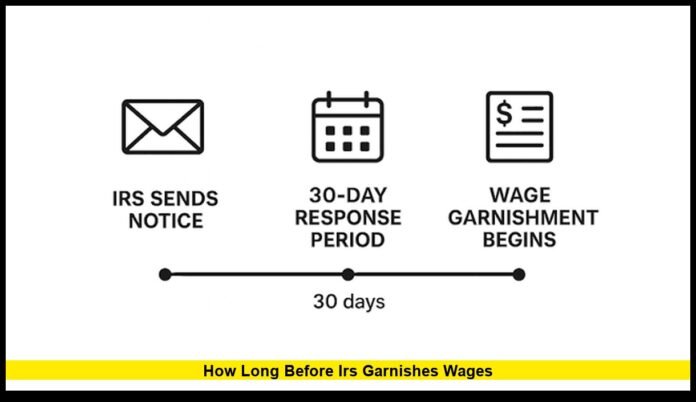

If you owe federal taxes, understanding how long before IRS garnishes wages can help you protect your income and avoid unexpected deductions from your paycheck. The Internal Revenue Service (IRS) generally follows a collection process before taking money directly from your wages. This process usually involves assessing the tax debt, sending a bill, and providing a final notice of intent to levy with information about your right to a hearing.
In most ordinary cases, the IRS must provide at least 30 days’ notice before issuing a wage levy under the applicable rules. However, this does not mean that the entire process begins and ends within 30 days. The time between your first unpaid tax bill and wage garnishment can vary depending on your account, the notices you receive, and whether you arrange to pay the debt.
The good news is that owing back taxes does not automatically mean your employer will begin withholding money immediately. You may be able to prevent or stop an IRS wage levy by arranging payments, requesting appropriate collection relief, or challenging an incorrect tax assessment.
How Long Before the IRS Garnishes Your Wages?
There is no fixed number of days or months that applies to every taxpayer. The IRS does not automatically garnish wages immediately after a missed payment or an overdue tax return.
Instead, the agency generally follows several steps before issuing a wage levy:
- The IRS assesses the tax liability and sends a notice and demand for payment.
- The taxpayer does not pay the amount owed.
- The IRS provides the required final notice of intent to levy and notice of the right to a hearing.
- The applicable waiting period expires, and no payment arrangement, legal restriction, or other circumstance prevents the levy.
In an ordinary case, the IRS must provide at least 30 days after the required final notice before proceeding with a levy. Certain exceptions can apply, so taxpayers should not assume that every case follows the same timeline.
The 30-day period is particularly important if you have received a formal final levy notice. It generally represents an opportunity to respond and exercise applicable hearing rights, not a guarantee that the IRS will wait another 30 days after every letter it sends.
If you have received only an initial tax bill, you may be much earlier in the collection process. If you have already received a final notice of intent to levy, your situation may be more urgent.
The most reliable way to estimate how soon the IRS could garnish your wages is to identify your latest notice and its response deadline.
The IRS Wage Garnishment Timeline
Understanding the typical collection process can help you determine what may happen next.
1. You Owe Federal Taxes
The process usually begins when you have an unpaid federal tax liability. This may happen because you filed a tax return but could not pay the balance, underpaid estimated taxes, or received an assessment after an IRS review.
Interest and applicable penalties may increase the amount you owe while the balance remains unpaid.
However, an overdue tax balance does not automatically authorize immediate wage garnishment. The IRS generally sends notices and follows the required collection procedures before levying wages.
If you already know that you cannot pay your balance in full, consider exploring payment options instead of waiting for additional collection notices.
2. The IRS Sends a Bill
After assessing a tax liability, the IRS generally sends a notice and demand for payment. This notice explains the amount owed and provides instructions for paying the balance.
The document may include the tax amount, penalties, interest, and payment options.
If you believe the amount is incorrect, review your tax records and payment history. A missing payment, processing error, or disagreement with an assessment may require a different response from someone who agrees with the balance but cannot afford to pay it.
Ignoring the bill can allow collection activity to progress.
3. Additional Collection Notices May Arrive
If you do not pay the balance, the IRS may send additional notices reminding you of the debt and explaining possible collection action.
Some notices warn about a federal tax lien or potential levy. These are different legal actions.
A tax lien is a legal claim against your property and rights to property. A levy is an actual collection action that takes money or other property to satisfy the debt.
Not every collection notice is a final notice of intent to levy. The notice number, wording, and instructions determine what the document means for your case.
For example, a CP504 notice warns about unpaid taxes and possible levy action, but it should not automatically be treated as identical to a formal final notice that provides a right to a Collection Due Process hearing.
4. The IRS Sends a Final Notice of Intent to Levy
A formal final notice is one of the most important documents in the wage garnishment process.
Common examples include Letter 1058, LT11, and certain CP90 notices. The notice generally explains that the IRS intends to levy property to collect unpaid taxes and describes your right to request a hearing.
In the ordinary collection process, the IRS must generally provide at least 30 days before issuing the levy after giving the required notice.
The document will explain how to respond and where to submit a hearing request. Read it carefully because the deadline may affect your ability to challenge the proposed collection action.
If you dispute the balance, need a payment arrangement, or believe the levy would cause financial hardship, take action promptly.
5. The IRS May Contact Your Employer
If the applicable waiting period expires and the debt remains unresolved, the IRS may send a wage levy to your employer, provided the legal requirements are satisfied.
Once your employer receives a valid levy, the employer generally must calculate the amount subject to withholding and send the required portion of your earnings to the IRS.
The timing of the first deduction depends on when the levy reaches your employer, the employer’s payroll procedures, and your pay schedule.
A wage levy may continue to affect successive paychecks. It is not necessarily limited to one deduction.
For this reason, the 30-day notice period should not be treated as an exact prediction of the date your paycheck will be reduced.
Which IRS Notices Should You Take Seriously?
IRS notices use different codes to communicate the status of a tax balance or collection action. Understanding the general purpose of common notices can help you determine how urgently you need to respond.
- CP14: Commonly notifies you that you have an unpaid tax balance.
- CP501 and CP503: Generally serve as reminders that taxes remain unpaid.
- CP504: Warns about unpaid taxes and possible levy action.
- Letter 1058 or LT11: Commonly serves as a formal final notice of intent to levy and notice of the right to a hearing.
- CP523: Warns that the IRS intends to terminate an installment agreement following a default and may resume collection activity.
The precise effect of a notice depends on the tax liability and circumstances. Do not assume that every letter gives you a new 30-day period or that every warning represents the final stage before wage garnishment.
If you receive a CP523 notice, for example, you should promptly review the stated deadline and contact the IRS about bringing the payment arrangement back into compliance.
If you are uncertain about a letter, use the contact information provided on the notice to ask about your current account status and the collection action being considered.
How Much Can the IRS Take From Your Paycheck?
An IRS wage levy does not automatically mean that your entire paycheck will be taken. Federal rules generally protect a portion of your earnings from levy.
The exempt amount depends on factors such as:
- Your pay frequency.
- Your filing status.
- The number of dependents you claim on the required statement.
- Applicable exemption figures for the year the levy is served.
- Any additional exemption amounts that apply under the levy instructions.
The IRS uses Publication 1494 to explain how employers calculate the amount exempt from a levy on wages, salary, and certain other income.
For 2026, the applicable exemption tables provide the figures employers use to determine the protected amount. The amount varies according to the taxpayer’s circumstances, so there is no single dollar figure that applies to everyone.
When an employer receives a wage levy, the employer generally provides a Statement of Dependents and Filing Status for the employee to complete. The employee generally has three days to return the statement under the levy instructions.
If the required information is not returned on time, the employer generally calculates the exemption using the default status specified by the rules. This may result in less income being protected than the employee would otherwise qualify for.
Complete the paperwork accurately and promptly. If you believe the calculation is wrong, contact the IRS to determine how it can be corrected.
The amount taken from your paycheck may also depend on other income sources and the applicable levy rules. In certain circumstances, exemptions may be allocated among income sources, meaning the withholding from one employer could differ from what you expected.
How to Stop IRS Wage Garnishment Before It Starts
If you have unpaid taxes but your employer has not yet received a levy, you may still have an opportunity to resolve the debt before deductions begin.
Request an Installment Agreement
An IRS installment agreement allows eligible taxpayers to pay their tax debt over time.
The available options depend on the balance owed, your ability to pay, and whether you meet the applicable eligibility requirements.
A qualifying installment-agreement request generally restricts levy action on the covered liability while the request is pending, subject to exceptions. An approved agreement may also prevent a levy from continuing when its terms do not permit the levy to remain in place.
However, submitting an application does not mean every existing levy has automatically been removed. If your employer has already received a levy, contact the IRS to determine whether a separate release is required.
Continue making any payments required under an existing agreement. If your financial situation changes, ask the IRS whether your payment terms can be adjusted.
Consider an Offer in Compromise
An offer in compromise allows qualifying taxpayers to settle certain tax debts for less than the full amount owed.
The IRS evaluates eligibility and financial circumstances before accepting an offer. Approval is not guaranteed, and an offer should not be viewed as an automatic way to eliminate tax debt.
A qualifying offer generally restricts levy action on the liability while it is pending and during certain periods after rejection, subject to applicable rules.
Review the requirements carefully before applying. The most appropriate option depends on your income, assets, expenses, and ability to pay.
Request a Collection Due Process Hearing
If you receive a qualifying final notice of intent to levy, you generally have 30 days from the date of the notice to request a Collection Due Process hearing.
The hearing provides an opportunity to raise eligible objections and discuss alternatives to the proposed levy. Depending on the circumstances, you may be able to propose a payment arrangement or challenge aspects of the collection action.
Follow the instructions on the notice and submit your request to the designated address or through the permitted process.
Do not assume that an ordinary telephone call to the IRS preserves your formal hearing rights. If you want to request a hearing, follow the notice’s specific instructions and deadline.
Ask About Currently Not Collectible Status
If paying the tax debt would leave you unable to cover essential living expenses, you may qualify for a temporary collection delay known as currently not collectible status.
The IRS may ask for financial details about your income, expenses, assets, and necessary living costs before making a decision.
This status does not eliminate the tax debt. Interest and applicable penalties may continue to accrue, and the IRS may review your circumstances again later.
Nevertheless, taxpayers who cannot afford basic necessities should discuss their financial hardship with the IRS rather than assuming that wage garnishment is unavoidable.
Resolve an Incorrect Tax Assessment
If you believe the IRS balance is wrong, gather your tax returns, payment confirmations, account records, and any other documents that support your position.
Contact the IRS to determine the correct process for correcting the account or disputing the assessment.
The appropriate procedure depends on the issue. A missing payment, an amended return, an audit adjustment, and a disagreement about the underlying tax liability may require different actions.
A dispute does not automatically stop every collection activity. Find out which review or appeal options apply to your case and whether any separate steps are needed to prevent a levy.
What If the IRS Has Already Started Garnishing Your Wages?
You may still have options even after your employer begins withholding money.
Contact the IRS using the telephone number on the levy or related correspondence. Explain your circumstances and ask what steps are available to resolve the debt or request a release.
The IRS is generally required to release a levy when applicable legal conditions are met. These include situations where the debt has been paid, the collection period expired before the levy was issued, releasing the levy would facilitate collection, a qualifying installment agreement prevents the levy from continuing, or the levy creates an economic hardship that prevents you from meeting basic, reasonable living expenses.
If the levy leaves you unable to afford necessities such as housing, food, utilities, or necessary medical care, explain the hardship clearly. Be prepared to provide financial information to support your request.
An approved levy release does not eliminate the underlying tax liability. You may still need to arrange payments or take other steps to resolve the debt.
The time required to stop deductions can depend on how quickly the IRS processes the release and your employer receives and implements it. Ask whether the IRS can send the release directly to the appropriate employer contact.
If your request is denied, you may have appeal options. A qualified tax professional or the Taxpayer Advocate Service may be able to help you understand the procedures available to you.
Can the IRS Garnish Wages Without Warning?
In most ordinary federal tax collection cases, the IRS must provide the required notice and opportunity for a hearing before levying wages. However, legal exceptions and special collection procedures exist.
Sometimes taxpayers do not receive or notice earlier correspondence because they moved, failed to update their address, or did not open their mail. The IRS generally sends notices to the taxpayer’s last known address, subject to applicable rules.
If your employer tells you that a tax levy has been received, ask which agency issued it and request a copy of the documentation if necessary.
An IRS wage levy is different from a garnishment initiated by a private creditor, a state tax agency, or a court. Those actions may follow different procedures and legal limits.
If you believe the IRS acted without providing required notice, contact the agency promptly and ask for an explanation of the collection history. Consider professional advice if you need to challenge the levy or protect your hearing rights.
Does an IRS Payment Plan Stop Wage Garnishment Immediately?
A qualifying installment-agreement request generally restricts certain levy actions while the request is pending, subject to exceptions. An approved agreement can also prevent a levy from continuing when the agreement’s terms require it to stop.
However, applying for a payment plan, having the request processed, and receiving approval are different stages.
If your employer already has a levy, ask the IRS whether the agreement or pending request affects that levy and whether a formal release must be issued.
Do not assume that the payroll deductions will stop simply because you submitted an application. Confirm the status of your request and follow up until you understand what action the IRS has taken.
If you default on an installment agreement, the IRS may send a notice proposing termination and may resume collection activity if the issue is not resolved. A CP523 notice should therefore be treated as urgent.
How Long Can the IRS Keep Garnishing Your Wages?
There is no universal limit on the number of paychecks affected by an IRS wage levy.
A wage levy generally continues until the covered tax debt is paid, the IRS releases the levy, or another applicable legal restriction or condition ends the collection action.
The duration depends on the outstanding balance, the amount withheld from each paycheck, and whether interest or applicable penalties continue to increase the debt.
Federal tax collection is generally subject to a 10-year period measured from the assessment date, but the calculation can be affected by events that suspend or extend the collection period.
For example, certain bankruptcy proceedings, appeals, and payment-agreement procedures may affect the collection deadline. The due date of the original tax return is not necessarily the date from which the 10-year period is calculated.
If you believe the IRS is attempting to collect a debt beyond the applicable period, request a review of the collection timeline. Do not assume that the debt has expired without checking the assessment dates and any events that may have affected the deadline.
Latest IRS Wage Garnishment Information for 2026
The core federal collection process remains centered on formal notices, statutory deadlines, and rules governing when the IRS may levy wages.
For taxpayers dealing with unpaid taxes in 2026, several points are especially important.
First, the usual 30-day notice period before a levy is a key deadline. It does not represent the entire time between the first unpaid tax bill and wage garnishment.
Second, the protected amount of wages is determined under the applicable levy exemption rules. The 2026 exemption tables are used to calculate how much income must remain exempt based on the taxpayer’s circumstances.
Third, eligible payment plans, offers in compromise, formal hearings, and hardship requests may affect collection activity. Their effect depends on the type of request, the stage of the case, and the applicable legal requirements.
Finally, there is no official universal timetable stating that every taxpayer will face wage garnishment a fixed number of days or months after missing a tax payment. The notice history and status of the individual account determine what may happen next.
Taxpayers should review their latest correspondence and confirm the current status of their account instead of relying on another person’s experience or a general estimate.
Practical Steps to Take If You Are Worried About IRS Wage Garnishment
If you owe the IRS and want to reduce the risk of a wage levy, consider these steps:
- Read your latest IRS notice. Identify the notice number, date, response deadline, and any hearing rights.
- Verify your balance. Review your account and payment records to determine whether the amount owed is correct.
- Contact the IRS promptly. Explain whether you can pay, need a payment plan, or dispute the liability.
- Explore collection alternatives. Depending on your circumstances, consider an installment agreement, an offer in compromise, or temporary collection relief.
- Protect your appeal rights. If you receive a qualifying final levy notice, follow the instructions for requesting a hearing before the deadline.
- Keep records. Save copies of notices, submitted forms, payment confirmations, and written decisions.
- Seek qualified help if necessary. An enrolled agent, certified public accountant, or tax attorney may help with complicated tax balances, appeals, and levy-release requests.
If your employer has already received a levy, prioritize contacting the IRS rather than waiting for your next paycheck. Ask whether a release is available and what information is required.
Final Thoughts on How Long Before IRS Garnishes Wages
The answer to how long before IRS garnishes wages depends on your tax account, the notices you have received, and whether you take action before a levy is issued. In most ordinary cases, the IRS must provide the required final notice at least 30 days before levying wages, but the overall collection process may begin much earlier.
The most effective way to address the risk is to respond to IRS notices, understand your deadlines, and explore available payment or appeal options before collection progresses. If a levy is already affecting your paycheck, you may still be able to request a release, particularly if the levy creates an immediate economic hardship or another qualifying condition applies.
Do not rely on a general timeline alone. Your latest IRS notice, the status of any payment-plan request, and the rules applicable to your account determine what may happen next.
Have you received an IRS collection notice or experienced wage garnishment? Share your experience in the comments and stay updated on important tax collection developments.