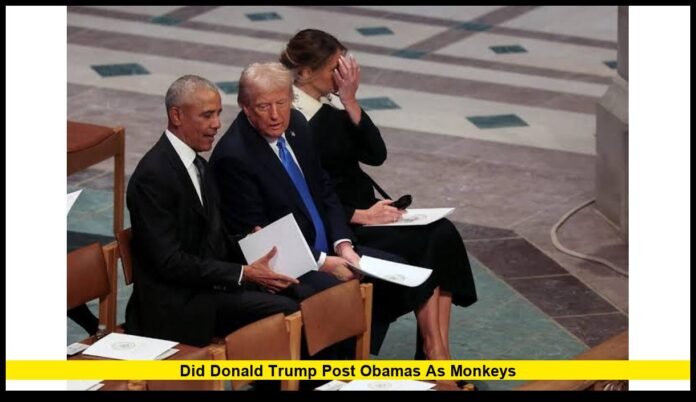

The question did donald trump post obamas as monkeys gained national attention after a video shared on President Donald Trump’s Truth Social account included an animated depiction of former President Barack Obama and former First Lady Michelle Obama as apes. The video appeared on February 5, 2026, and was removed the following day after widespread criticism. The incident prompted reactions from lawmakers in both political parties and renewed debate about racial imagery, presidential accountability, and the responsibilities of people managing official social media accounts.
Although the video primarily focused on allegations surrounding the 2020 presidential election, the brief animation near its conclusion quickly became the center of the controversy. Critics argued that the imagery invoked a racist stereotype with a long history in American society. The White House initially defended the clip as an internet meme before saying a staff member had mistakenly published it. Trump, meanwhile, said he had not watched the entire video before it appeared online.
Key Points Summary
╔════════════════════════════════════════════════════════════════════╗
║ – A video shared on Donald Trump’s Truth Social account included ║
║ an animated depiction of Barack and Michelle Obama as apes. ║
║ – The post appeared on February 5, 2026, and was removed the ║
║ following day after criticism from across the political spectrum.║
║ – The larger video promoted allegations about the 2020 election. ║
║ – Trump said he had not viewed the entire clip before publication. ║
║ – The White House attributed the post to a staff member’s error. ║
║ – The incident renewed debate about racist stereotypes, political ║
║ communication, and responsibility for presidential social media.║
╚════════════════════════════════════════════════════════════════════╝
How the Controversy Began
The incident unfolded late on February 5, when a political video appeared on Trump’s Truth Social account. The clip discussed claims about the 2020 election and included allegations consistent with Trump’s longstanding objections to the results of that contest.
Toward the end of the video, an animated sequence showed the faces of Barack and Michelle Obama superimposed onto the bodies of apes. The segment was brief, but its appearance transformed the post into a national controversy.
The video was not simply an isolated image of the former president and first lady. Rather, the controversial animation appeared within a longer piece of political content. That distinction became important as the administration explained how the material had been shared.
Trump later said he had watched the beginning of the video but had not seen the disputed sequence before publication. The White House subsequently attributed the post to an error by a staff member responsible for publishing content.
Nevertheless, the video appeared on the president’s account, making it a matter of public concern regardless of who had prepared or uploaded it. Reports about the animation spread rapidly, bringing renewed attention to the content and the administration’s response.
Why the Obama Depiction Became the Main Issue
The reaction was driven largely by the historical meaning associated with comparing Black people to apes. This imagery has been used for generations to demean Black Americans, portray them as less than human, and reinforce racist beliefs.
Such depictions have appeared in historical propaganda, racist caricatures, and other forms of discriminatory communication. Their significance extends beyond individual intent because they draw on a longstanding history of racial prejudice.
Barack Obama served as the first Black president of the United States, while Michelle Obama became one of the country’s most prominent first ladies. For many critics, depicting the couple in this manner was especially offensive because of the stereotype’s historical connection to the dehumanization of Black people.
The controversy also highlighted the difference between criticizing public officials and using racial imagery against them. Political figures are routinely subjected to satire, harsh commentary, and criticism of their decisions. However, critics argued that the animation went beyond policy-based disagreement by invoking a degrading racial association.
The format of a meme did not resolve those concerns. An image can be presented as humor while still carrying historical implications that audiences find offensive.
For that reason, the debate centered not only on whether the clip was intended as a joke but also on the responsibility of a president’s communications operation to consider the content it distributes.
When Was the Video Removed?
The video appeared on Trump’s Truth Social account late on February 5, 2026, at approximately 11:44 p.m. Eastern Time. It was removed on February 6, after criticism intensified.
The removal followed reactions from political figures and members of the public who objected to the animated sequence. However, deleting the post did not end the discussion. The incident raised questions about the review process used before content was published under the president’s name.
Social media posts can reach large audiences almost immediately, and taking down the original material does not necessarily prevent copies or screenshots from circulating. That dynamic helped the controversy continue after the video disappeared from Trump’s account.
The administration’s explanation that a staff member had published the material by mistake became an important part of the story. It raised questions about whether the complete video had been reviewed and what safeguards existed to prevent offensive content from being shared.
The episode demonstrated how a brief segment within a longer political video can overshadow the material’s original subject and become the dominant focus of public discussion.
Trump’s Explanation and the Question of Accountability
Trump said he had not watched the full video before it was posted. In comments to reporters aboard Air Force One on February 6, he explained that he had seen the beginning, which concerned election-related allegations, but had not viewed the controversial ending.
He also indicated that the video had been passed to people who handled publishing content on his account. Trump rejected the suggestion that he had made a mistake and did not apologize for sharing the clip.
His explanation created a distinction between the president’s stated intentions and the content ultimately published. Trump maintained that he had not knowingly approved the offensive animation, while critics argued that material shared through his account still required accountability.
For a president, social media serves as more than a personal communication channel. Posts can influence public debate, generate international attention, and shape how the administration is perceived. Consequently, the process used to select and publish material can become a significant issue in its own right.
The controversy did not establish that Trump personally created the animation. It did, however, raise questions about the checks and balances used by the people responsible for maintaining his online presence.
The White House’s Changing Response
The administration’s initial response added another dimension to the controversy. White House press secretary Karoline Leavitt described the video as an internet meme and criticized those who objected to it.
That response focused on the clip’s satirical format. However, the White House later said a staff member had mistakenly published the video.
The two explanations prompted questions about the administration’s handling of the incident. Critics argued that describing the content as a meme did not address the historical meaning of the imagery, while the later explanation left uncertainty about the internal approval process.
The White House did not publicly identify the staff member in its initial statement. Trump subsequently told reporters on February 12 that the employee had not been fired or disciplined.
The administration’s response therefore became part of the wider debate about political communications and responsibility. Removing the video addressed its continued presence on the account, but it did not settle questions about how it was approved or whether the publishing process needed to change.
Republicans and Democrats React
The controversy drew criticism from both parties, making it more than a routine dispute between Trump and his political opponents.
Republican Sen. Tim Scott of South Carolina strongly condemned the imagery and called for the post to be removed. His response attracted attention because he was a prominent Republican and a Black member of the Senate.
Other Republican lawmakers also voiced concern, with some urging Trump to apologize. Democratic officials and civil rights advocates similarly criticized the depiction and questioned how it had been allowed to appear on the president’s account.
The bipartisan reaction illustrated that objections to racial stereotypes can cross party lines. While lawmakers may disagree sharply over election policy, government priorities, and the conduct of political leaders, they can still express concern about the use of dehumanizing imagery.
The response also increased pressure on the administration to explain how the post had reached a public account with such a large audience.
Was the Animation Created With Artificial Intelligence?
The sequence used digitally altered imagery, placing the faces of Barack and Michelle Obama onto animated ape bodies. Reports described it as apparently AI-generated or digitally manipulated, although the exact production method was not the main issue in the controversy.
The animation appeared in a meme-style video that used animal imagery to portray political figures. The White House referenced the meme format when it initially defended the content.
Artificial intelligence and digital editing tools have made it easier to create political images that can be distributed quickly online. These tools have legitimate creative and satirical uses, but they can also be used to spread misleading material or reproduce harmful stereotypes.
The technology used to create an image does not determine whether its message is appropriate. The context, historical associations, and potential impact remain important considerations.
In this case, the controversy focused on the racial implications of the animation and the decision to share it through a presidential account, rather than on whether the sequence had been generated by a particular tool.
What the Incident Means for Presidential Social Media
Presidential social media accounts have become central to modern political communication. They allow leaders to reach supporters directly, comment on breaking events, criticize opponents, and promote their priorities without relying entirely on traditional news outlets.
That immediacy also creates risks. A post can circulate widely before an error is identified, and deleting it may not erase its impact.
The controversy involving the Obamas highlighted the importance of reviewing videos and images before publication. A thorough process can help identify misleading claims, offensive material, and content that could undermine public confidence.
Delegating social media management does not eliminate questions of responsibility. When material appears on an official presidential account, the public may reasonably expect the administration to explain how it was selected and what measures exist to prevent similar incidents.
The episode also demonstrated the limitations of treating controversial political content as harmless humor. A meme can have a broader impact when it invokes historical discrimination, particularly when shared by someone holding the nation’s highest elected office.
Frequently Asked Questions
What did the video show?
The video included a brief animated sequence depicting Barack and Michelle Obama with their faces superimposed onto the bodies of apes. The sequence appeared near the end of a longer political video concerning the 2020 election.
Did Trump personally make the video?
There is no verified evidence establishing that Trump personally created the animation. He said he had not watched the entire clip before publication, and the White House attributed the post to a staff member’s error.
Why was the post criticized?
Critics objected to the historical association between ape imagery and racist efforts to dehumanize Black people. They argued that the depiction was offensive regardless of whether it was intended as political satire.
Did the White House remove the post?
Yes. The video was removed on February 6, 2026, following widespread criticism.
Did Trump apologize?
Trump did not apologize for sharing the video. He said he had not seen the controversial segment before it was published and rejected the suggestion that he had made a mistake.
Was the video about the 2020 election?
Yes. The larger clip promoted allegations concerning the 2020 presidential election. The animated depiction of the Obamas appeared near the end and became the primary focus of the backlash.
Was the staff member responsible disciplined?
Trump said on February 12 that the staff member he identified as responsible had not been fired or disciplined. The administration did not initially publicly identify the individual.
Conclusion
The controversy surrounding Trump’s Truth Social post became a significant political story because it combined presidential social media, racial imagery, and questions about accountability. The video included an animated depiction of Barack and Michelle Obama as apes, triggering criticism from across the political spectrum.
Trump said he had not watched the complete clip before publication, while the White House attributed the post to a staff member’s mistake. Although the video was removed, the president did not apologize, and questions about the administration’s review process remained.
Ultimately, the incident demonstrated that the context and historical meaning of political imagery matter, even when content is presented as a meme. It also reinforced the importance of careful editorial oversight when communications are distributed through the account of a sitting president.
What is your view of the controversy and the responsibility political leaders have for material shared through their accounts? Share your thoughts in the comments and stay informed about major developments in U.S. politics.