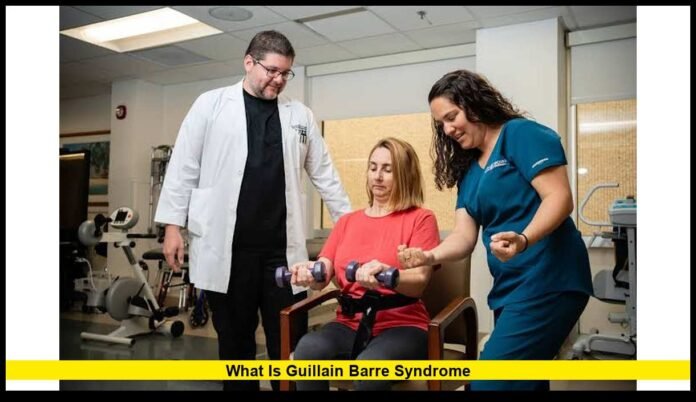

Guillain-Barré syndrome is a rare neurological disorder that causes the immune system to attack the peripheral nerves. Understanding What is Guillain Barre Syndrome is important because the condition can develop quickly, cause progressive muscle weakness, and sometimes interfere with breathing. Early medical evaluation and treatment can help reduce complications and improve recovery.
Guillain-Barré syndrome (GBS) can affect people of different ages. It often begins with tingling, numbness, or weakness in the feet and legs before spreading to other parts of the body. Some people experience mild symptoms, while others develop severe paralysis that requires hospital care and breathing support.
The condition is not contagious. It is also not usually inherited. Although many people develop GBS after an infection, doctors do not always identify a specific trigger. There is no single test that confirms every case, so healthcare professionals consider symptoms, neurological examinations, laboratory findings, and other diagnostic results.
GBS requires prompt medical attention because symptoms can worsen over hours or days. Recognizing the warning signs and understanding the available treatments can help patients and families respond appropriately.
What Happens in the Body During Guillain-Barré Syndrome?
The peripheral nervous system connects the brain and spinal cord to the muscles, skin, and internal organs. These nerves carry signals that allow people to move, feel sensations, and perform many automatic body functions.
In Guillain-Barré syndrome, the immune system mistakenly attacks components of these nerves. The resulting inflammation and damage interfere with communication between the brain and the body.
Some nerves have a protective covering called myelin. It helps electrical signals travel efficiently along nerve fibers. When the immune system damages this covering, nerve signals can slow down or become disrupted.
In other forms of GBS, the immune attack damages the axons, which carry electrical signals through nerve cells. Axonal damage can cause substantial weakness and may require a longer recovery.
The effects depend on which nerves the condition affects and how severely they become damaged. A person may experience difficulty walking, reduced reflexes, abnormal sensations, or problems controlling certain muscles.
In severe cases, GBS can affect the nerves that control breathing, heart rate, and blood pressure. These complications explain why doctors treat suspected GBS as a medical emergency.
What Are the Early Symptoms of Guillain-Barré Syndrome?
Early symptoms often appear in the feet and legs. They may seem mild initially, but the condition can progress rapidly.
Common early warning signs include:
- Tingling or pins-and-needles sensations in the feet or hands.
- Weakness in the legs that makes walking or climbing stairs difficult.
- Numbness or unusual sensations in the limbs.
- Muscle pain or aching in the back or legs.
- Difficulty maintaining balance or coordinating movements.
- Reduced or absent tendon reflexes during a medical examination.
Symptoms frequently affect both sides of the body. However, the exact pattern can differ between individuals.
Some people notice that their legs feel unusually heavy. Others struggle to stand from a chair, walk normally, or grip everyday objects.
Weakness may spread from the legs toward the arms and upper body. Facial muscles can also become affected, causing difficulty smiling, swallowing, speaking, or closing the eyes.
Pain deserves attention, too. Some patients experience sharp, burning, or deep muscular pain before obvious weakness develops.
Not everyone experiences every symptom. The absence of severe pain or obvious numbness does not rule out GBS.
Seek emergency medical care if weakness progresses quickly, walking becomes difficult, or new neurological symptoms develop. Call 911 if there is trouble breathing, swallowing, or speaking, or if severe weakness develops suddenly.
Which Symptoms Require Immediate Emergency Care?
Guillain-Barré syndrome can affect muscles involved in breathing and swallowing. It can also disrupt automatic functions that regulate circulation and heart rate.
Warning signs that require immediate emergency evaluation include:
- Shortness of breath, particularly when lying flat.
- Difficulty taking a deep breath or speaking full sentences.
- Trouble swallowing liquids or saliva.
- Rapidly worsening weakness or inability to stand.
- New facial weakness or difficulty controlling facial movements.
- Fainting, severe dizziness, or unusual heart rate changes.
Breathing problems may develop before a person realizes how weak the respiratory muscles have become. Medical teams can measure breathing capacity and monitor changes before respiratory failure occurs.
Do not wait for every symptom to appear before seeking help. GBS can progress quickly, and early treatment may reduce the severity of the illness.
What Causes Guillain-Barré Syndrome?
Researchers have not identified one universal cause of Guillain-Barré syndrome. However, evidence shows that the condition frequently develops after an infection.
The immune system normally identifies and attacks harmful bacteria and viruses. In GBS, that response can mistakenly target structures in the peripheral nervous system.
This process is sometimes associated with molecular mimicry. Certain molecules found on infectious organisms resemble components of human nerves. The immune response against the infection may then cross-react with nerve tissue.
This does not mean that everyone who gets an infection will develop GBS. The syndrome remains rare, even among people who experience infections associated with it.
Infections Associated With Guillain-Barré Syndrome
Several infections have been linked to GBS, including:
- Campylobacter infection: This bacterial infection often causes diarrhea and gastrointestinal illness. It is one of the most common recognized triggers of GBS in the United States.
- Influenza: Some people develop GBS after an influenza infection.
- COVID-19: GBS has been reported following COVID-19, although an individual case requires careful medical assessment to establish the likely cause.
- Cytomegalovirus: This virus can cause symptoms ranging from mild illness to more serious disease in certain people.
- Epstein-Barr virus: This virus can cause infectious mononucleosis and has been associated with GBS.
- Zika virus: GBS has been associated with Zika infections, particularly in affected outbreak settings.
A respiratory or gastrointestinal infection may occur days or weeks before neurological symptoms begin. By the time weakness appears, the original infection may have already resolved.
Doctors may therefore ask about recent diarrhea, fever, respiratory symptoms, travel, and other illnesses when evaluating suspected GBS.
Can Vaccines Cause Guillain-Barré Syndrome?
The relationship between vaccination and GBS requires careful interpretation.
GBS has been reported after certain vaccinations, but this does not mean that every case following vaccination was caused by the vaccine. In the United States, any increased risk associated with particular vaccines has generally been very small when an association has been identified.
The Centers for Disease Control and Prevention notes that people are more likely to develop GBS after having influenza than after receiving a flu vaccine.
Vaccination decisions should consider the benefits of preventing infections, the individual’s medical history, and any applicable vaccine-specific precautions. People who previously developed GBS should discuss their circumstances with a healthcare professional before receiving vaccines for which a history of GBS may affect recommendations.
The important distinction is that GBS can follow infections, while a temporal association with vaccination alone does not establish causation.
Can Stress, Diet, or Family History Cause GBS?
GBS is not generally considered an inherited disorder, and most cases occur sporadically. A person usually does not develop it because a family member has the condition.
There is also no established evidence that ordinary emotional stress or a particular food directly causes GBS. Doctors focus instead on the neurological symptoms, recent infections, medical history, and possible immune-related triggers.
Scientists continue to investigate why only a small proportion of people develop GBS after particular infections. Individual susceptibility and differences in immune responses may contribute, but the complete explanation remains uncertain.
Who Is at Risk of Developing Guillain-Barré Syndrome?
Anyone can develop Guillain-Barré syndrome, including children and adults. It remains uncommon in the general population.
Current CDC information estimates that approximately 3,000 to 6,000 people develop GBS each year in the United States.
Certain characteristics are associated with a higher likelihood of developing the condition:
- Older age: GBS becomes more common with increasing age.
- Sex: The condition occurs more frequently in males than in females.
- Recent infection: A recent bacterial or viral infection can increase the risk.
- Certain immune responses: Individual biological differences may influence susceptibility.
These factors do not determine whether someone will develop GBS. Most people who experience an associated infection never develop the syndrome.
GBS also does not spread from one person to another. When multiple cases appear in the same community, public health investigators may examine whether a shared infection could explain the pattern.
What Are the Different Types of Guillain-Barré Syndrome?
Doctors classify GBS into several forms based on the nerves affected and the pattern of nerve damage. These distinctions can help specialists understand the illness and assess its likely course.
1. Acute Inflammatory Demyelinating Polyradiculoneuropathy (AIDP)
AIDP is the most common form of GBS in North America and Europe. It primarily affects the myelin covering surrounding peripheral nerves.
Damage to this protective layer disrupts nerve signals. Patients may develop progressive weakness, sensory changes, and reduced reflexes.
Recovery depends on the extent of nerve damage and how quickly treatment begins.
2. Acute Motor Axonal Neuropathy (AMAN)
AMAN primarily affects the axons of motor nerves, which control muscle movement. It can cause substantial weakness or paralysis without the same degree of sensory involvement seen in some other forms.
Some patients recover relatively quickly, while others need prolonged rehabilitation if axonal damage is extensive.
3. Acute Motor-Sensory Axonal Neuropathy (AMSAN)
AMSAN affects both motor and sensory nerve axons. It can produce significant muscle weakness, loss of sensation, and prolonged disability.
Recovery may take longer when nerve fibers sustain substantial damage.
4. Miller Fisher Syndrome
Miller Fisher syndrome is a recognized variant associated with GBS. Its characteristic features include:
- Weakness or paralysis of the muscles that move the eyes.
- Poor balance and coordination.
- Reduced or absent tendon reflexes.
Some patients also develop other symptoms associated with GBS. Medical evaluation is essential because eye movement problems and balance difficulties can have several different causes.
How Do Doctors Diagnose Guillain-Barré Syndrome?
No single test can confirm every case of GBS. Doctors combine a person’s symptoms, medical history, physical examination, and test results to reach a diagnosis.
Early diagnosis can be challenging because other neurological disorders may produce similar symptoms. Doctors also consider how quickly weakness develops and whether it affects both sides of the body.
Neurological Examination
A healthcare professional evaluates muscle strength, reflexes, sensation, coordination, and the ability to walk. Reduced or absent reflexes can support a diagnosis of GBS.
Doctors also assess facial movement, swallowing, and other functions when symptoms suggest that the condition affects additional nerves.
Nerve Conduction Studies and Electromyography
Nerve conduction studies measure how electrical signals travel through peripheral nerves. Abnormal results can indicate damage to myelin or nerve fibers.
Electromyography, or EMG, measures electrical activity in muscles. Together, these tests can help specialists identify the pattern of nerve damage.
However, results may be inconclusive during the earliest stages. A doctor may recommend repeat testing if symptoms continue to progress.
Lumbar Puncture
A lumbar puncture, commonly called a spinal tap, collects cerebrospinal fluid from the lower back.
In many cases of GBS, the fluid contains elevated protein levels without a corresponding increase in white blood cells. This finding can support the diagnosis, but it may not appear early in the illness.
A normal result does not automatically exclude GBS.
Breathing and Heart Monitoring
Because GBS can affect breathing and automatic body functions, doctors may repeatedly measure respiratory muscle strength and monitor oxygen levels, heart rhythm, and blood pressure.
An electrocardiogram may help assess heart rhythm. Additional tests can identify complications or rule out other conditions.
MRI scans and blood tests may also be useful when doctors need to investigate alternative explanations for the symptoms.
How Is Guillain-Barré Syndrome Treated?
There is currently no definitive cure that reverses every form of GBS. However, established treatments can reduce the immune attack on the nervous system, while supportive care helps prevent serious complications.
Most people with suspected or confirmed GBS require hospital assessment. The need for intensive care depends on the severity of weakness, breathing function, and other complications.
Two principal treatments are intravenous immunoglobulin and plasma exchange.
Intravenous Immunoglobulin (IVIG)
IVIG delivers concentrated antibodies collected from screened donors into a patient’s bloodstream.
The treatment changes immune activity and helps reduce the harmful immune response affecting the nerves.
Doctors commonly use IVIG because it can improve outcomes and shorten recovery in appropriately selected patients. It is usually administered over several days.
Possible side effects include headache, nausea, and infusion reactions. Rare but serious complications can occur, so clinicians consider individual risks before treatment.
Plasma Exchange
Plasma exchange, also known as plasmapheresis, removes plasma from the blood. Plasma contains antibodies and other proteins involved in immune responses.
During the procedure, a machine separates plasma from blood cells. The medical team returns the blood cells with replacement fluid.
This process can remove antibodies involved in nerve damage and reduce the severity of GBS.
Plasma exchange and IVIG are established treatments with broadly comparable effectiveness when appropriately administered. Doctors select the option that best fits the patient’s condition and clinical circumstances.
Treatment generally offers the greatest benefit when started early in the illness. Medical guidance commonly recommends IVIG within two weeks of weakness onset or plasma exchange within four weeks, depending on the patient’s circumstances.
Giving both treatments sequentially does not routinely improve outcomes compared with an appropriate treatment alone.
Hospital and Intensive Care Support
Some patients need intensive care because their breathing muscles become weak or their heart rate and blood pressure become unstable.
Hospital care may include:
- Mechanical ventilation when a patient cannot breathe adequately.
- Monitoring of heart rhythm and blood pressure.
- Assistance with swallowing and nutrition.
- Pain management.
- Measures to prevent blood clots and pressure injuries.
- Support for bladder and bowel problems.
- Treatment of infections and other complications.
Doctors also monitor for autonomic dysfunction, which can cause sudden changes in blood pressure or heart rate.
Corticosteroids alone are not an effective established treatment for GBS. They should not replace IVIG or plasma exchange when those treatments are indicated.
How Long Does Guillain-Barré Syndrome Last?
The course of GBS varies considerably. Some people experience a relatively short period of weakness, while others require months of rehabilitation.
The illness often progresses during the first days or weeks. Symptoms commonly reach their most severe point within approximately two weeks, although progression can continue for longer.
A period of stabilization may follow. During this stage, symptoms stop worsening before gradual improvement begins.
Many patients start to recover within two to three weeks after symptoms begin. However, this does not mean that they have fully regained their strength by that point.
Recovery may take several months or years, especially when the illness causes extensive nerve damage or severe paralysis.
The CDC reports that most people recover, but the speed and completeness of recovery differ between patients.
Can Guillain-Barré Syndrome Cause Permanent Damage?
Many people regain most or all of their previous abilities. Nevertheless, some experience lasting symptoms.
Potential long-term effects include:
- Persistent muscle weakness.
- Fatigue that interferes with daily activities.
- Numbness or tingling.
- Chronic nerve pain.
- Reduced balance or coordination.
- Difficulty returning to work or previous physical activities.
The likelihood of lasting problems depends on several factors, including the severity of the initial illness, the type of nerve damage, complications, and the person’s response to rehabilitation.
Severe cases can result in permanent disability. In a small proportion of cases, life-threatening complications lead to death, particularly during the acute phase.
Early treatment and careful supportive care can improve the chances of a favorable outcome. However, no treatment can guarantee complete recovery.
What Does Rehabilitation After Guillain-Barré Syndrome Involve?
Rehabilitation helps patients regain strength, mobility, independence, and confidence after the acute illness.
A rehabilitation program should reflect the person’s abilities, symptoms, and stage of recovery.
Physical therapy focuses on movement, strength, flexibility, balance, and walking. Therapists may introduce exercises gradually as muscle function improves.
Occupational therapy helps patients manage everyday activities such as dressing, bathing, preparing meals, and using household equipment.
Speech and swallowing therapy may help people who experienced facial weakness, swallowing difficulties, or changes in speech.
Pain management addresses nerve pain and discomfort that may continue after the acute illness.
Some patients need wheelchairs, walkers, braces, or other assistive devices during recovery. Others gradually resume their usual activities without long-term mobility support.
Fatigue can persist even after strength improves. Patients should work with their healthcare team to balance activity and rest rather than pushing through severe exhaustion.
Recovery is not always linear. Progress may vary from week to week, so treatment plans should change as abilities improve.
How Can Guillain-Barré Syndrome Be Prevented?
There is no proven method that prevents every case of GBS. The syndrome can develop unexpectedly, including in people who were previously healthy.
Reducing the risk of infections remains a practical public health measure. Handwashing, safe food handling, and appropriate vaccination can help prevent certain illnesses associated with GBS.
For example, thorough food preparation and avoiding cross-contamination can reduce the risk of Campylobacter infection.
These measures do not guarantee that someone will avoid GBS. They help reduce the risk of some infections rather than directly preventing the neurological condition.
People who develop unusual weakness after an infection should seek prompt medical evaluation instead of assuming the symptoms will disappear on their own.
Frequently Asked Questions About Guillain-Barré Syndrome
What is Guillain Barre Syndrome in simple terms?
Guillain-Barré syndrome is a rare condition in which the immune system mistakenly attacks peripheral nerves. It can cause tingling, numbness, muscle weakness, and, in severe cases, paralysis or breathing difficulties.
Is Guillain-Barré syndrome contagious?
No. GBS itself does not spread between people. An infection that sometimes precedes GBS may be contagious, but the resulting neurological condition is not.
What is the first sign of Guillain-Barré syndrome?
Tingling in the feet or hands and weakness in the legs are common early symptoms. Weakness may spread upward, although the initial pattern varies.
How common is Guillain-Barré syndrome in the United States?
The CDC estimates that approximately 3,000 to 6,000 people develop GBS each year in the United States. It is considered a rare neurological disorder.
Can Guillain-Barré syndrome be cured?
There is no definitive cure, but IVIG and plasma exchange can reduce the severity of the illness. Many patients recover substantially, although some experience lasting weakness, fatigue, or pain.
How long does recovery take?
Recovery may take weeks, months, or years. Many patients begin improving within a few weeks, but severe nerve damage can prolong rehabilitation.
Can Guillain-Barré syndrome affect breathing?
Yes. GBS can weaken the muscles responsible for breathing and swallowing. Severe cases may require mechanical ventilation and intensive care.
Does Guillain-Barré syndrome always cause paralysis?
No. Some people experience weakness and sensory symptoms without developing severe paralysis. The severity depends on the extent and location of nerve damage.
Can Guillain-Barré syndrome return after recovery?
Recurrence is possible but uncommon. New or worsening weakness after recovery requires medical evaluation because several neurological conditions can produce similar symptoms.
Is Guillain-Barré syndrome associated with vaccines?
GBS has rarely been associated with certain vaccines, but a case occurring after vaccination does not automatically establish that the vaccine caused it. Some infections, including influenza, are also associated with GBS. Individual concerns should be discussed with a healthcare professional.
Final Thoughts on Guillain-Barré Syndrome
Guillain-Barré syndrome is a rare but potentially serious neurological condition that requires prompt recognition and appropriate medical care. Its symptoms can progress quickly, making early evaluation particularly important when weakness spreads or walking becomes difficult.
Although some patients face severe complications and prolonged rehabilitation, many recover substantially with treatment and supportive care. Continued medical follow-up can help address persistent weakness, pain, fatigue, and mobility challenges.
Have you or someone you know experienced Guillain-Barré syndrome? Share your questions or experiences in the comments, and stay informed about the latest verified developments in neurological health.