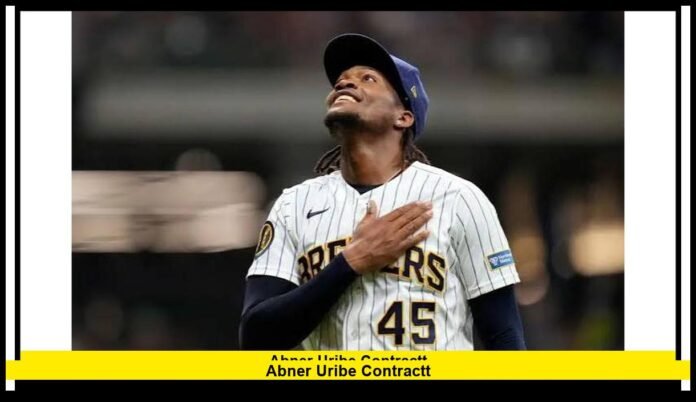

The abner uribe contract situation has become an important subject for Milwaukee Brewers fans following the right-handed reliever’s emergence as a dependable late-inning option. Uribe entered the 2026 MLB season on a reported one-year salary arrangement worth approximately $798,300, placing him among the club’s pre-arbitration players. His current compensation, growing importance to Milwaukee’s bullpen, and eventual eligibility for salary arbitration could all influence his financial future. As of the latest available information, no officially confirmed multiyear extension has been announced, leaving questions about his next deal open as the Brewers evaluate their roster beyond the 2026 campaign.
Uribe’s value extends beyond his annual salary. His ability to generate strikeouts, handle pressure, and work in important innings has made him a significant part of Milwaukee’s pitching plans. However, his contract outlook also involves service-time rules, injury considerations, and the financial risks teams face when committing guaranteed money to relief pitchers.
Abner Uribe’s 2026 Contract and Salary Breakdown
Uribe’s reported 2026 salary is approximately $798,300, according to publicly available MLB payroll estimates. The figure represents his compensation for the current season rather than the total value of a multiyear contract.
His pre-arbitration status is important because it determines how his compensation compares with that of more experienced players. Before reaching salary arbitration, eligible young major leaguers generally earn salaries established through agreements with their clubs, subject to the collective bargaining agreement and applicable minimum salary requirements.
Key contract information
- Player: Abner Uribe
- MLB team: Milwaukee Brewers
- Position: Right-handed relief pitcher
- 2026 reported salary: Approximately $798,300
- Contract classification: Pre-arbitration
- Multiyear extension: No confirmed announcement identified
- Future salary considerations: Service time, arbitration eligibility, performance, and negotiations
These details provide a useful picture of Uribe’s current financial position. Nevertheless, a reported salary should not be interpreted as proof that the player and team have negotiated a long-term guarantee.
Milwaukee benefits from having an effective reliever whose current compensation remains below the levels that can develop through arbitration and free agency. Uribe, meanwhile, has an opportunity to strengthen his position by continuing to deliver reliable results at the major league level.
Why Uribe’s Contract Status Matters to Milwaukee
The Brewers must balance their spending across the starting rotation, bullpen, lineup, and bench. Managing the cost of young players is particularly important for organizations that want to remain competitive without allowing payroll commitments to limit their options elsewhere.
Uribe offers Milwaukee a potentially valuable combination of velocity, strikeout ability, and experience in high-leverage situations. Those characteristics can make a difference in close games, particularly when the starting pitcher exits before the late innings.
A relatively inexpensive bullpen contributor gives the front office more flexibility when considering other roster needs. Milwaukee can allocate resources toward additional pitching depth, position-player reinforcements, or retaining established players while continuing to develop younger talent.
However, the team’s financial advantage will not necessarily last indefinitely. As Uribe accumulates major league service time, his compensation may rise through subsequent salary agreements and arbitration eligibility.
That progression creates an important decision for the Brewers. They can continue with annual contract arrangements or explore an extension that provides greater certainty about Uribe’s future salary and role.
Neither approach is automatically better. The appropriate decision depends on his performance, health, projected development, and the club’s broader payroll strategy.
Abner Uribe’s Performance Strengthens His Financial Position
Uribe’s performance has become a central part of the discussion surrounding his future value. During the 2026 season, he established himself as an important member of Milwaukee’s late-inning relief group.
At the end of August, Uribe had recorded a 2.05 ERA across 49 appearances. That performance illustrated his effectiveness before a forearm injury interrupted his season.
For a relief pitcher, maintaining a low ERA can be especially valuable because individual appearances often involve situations in which one mistake can change the result of a game. Relievers who consistently limit scoring opportunities give managers greater confidence when protecting narrow leads.
Several performance indicators could influence Uribe’s future earning potential.
Strikeout production
Strikeouts are valuable because they allow pitchers to finish plate appearances without relying on a fielder to record an out. A reliever who can consistently overpower hitters may be particularly useful in high-pressure innings.
Command and control
Velocity alone does not guarantee success. Walks and poorly located pitches can create difficult situations, even for pitchers with excellent raw stuff. Improving command can help Uribe become more consistent and strengthen his value to Milwaukee.
Run prevention
ERA remains an important measure of a pitcher’s results, but teams also evaluate strikeout rates, walk rates, home runs allowed, and other indicators to understand how sustainable those results might be.
Performance in leverage situations
Relievers are frequently judged by their ability to handle the most important innings. Consistency against difficult hitters and during close games can influence how a manager uses a pitcher and how the front office evaluates his future role.
These factors can affect both baseball decisions and contract negotiations. Strong performance may improve a player’s leverage in future discussions, although salary arbitration follows specific rules and does not guarantee a particular financial outcome.
How the 2026 Forearm Injury Could Affect His Outlook
Uribe’s health is another important consideration when assessing his long-term value.
The Brewers placed him on the 15-day injured list in August 2026 with a right forearm flexor strain. The injury interrupted a productive stretch during which he had become an important setup option for the team.
Milwaukee subsequently activated him on August 31 after his rehabilitation assignment. His return restored an experienced late-inning arm to the bullpen during a significant portion of the schedule.
The injury does not automatically diminish Uribe’s future contract prospects. Players can recover from temporary setbacks and continue performing at a high level. Nevertheless, clubs generally examine injury history, workload, recovery, and durability before committing substantial guaranteed money to pitchers.
Relievers face particular challenges because their roles can involve frequent appearances, intense bursts of effort, and limited recovery time during demanding stretches of the season.
For Uribe, maintaining his health and demonstrating that he can handle a sustained workload will be important as Milwaukee considers its future plans.
The key distinction is between a documented injury and an assumption about its long-term consequences. His August absence is established, but it should not be treated as evidence that he will experience recurring problems or that the Brewers will avoid an extension.
Understanding Uribe’s Arbitration Timeline
Salary arbitration is a major milestone for players who have progressed beyond the earliest stage of their major league careers.
Under MLB’s collective bargaining system, players generally become eligible for arbitration after accumulating the required service time. Arbitration provides a mechanism for determining salary when an eligible player and his club cannot agree on compensation through ordinary negotiations.
For the Brewers, arbitration eligibility matters because a player’s salary can increase as his experience and contributions grow.
Uribe’s precise timetable should be assessed using his official service-time total and the rules applicable to the relevant offseason. Super Two eligibility can also affect the timing of a player’s first arbitration opportunity.
What is Super Two status?
Super Two status allows a limited group of players with between two and three years of major league service to qualify for arbitration earlier than the standard timetable. Eligibility depends on the applicable service-time cutoff, so it cannot be assumed simply because a player is approaching three years of experience.
This distinction matters when projecting future payroll expenses. An earlier arbitration opportunity could bring salary negotiations forward, while the standard schedule would produce a different timeline.
Arbitration does not automatically mean a player will receive a specific salary increase. The outcome depends on the applicable process, the player’s record, comparable cases, and negotiations between the parties.
Milwaukee will need to monitor Uribe’s service-time position when making decisions about its future bullpen budget.
Could Milwaukee Offer Abner Uribe a Multiyear Extension?
A contract extension is one possible path for Uribe, but no confirmed long-term agreement has been identified in the latest available information.
An extension could offer benefits to both sides. Uribe could receive guaranteed compensation and greater financial security, while the Brewers could gain additional control over a pitcher they believe can remain an important contributor.
The structure would matter as much as the total value. An agreement could cover some arbitration-eligible seasons, include different annual salaries, or feature club options that provide flexibility in later years.
For example, Milwaukee might consider an extension if its evaluation indicates that Uribe can remain effective in high-leverage situations for several seasons. The team would also have to assess the risk of guaranteeing money to a pitcher whose performance or availability could change.
Relievers can experience significant year-to-year fluctuations. A pitcher who performs exceptionally well in one season may encounter command problems, reduced effectiveness, or injuries in another.
That uncertainty can make teams cautious about offering long-term guarantees. On the other hand, waiting too long can increase the cost of retaining a player whose performance continues to improve.
For Uribe, a strong record of health and consistent results could improve the case for a future agreement. Until the Brewers announce specific terms, however, any proposed contract value or extension length remains speculative.
How Uribe Fits Into Milwaukee’s Bullpen Plans
Uribe’s importance is not limited to his individual statistics. His role also affects the way Milwaukee can distribute innings among its relief pitchers.
The Brewers have used Trevor Megill as their established closer, while Uribe has served as a key setup option. That arrangement gives the team a way to deploy Uribe before the final inning and preserve Megill for save opportunities.
Uribe’s previous experience filling a closing role also provides useful flexibility. During the 2025 regular season, he stepped into late-inning responsibilities when Megill was unavailable and recorded five saves over his final 13 regular-season appearances, posting a 1.38 ERA during that stretch.
That experience demonstrates why the Brewers may value him as more than an ordinary middle reliever. A pitcher capable of handling setup work and selected closing opportunities can help a manager navigate injuries, difficult matchups, and changes in bullpen availability.
His future role will depend on the team’s personnel, his health, and his performance. A larger responsibility could increase his importance to the organization, although it would not automatically trigger a new contract or a predetermined salary.
What Fans Should Watch During the Next Contract Cycle
Several developments could provide a clearer picture of Uribe’s financial future as Milwaukee moves beyond the 2026 season.
Official contract announcements: A confirmed extension would establish the length, guaranteed compensation, and any option provisions.
Arbitration eligibility: Updated service-time information will help clarify when Uribe could enter the arbitration process.
Health and workload: His ability to remain available throughout a season will be an important part of the Brewers’ evaluation.
Role within the bullpen: Continued use in high-leverage situations could reinforce his value to the team.
Performance consistency: Strikeouts, command, run prevention, and availability will help determine whether his production remains sustainable.
Fans should distinguish confirmed contract details from predictions about future negotiations. Salary estimates can be useful, but they do not establish that an extension is imminent or that the team has made a specific offer.
Abner Uribe Contract Outlook for 2027 and Beyond
Looking ahead, Uribe’s financial future will depend on a combination of performance, service time, health, and Milwaukee’s roster priorities. His reported 2026 compensation provides a baseline for understanding his current position, but it does not establish what he will earn in subsequent seasons.
If he continues to deliver reliable innings and remains healthy, the Brewers could have reasons to retain him beyond his current arrangement. Depending on the circumstances, that could mean negotiating an extension or allowing his compensation to progress through the established salary system.
If Milwaukee chooses not to pursue a long-term agreement immediately, that decision would not necessarily indicate dissatisfaction. Teams often prefer to evaluate relief pitchers over multiple seasons before accepting the risks associated with guaranteed contracts.
Uribe also has an incentive to remain consistent. Continued success could strengthen his reputation as a dependable late-inning pitcher and improve his position in future salary discussions.
For now, the clearest picture is that Uribe entered 2026 on a reported one-year, pre-arbitration salary arrangement, returned from his August forearm injury on August 31, and remains an important part of the Brewers’ bullpen planning. No confirmed multiyear extension has been announced in the information reviewed.
Do you think Milwaukee should secure Uribe with a long-term deal or wait for the next stage of his career? Share your opinion in the comments and follow the latest Brewers contract developments.