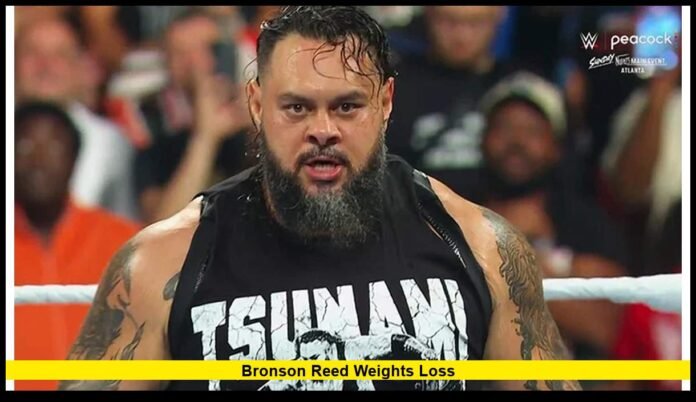

The Bronson Reed weight loss transformation has attracted widespread attention among WWE fans after the Australian superstar returned to the ring with a noticeably leaner physique. Known for his powerful presence, remarkable strength, and devastating Tsunami splash, Reed has made it clear that his physical transformation is about more than appearance. He wants to move better, improve his conditioning, and remain competitive in an industry where wrestlers must continually evolve.
Reed has revealed that he weighed approximately 365 pounds when he returned to WWE in late 2022. Ahead of his comeback in September 2026, he estimated his weight at around 265 to 270 pounds. That represents a reduction of approximately 95 to 100 pounds from his previously reported peak.
His transformation took place over several years, with a particularly important period during his recovery from a torn biceps injury in 2026. Changes to his nutrition, strength training, and cardiovascular conditioning helped him work toward his new physical goals.
The result is a different version of the powerhouse fans remember. Reed still relies on strength and size, but he now wants his speed, athleticism, and versatility to become equally important parts of his wrestling identity.
Bronson Reed’s Weight Transformation: From Powerhouse to More Versatile WWE Superstar
Reed’s physical changes have sparked conversations about what it means to be a heavyweight performer in modern professional wrestling. His previous appearance emphasized mass and raw strength, while his current build gives him an opportunity to showcase a broader athletic skill set.
The Australian wrestler has never been an ordinary heavyweight. Throughout his career, he has combined considerable size with agility, using his body weight to create dramatic moments inside the ring. His signature splash from the top rope has long been one of the clearest examples of that combination.
Now, Reed wants audiences to recognize more than his size. He believes that his years of experience on the independent wrestling circuit and in Japan have equipped him with techniques and abilities that deserve greater attention.
During a recent interview, he explained that becoming larger had helped establish him as an attraction. At one point, he reached approximately 350 pounds. However, he eventually decided that continuing to add weight was not necessarily the best way to develop his career.
His new approach reflects a broader objective: maintaining his imposing presence while improving how he moves, performs, and feels outside the ring.
How Bronson Reed Approached His Physical Transformation
Reed’s transformation was not an overnight change. He has described a process that developed over several years, with his injury recovery providing an important opportunity to intensify his efforts.
His reported weight of 365 pounds in late 2022 provides a useful reference point. Before returning to competition in September 2026, he expected to weigh between 265 and 270 pounds.
That difference represents nearly 100 pounds, although the figures reflect separate points in his career rather than a continuous, precisely measured record.
Reed’s transformation also involved more than reducing the number on a scale. He worked on his conditioning and nutrition while continuing to develop his strength.
The objective was to create a physique that could support the demands of professional wrestling. That includes explosive movements, repeated impacts, cardiovascular endurance, and the ability to perform consistently during lengthy matches.
For Reed, changing his body was also a way to challenge expectations. He wanted fans to see that a wrestler could remain physically imposing without maintaining the same weight throughout his career.
The Role of Nutrition and Strength Training
Nutrition and resistance training were important components of Reed’s preparation.
Reports about his recovery have described assistance from Australian wrestling coach Slex, who helped him revise his nutrition and strength-and-conditioning approach. Reed also discussed maintaining an intensive exercise routine during his preparation.
In one account of his training, he described lifting six times a week alongside cardiovascular exercise. That illustrates the amount of work he was willing to undertake, although it should not be interpreted as a universal recommendation for people seeking weight loss.
A professional wrestler’s training needs differ from those of an ordinary gym member. Reed must maintain sufficient strength to perform demanding moves while preparing his body for the physical impact of matches.
His background in powerlifting also influenced his earlier physique. He has discussed pursuing personal records in the bench press, squat, and deadlift. Those activities helped him build the muscular foundation that became a major part of his wrestling identity.
His more recent approach places greater emphasis on how strength translates into movement and performance.
A lighter body can potentially improve certain aspects of athletic movement, but the outcome depends on several factors, including muscle retention, technique, conditioning, and recovery. Reed’s goal has been to improve those qualities together rather than sacrifice strength simply to weigh less.
How His Biceps Injury Changed His Preparation
Reed suffered a serious biceps injury in February 2026 that required surgery and kept him away from regular competition.
The injury interrupted his wrestling schedule at a time when his career demanded consistent performances. It also created uncertainty about how quickly he could return to the ring.
During rehabilitation, Reed had to adjust his exercise routine around the limitations of his injured arm. He discussed continuing cardiovascular work while rebuilding strength, demonstrating how conditioning could remain part of his preparation even when certain upper-body exercises were restricted.
Reports on his transformation indicate that he lost approximately 20 kilograms, or 44 pounds, during a six-month recovery period.
That figure represents a substantial portion of his overall reported weight reduction. It also highlights how the period away from competition became an opportunity to focus on physical changes that might have been harder to prioritize during a regular wrestling schedule.
Recovery from surgery requires careful progression. Wrestlers must regain strength and function without rushing back into movements that could aggravate an injury.
Reed’s return in September showed that he had resumed performing in front of WWE audiences. However, his long-term success will depend on maintaining his conditioning and continuing to manage the physical demands of competition.
Why Reed Believes His New Physique Makes Him More Effective
Reed has directly challenged the idea that losing weight necessarily makes a powerhouse less intimidating.
Some fans questioned whether his slimmer appearance would reduce the impact of his signature moves. Reed responded by explaining that his lighter frame could help him achieve greater distance and airtime when performing the Tsunami.
That move requires a combination of explosive power, coordination, timing, and control. A wrestler’s body weight contributes to the visual impact, but it is not the only factor that determines how effective the maneuver looks.
Reed believes that improving his movement has allowed him to perform with greater speed while retaining his strength.
He has also explained that reducing his weight has made everyday activities easier. Those benefits matter because professional wrestling places significant demands on a performer’s body, both during matches and between events.
His comments suggest that he sees his new physique as a practical improvement rather than simply a cosmetic change.
The real test, however, comes inside the ring. Wrestling fans will judge the transformation through his performances, including how effectively he moves against opponents of different sizes and styles.
Bronson Reed’s Latest WWE Comeback and Money in the Bank Result
Reed returned to WWE programming on September 6, 2026, during Sunday Night’s Main Event.
His comeback was dramatic. He intervened in the confrontation involving Bron Breakker and Oba Femi, attacked Femi with a steel chair, and delivered multiple Tsunami splashes.
The return immediately restored Reed to the center of an ongoing WWE storyline and gave fans their first major look at his changed physique in action.
He subsequently became involved in the developing rivalry with Femi, who challenged him to a singles match at Money in the Bank.
The match took place on October 10, 2026, in New Orleans, Louisiana. Femi defeated Reed, handing the returning powerhouse a loss in one of his first major tests following his transformation.
The result does not erase the progress Reed made during his recovery. Instead, it establishes a competitive challenge for the next stage of his WWE run.
His physical changes have attracted attention, but victories, rivalries, and consistent performances will ultimately determine his standing on the roster.
Bronson Reed Weight Loss and Its Effect on His Personal Life
Reed has described benefits from his transformation that extend beyond his professional career.
He explained that moving around during everyday activities has become easier. Playing with his daughter and tying his shoes are among the simple tasks he has specifically mentioned as more comfortable after losing weight.
He has also expressed greater satisfaction with his appearance and said that his joints feel better.
These observations provide a personal perspective on why the transformation matters to him. The motivation was not limited to meeting the expectations of WWE fans or creating a different on-screen image.
Professional wrestlers spend considerable time traveling, training, and recovering between performances. Their bodies experience repeated physical stress, making comfort and mobility meaningful considerations.
Although individual experiences vary, Reed has presented his physical changes as a positive development in his everyday life.
His comments also challenge the assumption that a wrestler’s body must remain unchanged to preserve a recognizable character. For Reed, improving his physical condition has become part of developing a stronger version of himself.
Will Bronson Reed Maintain His New Weight?
Reed’s recent comments indicate that he is comfortable with his lighter physique and believes it gives him more options as a performer.
However, maintaining a particular weight is only one part of long-term physical preparation. A professional wrestler must also preserve strength, endurance, flexibility, and the ability to recover between matches.
His training will need to support those goals while accounting for the demands of his surgically repaired biceps.
There is no publicly established guarantee that Reed will remain at precisely 270 pounds. His previously stated estimate should be understood as a reported figure rather than a permanently fixed weight.
It is also important to distinguish between the goals of a professional athlete and those of someone pursuing ordinary weight management. Reed’s conditioning reflects the demands of his occupation, and his training schedule should not be treated as a template for everyone.
For now, his transformation represents a change in direction rather than a final destination. He has made it clear that he wants to keep improving, and his next performances will show how successfully he balances strength, size, and mobility.
What the Transformation Means for Reed’s WWE Future
Reed’s return has placed renewed attention on his role within The Vision and his rivalry with Oba Femi.
The defeat at Money in the Bank gives him a storyline obstacle to overcome. It also creates an opportunity to demonstrate that his new conditioning can support a longer and more consistent run in WWE.
His experience offers an important lesson about professional wrestling: physical appearance can help establish a character, but athletic versatility and performance ultimately shape a wrestler’s career.
Reed built his reputation as a formidable heavyweight. Now, he wants to preserve that reputation while showing that he can do more than overpower opponents.
His nearly 100-pound transformation has become a defining part of his comeback story. Whether it leads to championship opportunities or a new level of success will depend on what happens next inside the ring.
What do you think of Bronson Reed’s transformation and his recent WWE comeback? Share your opinion in the comments and stay tuned for the latest wrestling news and updates!