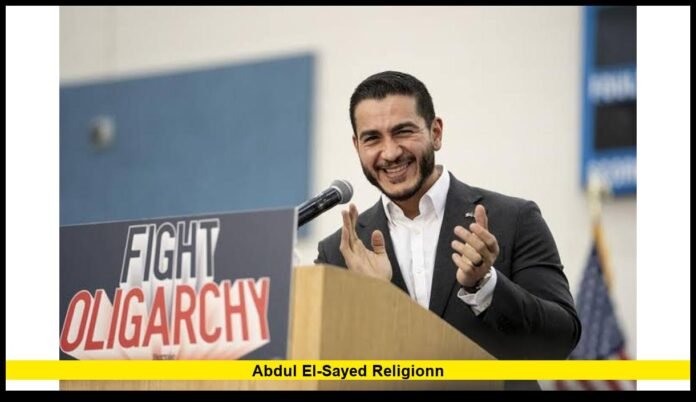

Abdul El-Sayed religion is a subject attracting growing public attention as the Michigan physician and Democratic Senate nominee campaigns for a seat in the U.S. Senate. El-Sayed identifies as Muslim and has publicly discussed how his faith influences his understanding of social responsibility, economic fairness, human dignity, and public service. His religious identity has become particularly prominent during the 2026 election cycle, as political debates surrounding his candidacy have raised broader questions about religious freedom, representation, and the place of Muslim Americans in national politics.
Born and raised in Michigan to Egyptian immigrant parents, El-Sayed has built a career spanning medicine, epidemiology, public administration, and progressive politics. He has argued that religious beliefs should not prevent anyone from participating fully in American democracy. With the November 3, 2026, Senate election approaching, his faith remains an important part of the public conversation surrounding his campaign, even as healthcare affordability, economic pressures, and government accountability remain central political issues.
What Is Abdul El-Sayed’s Religion?
Abdul El-Sayed is a Muslim American whose religious beliefs are rooted in Islam. He has openly discussed his faith in interviews, political appearances, and conversations with religious leaders, explaining that his beliefs encourage him to consider his responsibilities toward other people.
For El-Sayed, religion is not simply a personal label. He has connected his faith with compassion, accountability, fairness, and the responsibility to help people facing hardship. These principles have also appeared in his public service record and political platform.
His religious background should be understood alongside his American upbringing and Egyptian family heritage. Although Islam is associated with many Arab American communities, Arab identity and Muslim identity are different categories. Arab Americans belong to various religious traditions, while Muslims come from numerous ethnic, cultural, and national backgrounds.
El-Sayed’s experience reflects this distinction. He grew up in southeastern Michigan, attended American public schools, and pursued an academic and professional career that eventually brought him into state and national politics.
His Muslim identity is a documented aspect of his public life, but it does not independently determine his political opinions. Like other Americans, he has developed his positions through a combination of personal experiences, professional training, ideological commitments, and civic engagement.
Abdul El-Sayed’s Family Background and Early Life
El-Sayed was born and raised in Michigan in a family with Egyptian roots. His father, Mohamed, immigrated to the United States from Egypt, and El-Sayed grew up in an environment shaped by his family’s background and his experiences as an American.
His education began in Michigan’s public school system. He later attended the University of Michigan, where he graduated with high distinction and participated in collegiate lacrosse.
He continued his education at Columbia University, earning a medical degree, and at the University of Oxford, where he completed doctoral studies as a Rhodes Scholar. His academic training helped establish his career in medicine and public health before he became widely known in electoral politics.
These achievements are relevant to understanding his background because they demonstrate that his public identity encompasses more than religion or ethnicity. His professional experience has included scientific research, healthcare administration, and efforts to improve public institutions.
El-Sayed’s upbringing also connects him to Michigan’s diverse communities, including Arab Americans and Muslim residents in the Detroit metropolitan area. Those communities have played an important role in discussions about representation and political participation throughout the state.
However, it would be inaccurate to assume that every member of these communities shares his political views. Michigan’s Muslim and Arab American populations include people with different religious practices, ideological positions, and electoral priorities.
How His Muslim Faith Influences His Political Philosophy
El-Sayed has spoken about faith as a source of moral accountability. In public discussions with religious leaders, he has connected the idea of being accountable to something greater than oneself with the responsibility to improve conditions for other people.
His explanation places particular emphasis on practical consequences. If a person has the ability to help someone who lacks food, healthcare, or other necessities, he believes that responsibility should lead to action.
This perspective overlaps with several of the priorities he has pursued throughout his career. His work in public health has focused on improving access to essential services, addressing preventable health risks, and strengthening government programs that affect everyday life.
His progressive political philosophy also emphasizes reducing economic inequality and making healthcare more affordable. He has argued for policies intended to ensure that access to medical treatment and basic necessities is not determined entirely by a person’s financial circumstances.
Although these positions are consistent with the values he associates with Islam, his policy proposals should be evaluated on their own merits. Religious traditions can inspire different political approaches, and no single politician represents the beliefs of every person who follows the same faith.
El-Sayed’s public statements provide a clearer picture of his individual approach: he sees faith as a motivation for service rather than a reason to exclude people who believe differently.
Religious Freedom and the Separation of Church and State
Religious liberty is an important theme in El-Sayed’s public comments about his identity. He has argued that Americans should not have to abandon their religious beliefs to participate fully in public life.
This position reflects the constitutional principle that the government cannot establish an official religion while protecting individuals’ freedom of religious practice. It also recognizes the right of Americans to hold different beliefs or no religious beliefs at all.
El-Sayed’s perspective is particularly relevant in a country where religious identity can influence how candidates are perceived by voters. Muslim Americans have sometimes faced suspicion or discrimination in public discussions, especially when international conflicts or national security issues dominate political debate.
El-Sayed has challenged the assumption that being Muslim makes someone less American or less qualified to hold elected office. His argument is that citizenship and public responsibility should not be judged by a person’s religious background.
The issue extends beyond his individual candidacy. It raises questions about whether political candidates from minority faith communities can compete on the same terms as other candidates and whether voters distinguish between personal religious identity and actual policy proposals.
For El-Sayed, protecting religious freedom means ensuring that Americans can participate in civic life without being required to conform to a particular religious tradition.
Why His Religion Has Become a Major Political Issue in 2026
The discussion surrounding El-Sayed’s faith intensified after he won the Democratic nomination for Michigan’s open U.S. Senate seat in August 2026.
His victory placed him in a competitive general election against Republican nominee Mike Rogers, a former congressman. Because the seat is open following Democratic Senator Gary Peters’ retirement, the race has become an important contest in the broader struggle for control of the Senate.
El-Sayed’s religious background has drawn attention from political opponents and commentators, some of whom have used his Muslim identity to question his suitability for office. These attacks have contributed to a broader national discussion about anti-Muslim rhetoric in American politics.
On October 8, President Donald Trump made inflammatory public remarks targeting El-Sayed’s background and political positions. The comments intensified the controversy shortly before the candidates’ first general-election debate.
The debate in Grand Rapids subsequently became combative, with El-Sayed and Rogers exchanging sharp criticism. Their disagreements included healthcare, economic policy, foreign affairs, and the role of the federal government.
El-Sayed sought to keep attention on issues affecting Michigan households, including affordability and access to healthcare. He also defended his policy positions against attacks related to his identity and associations.
The episode illustrates how religious identity can become entangled with campaign messaging. For some voters, the controversy may raise questions about discrimination and representation; for others, it may prompt closer examination of the candidates’ policy differences.
Nevertheless, the political debate should distinguish between substantiated evidence about a candidate’s positions and accusations based primarily on religious identity.
Could Abdul El-Sayed Become the First Muslim U.S. Senator?
If El-Sayed wins the November 2026 general election, he would become the first Muslim elected to serve in the United States Senate.
That possibility gives his campaign significance beyond Michigan. It would represent a milestone for Muslim Americans seeking greater representation in the federal government, while also challenging longstanding assumptions about which religious communities are represented in national political institutions.
The potential milestone does not mean that all Muslim Americans share his ideology or support his campaign. Instead, it reflects the broader principle that Americans from different religious backgrounds can seek elected office and compete for public support.
El-Sayed’s campaign also demonstrates the distinction between symbolic representation and governing priorities. Voters must consider his proposals, professional experience, political judgment, and ability to represent Michigan, regardless of whether they share his faith.
His candidacy therefore brings together two important questions: whether American institutions provide equal opportunities for candidates from different religious backgrounds and whether voters believe a particular candidate offers effective solutions to the state’s challenges.
The outcome will be determined by Michigan voters in November, not by his religious identity alone.
His Public Health Career Beyond Religion
Before becoming a prominent Senate candidate, El-Sayed established a career in public health. His professional experience includes service as Detroit’s health director and leadership within Wayne County’s health and human services administration.
In Detroit, he worked to rebuild public health operations following years of financial and institutional difficulties. His work included addressing environmental health concerns and improving services for residents.
In Wayne County, he was involved in efforts to strengthen public health and human services for a large and diverse population. His broader record has included initiatives involving childhood lead exposure, access to essential medications, and medical debt relief.
He has also written about healthcare reform, including proposals for a system that would make medical treatment more accessible and affordable. His background in medicine and epidemiology has become a central part of his argument that government decisions should be informed by evidence and focused on public needs.
These professional experiences provide an independent basis for assessing his candidacy. While he has described faith as one source of his values, his administrative record and policy proposals can also be examined through measurable outcomes and practical considerations.
For voters researching his background, distinguishing his professional achievements from discussions about religion offers a more complete understanding of his public life.
How His Faith Relates to Healthcare and Economic Equality
Healthcare is among the clearest areas where El-Sayed’s professional background and stated moral commitments intersect.
He has advocated for broader healthcare coverage and policies designed to reduce the financial burdens associated with medical treatment. His support for Medicare for All reflects his view that access to healthcare should be treated as a public priority rather than a privilege available only to those who can comfortably afford it.
He has also emphasized economic fairness, including reducing medical debt and addressing the financial pressures facing working families.
His religious perspective provides part of the moral framework through which he discusses these issues. He has linked responsibility toward others with efforts to reduce suffering and improve people’s ability to live healthy, secure lives.
However, these policy questions also involve practical debates about funding, implementation, taxation, and the responsibilities of government. Voters can agree or disagree with his proposals without making assumptions about his personal faith.
This distinction is essential to a balanced assessment of any candidate. Religion may help explain a politician’s motivations, but policy decisions also require scrutiny of evidence, costs, potential benefits, and likely consequences.
Frequently Asked Questions About His Religious Beliefs
Is Abdul El-Sayed Muslim?
Yes. El-Sayed identifies as Muslim and has spoken publicly about how his faith informs his understanding of responsibility, compassion, justice, and public service.
Is Abdul El-Sayed Egyptian or American?
He is American, born and raised in Michigan, and comes from an Egyptian immigrant family. His American nationality and Egyptian heritage are distinct aspects of his background.
Does his religion determine his political views?
Not entirely. El-Sayed has said that his faith influences his values, but his political positions also reflect his public health career, progressive ideology, and views about the role of government.
Does he believe religious minorities should participate in American politics?
His public statements support religious freedom and equal participation in civic life. He has argued that Muslim Americans should be able to serve in public office without being treated as less American because of their religion.
What is the latest development involving his faith and campaign?
As of October 9, 2026, his Muslim identity remains part of the political controversy surrounding Michigan’s Senate race. Recent presidential remarks and the combative debate with Republican Mike Rogers have renewed discussion about religious identity, discrimination, and the candidates’ policy differences.
Conclusion
Abdul El-Sayed’s Muslim faith is an important part of his personal identity and public philosophy. He has described religion as a source of accountability, compassion, and responsibility toward others, connecting those principles with his work in healthcare and his progressive political agenda.
His candidacy has also brought renewed attention to religious representation in American politics. As the Michigan Senate contest moves toward Election Day, voters will continue to weigh his policy proposals, professional experience, and response to criticism alongside the broader debate about religious freedom.
Understanding his background requires separating established facts about his beliefs from political claims made during the campaign. His faith is one element of his identity, while his record and proposals remain essential to evaluating his suitability for public office.
What are your thoughts on religious diversity and representation in American politics? Leave a comment and follow the latest updates on Abdul El-Sayed’s campaign.