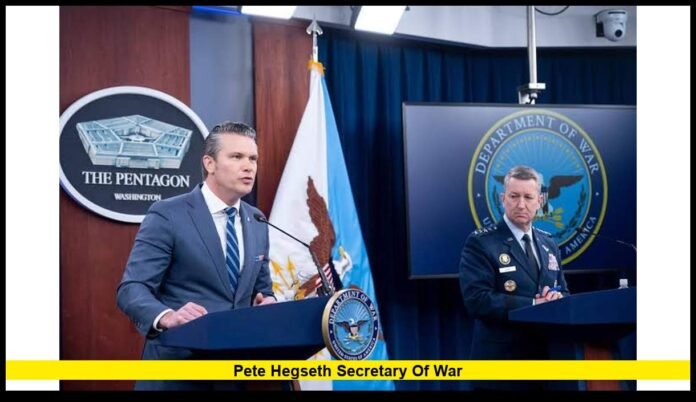

Pete Hegseth secretary of war is the current senior civilian leader overseeing the U.S. military under President Donald Trump, with the administration using the title after a 2025 executive order restored “Secretary of War” as a secondary title. Hegseth remains the same official who was confirmed by the Senate and sworn in as the 29th secretary of defense in January 2025. The Department of War now uses the “Secretary of War” title in its official public communications.
The latest developments show Hegseth continuing to pursue a broad military restructuring agenda. His most recent major announcement came during a State of the Force address at Marine Corps Base Quantico in Virginia, where he unveiled six initiatives involving autonomous warfare, military infrastructure, officer development, future warfare planning and religious affairs.
The changes represent a major part of Hegseth’s approach to leading the military. His stated priorities have centered on rebuilding the force, restoring what he calls a warrior ethos and strengthening deterrence. His administration has also emphasized military readiness, rapid technological development and changes to senior leadership.
Why Pete Hegseth Is Called Secretary of War
The title “Secretary of War” returned to official executive-branch communications after President Trump signed Executive Order 14347 on September 5, 2025.
The order authorized the secretary of defense to use “Secretary of War” as an additional secondary title. It also authorized the Defense Department to use “Department of War” in specified official communications, ceremonial settings and other non-statutory contexts.
There is an important legal distinction.
The executive order did not itself erase the statutory name “Department of Defense.” The order specifically stated that statutory references to the Department of Defense and Secretary of Defense remain controlling until Congress changes the law.
That means Hegseth can officially be presented by the administration as secretary of war while federal law continues to retain the statutory framework established for the Department of Defense.
The Department of War has nevertheless adopted the terminology extensively in its own public-facing operations. Its official website identifies Hegseth as secretary of war and describes him as the official who oversees the War Department and serves as the principal war policymaker and adviser.
When Pete Hegseth Became Secretary of Defense
Hegseth entered the Trump administration after a closely contested confirmation process.
The Senate confirmed him on January 24, 2025, by a 51-50 vote. Vice President JD Vance cast the deciding vote after three Republican senators opposed the nomination.
Hegseth was sworn in the following day, January 25, 2025. He became the 29th secretary of defense and took responsibility for an organization overseeing millions of U.S. service members and civilian personnel.
His military background was an important part of his public profile before entering the administration.
Hegseth graduated from Princeton University in 2003 and received his commission as an infantry officer in the Army National Guard. His military service included deployments connected to Guantanamo Bay, Iraq and Afghanistan. The Department of War lists two Bronze Star Medals among his military awards, along with other decorations and the Combat Infantryman Badge and Expert Infantryman Badge.
His background also included work as a veterans’ advocate, media personality and author before he became a Cabinet official.
What the Secretary of War Does
The secretary of war occupies the top civilian leadership position within the military department represented by the administration as the War Department.
The position involves major responsibilities involving military policy, resources, readiness, strategic planning and oversight. The official Department of War description says the secretary acts as the principal war policymaker and adviser.
Hegseth works alongside senior military leaders, including the chairman and vice chairman of the Joint Chiefs of Staff, while civilian officials handle policy, operational planning, fiscal matters and resource decisions.
The secretary is also responsible for translating presidential priorities into department-level policies and programs.
That makes Hegseth’s current agenda significant beyond the title change. The name “Secretary of War” describes how the administration presents the office, while the underlying responsibilities remain those associated with the nation’s top civilian defense official.
Hegseth’s Latest State of the Force Initiatives
Hegseth’s most significant recent policy announcements came during his State of the Force address at Marine Corps Base Quantico.
The event brought together roughly 600 active-duty officers and enlisted leaders. Hegseth used the speech to outline six initiatives that he said would shape the War Department’s direction.
The six initiatives are:
- Autonomous Warfare Command
- Project Meridian
- Fortress America
- The Next Great American Base
- America’s Corps of Cadets
- Office of Religious Affairs
Together, they cover technology, military infrastructure, officer development and internal organizational priorities.
Autonomous Warfare Command
One of Hegseth’s most consequential announcements was the planned creation of an Autonomous Warfare Command.
The proposed four-star combatant command would focus on autonomous and robotic military capabilities across the services. Hegseth said the effort would accelerate the military’s development and deployment of drones, robotics and artificial intelligence.
The initiative reflects the increasing importance of unmanned systems in modern warfare.
Hegseth also announced Project Agincourt, which is intended to establish the pathway toward the new command while continuing existing unmanned-systems responsibilities and testing a new acquisition approach.
The emphasis on autonomous systems is one of the clearest examples of Hegseth’s effort to change how the military approaches emerging technology.
Project Meridian
Hegseth also announced Project Meridian, a study focused on the future of warfare.
The project involves prominent figures from the technology and political worlds, including Elon Musk, Palmer Luckey and former House Speaker Newt Gingrich. Its stated purpose is to examine future technological and military capabilities rather than simply continue existing defense planning.
The project is designed to consider areas such as artificial intelligence, robotics and other emerging technologies.
Its inclusion in Hegseth’s latest agenda shows how strongly technological superiority has become part of his military strategy.
Fortress America
Another initiative, known as Fortress America, focuses on military infrastructure and resilience.
The plan aims to make military bases more capable of sustaining operations during disruptions. Hegseth has emphasized energy independence, supply resilience and the ability of installations to continue operating under attack or other major disruptions.
The initiative connects military readiness with the physical infrastructure supporting U.S. forces.
The Next Great American Base
Hegseth also announced plans for a new state-of-the-art military installation.
The Department of War says the initiative is intended to create a new major military installation, with the project moving toward a process for identifying a suitable location.
The proposal is part of Hegseth’s broader effort to rethink military infrastructure rather than simply maintain existing installations.
America’s Corps of Cadets
Hegseth’s sixth major initiative involves expanding pathways for future military officers.
The America’s Corps of Cadets program is intended to broaden military leadership development beyond the service academies and existing military colleges. The department said it is partnering with additional universities to expand the pool of students who can develop military leadership skills and eventually commission into the force.
The initiative reflects Hegseth’s emphasis on leadership development and the future officer corps.
Office of Religious Affairs Under Hegseth
Hegseth also announced the creation of an Office of Religious Affairs.
The office will report directly to the secretary’s office and is intended to strengthen religious support for service members. Hegseth presented the initiative as part of his broader emphasis on the spiritual well-being of military personnel.
The announcement represents one of the more distinctive cultural changes associated with Hegseth’s leadership.
The administration has said the office will support religious services and military chaplains. Its direct reporting relationship to Hegseth gives the new organization a prominent position within the department’s leadership structure.
Hegseth and Senior Military Leadership Changes
Another important element of Hegseth’s tenure has been his approach to the senior military leadership structure.
During his recent State of the Force address, Hegseth announced plans for a substantial reduction in the number of general and flag officer positions. The administration has presented the move as an effort to reduce layers of senior leadership and improve accountability.
The issue has attracted significant attention because senior military officers play a central role in strategic planning, operations and institutional continuity.
Hegseth has argued that the military needs a leaner leadership structure and that senior officers should remain focused on operational effectiveness.
Critics have raised concerns about the impact of rapid personnel changes on military expertise and institutional stability. Those competing views are now part of the broader debate surrounding his Pentagon reforms.
Hegseth’s Focus on Military Technology
Technology has become one of the defining areas of Hegseth’s current agenda.
His support for autonomous warfare, drones and robotics reflects the changing character of modern military operations. The War Department’s recent announcements show an effort to create dedicated structures for technologies that previously operated across multiple parts of the military.
The proposed Autonomous Warfare Command is particularly significant because it would create a four-star-level structure dedicated to autonomous and robotic capabilities.
Hegseth has also emphasized the importance of speed.
His approach calls for faster development and acquisition rather than lengthy processes that can delay emerging capabilities. The goal is to ensure that U.S. forces can field new technologies while they are still relevant to the battlefield.
Hegseth’s Current Role in Military Policy
As of the latest confirmed updates, Hegseth remains in charge of the department and continues to implement the Trump administration’s military agenda.
The Department of War’s official leadership page continues to identify him as secretary of war. It also lists Steve Feinberg as deputy secretary of war and Air Force Gen. Dan Caine as chairman of the Joint Chiefs of Staff.
Hegseth has remained active on international and regional security issues as well.
Department records show him participating in major defense engagements during 2026, including meetings with foreign defense officials and speeches on U.S. security priorities. His public agenda has included NATO, the Indo-Pacific and regional security matters.
His role therefore extends well beyond domestic Pentagon reforms.
Hegseth and the Military Voting Stand-Down
A recent personnel-related decision also involved voting access for service members.
Hegseth directed a one-day military-wide stand-down in October to give service members an opportunity to vote either in person or through mail ballots. The directive also addressed eligible military family members.
The move reflects the practical challenges faced by military personnel who may be stationed away from their home states or serving overseas.
Hegseth said the Department of War was committed to helping service members exercise their voting rights.
The initiative is separate from Hegseth’s weapons and military modernization programs, but it illustrates the broad range of responsibilities handled by the department’s senior civilian leader.
What the Title Means for Americans
For Americans searching for the latest information about Pete Hegseth, the most important point is that “Secretary of War” is now the administration’s official secondary title for the secretary of defense.
President Trump’s September 2025 executive order authorized the terminology but also acknowledged that statutory references remained unchanged unless Congress acted.
That distinction matters because government departments are created and governed by federal law.
The administration can use the secondary title in the contexts authorized by the executive order. A permanent statutory renaming, however, would require congressional action.
For everyday public communications, Hegseth is now routinely identified by the administration as secretary of war. The Department of War website uses that title throughout its leadership and biography pages.
Pete Hegseth Secretary of War: Key Facts
╔════════════════════════════════════════════════════════════════════╗
║ – Pete Hegseth is the current secretary of war under President Donald Trump. ║
║ – He was confirmed by the Senate on January 24, 2025, by a 51-50 vote. ║
║ – He was sworn in on January 25, 2025, as the 29th secretary of defense. ║
║ – President Trump authorized “Secretary of War” as a secondary title on September 5, 2025. ║
║ – Federal statutory references to Secretary of Defense remain controlling under the executive order. ║
╚════════════════════════════════════════════════════════════════════╝
Frequently Asked Questions
Who is Pete Hegseth?
Pete Hegseth is the Trump administration official serving as secretary of war. He previously became the 29th secretary of defense after Senate confirmation in January 2025.
When did Pete Hegseth become secretary of war?
Hegseth became known officially as secretary of war after President Trump issued Executive Order 14347 on September 5, 2025. The order authorized the title as a secondary designation.
Is Pete Hegseth still the secretary of defense?
Yes. The executive order authorized “Secretary of War” as a secondary title and stated that statutory references to “Secretary of Defense” remain controlling unless changed by law.
What does Pete Hegseth do as secretary of war?
He oversees the military department represented by the administration as the War Department and serves as the principal civilian policymaker and adviser for military matters.
What are Hegseth’s newest military initiatives?
His latest State of the Force address announced six initiatives: Autonomous Warfare Command, Project Meridian, Fortress America, The Next Great American Base, America’s Corps of Cadets and an Office of Religious Affairs.
What is Autonomous Warfare Command?
It is a proposed four-star-level combatant command focused on autonomous and robotic military capabilities across the joint force.
What is Project Meridian?
Project Meridian is a future-warfare study announced by Hegseth that brings together technology and policy figures to examine capabilities and domains that could shape future military operations.
When was Hegseth confirmed by the Senate?
The Senate confirmed Hegseth on January 24, 2025, by a 51-50 vote, with Vice President JD Vance breaking the tie.
What is the legal status of the Department of War name?
The administration uses “Department of War” as a secondary title under Executive Order 14347. The order itself says statutory references to the Department of Defense remain controlling until changed by law.
Pete Hegseth’s tenure is continuing to reshape the Pentagon’s approach to leadership, technology, infrastructure and military readiness, making his actions as secretary of war a major part of the Trump administration’s national-security agenda.
Stay with the latest confirmed developments as Hegseth’s military reforms and the future role of the Department of War continue to unfold.