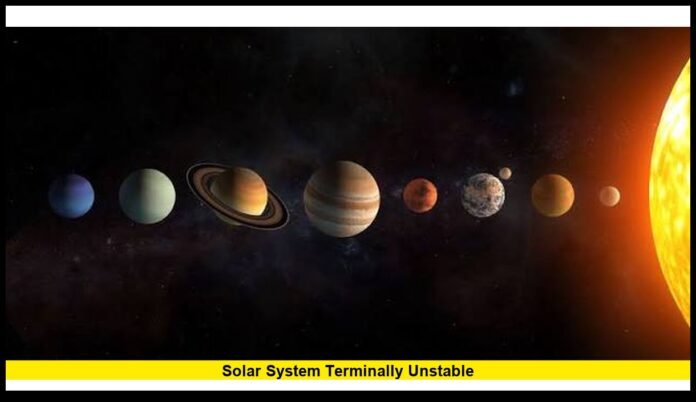

Solar System terminally unstable is the striking conclusion behind a newly published study that revisits how the planets may behave when the Sun reaches the end of its life. The research, published in The Astrophysical Journal Letters on October 1, 2026, argues that earlier estimates of the outer Solar System’s long-term stability may have overlooked an important feature of stellar evolution: the Sun may lose mass in discrete, asymmetric events rather than through perfectly smooth mass loss.
The study was conducted by Konstantin Batygin, Jim Fuller, and Fred C. Adams. It examines the future evolution of the giant planets as the Sun leaves its current main-sequence stage, expands into a red giant, sheds much of its outer material, and ultimately becomes a white dwarf.
The finding does not mean the Solar System is about to become unstable. The researchers are studying events billions of years in the future. The new work instead changes the expected fate of the outer planets after the Sun begins its final evolutionary stages.
Earlier models generally treated solar mass loss as smooth. Under that assumption, the giant planets could remain dynamically organized for extraordinarily long periods. The new simulations introduce stochastic, discrete mass-ejection events that can give the Sun small gravitational recoils. Those repeated kicks can gradually alter planetary orbits.
At the mass-loss levels examined in the study, the consequences become significant. About 40% of the modeled systems undergo disruption or violent scattering before the Sun finishes becoming a white dwarf, while roughly 90% become dynamically unstable within three billion years after white-dwarf formation.
What the New Study Actually Found
The new research focuses primarily on the outer Solar System, especially Jupiter, Saturn, Uranus, and Neptune.
For decades, astronomers have known that the Solar System is not perfectly predictable over extremely long periods. Planetary gravity creates small changes in orbital motion, and those changes can accumulate. The inner planets, particularly Mercury, already provide a clear example of this chaotic behavior.
Previous numerical studies found that Mercury has about a 1% chance of becoming dynamically unstable during the Sun’s remaining main-sequence lifetime. That instability could drive Mercury toward a collision with the Sun or Venus, with rare trajectories capable of disturbing other terrestrial planets.
The outer planets have traditionally looked much more secure.
Earlier calculations placed the intrinsic dynamical instability timescale of the giant-planet system around 10¹⁸ years. That number is vastly longer than the current age of the universe. Even when researchers considered encounters with passing stars and the effects of the Sun losing mass, estimates generally placed the eventual breakdown of the outer planetary architecture on a timescale of tens to roughly 100 billion years.
The new study challenges that picture.
Its central argument is that the previous calculations relied on an assumption that may be too simple: treating the Sun’s future mass loss as smooth.
Why Solar Mass Loss Matters
The Sun currently contains almost all of the mass in the Solar System. Its gravity therefore provides the dominant force controlling planetary orbits.
That situation will change dramatically as the Sun ages.
NASA states that the Sun is about 4.6 billion years old and is expected to remain a main-sequence star for roughly another five billion years. It will then expand into a red giant before eventually leaving behind a white dwarf.
During this transformation, the Sun will lose a substantial fraction of its mass.
The new study models a final white-dwarf mass of about 0.538 times the Sun’s present mass. That means the Sun loses roughly 46% of its current mass during its giant-branch evolution in the model.
If the mass disappears slowly and symmetrically, planetary orbits respond in a comparatively orderly way.
The planets move outward as the Sun’s gravitational pull weakens. In the researchers’ smooth-mass-loss control simulations, the giant planets remained dynamically organized. Their semimajor axes expanded, but the basic orbital architecture survived.
The critical difference appears when mass loss occurs in discrete pieces.
The Role of Discrete Stellar Ejections
The researchers build their model around evidence that newborn white dwarfs can receive measurable velocity kicks.
The paper cites Gaia observations of wide binary systems showing white-dwarf recoil velocities of approximately 0.75 kilometers per second. The researchers connect these observations with a possible mechanism in which a dying star loses its envelope through multiple asymmetric ejection events.
Each individual event would produce only a small change in the Sun’s velocity.
However, thousands of such events can accumulate.
The study models the mass loss as discrete parcels rather than a continuous stream. The direction of each ejection is treated as independent, allowing the resulting recoil to build up through a random walk.
This matters because every small change in the Sun’s motion changes the gravitational environment experienced by its planets.
The researchers describe the resulting process as stochastic forcing. Instead of planetary orbits simply expanding as the Sun loses mass, their orbital elements can wander.
That wandering can change orbital periods, eccentricities and the relationships between neighboring giant planets.
How Large Are the Modeled Mass-Loss Events?
One of the most important numbers in the study is the assumed mass of each ejection.
For the study’s reference case, the researchers use an ejected mass of approximately 10⁻⁴ solar masses per event. Their simulations produce about 4,600 individual recoil events during the modeled stellar-evolution sequence.
The individual kicks are small.
The paper reports recoil speeds of several meters per second per event, with a median of roughly 7 meters per second in the reference case.
That might seem insignificant compared with the enormous scale of the Solar System.
The effect becomes important because the kicks accumulate. Their directions are not all the same, so the orbital changes behave statistically like a random walk.
The researchers found that the accumulated disturbance can become large enough to alter the spacing and eccentricities of the giant planets.
For the reference ejection mass, the simulations produced substantial dispersion in the Jupiter-Saturn period ratio. Neptune’s eccentricity could also become much larger than its present value, reaching approximately 0.5 in some modeled outcomes.
Those changes can push the outer planets toward orbital configurations in which close encounters become possible.
What Happens to Jupiter, Saturn, Uranus and Neptune?
The giant planets occupy a delicate gravitational system.
Jupiter is the most massive planet in the Solar System, and its gravity strongly influences the other planets and countless smaller objects. Saturn, Uranus and Neptune also interact gravitationally with one another.
Under smooth solar mass loss, these interactions do not necessarily destroy the system.
The new simulations show something different when stochastic solar recoil is included.
The planets’ orbital relationships begin to spread. Some modeled systems develop increased eccentricities. Others experience changes in orbital spacing. In more extreme cases, planets can cross paths or enter configurations that trigger gravitational scattering.
The important point is that the instability can begin during the Sun’s giant-branch evolution.
It does not necessarily wait until the Sun has already become a white dwarf.
The paper reports that approximately 40% of its reference realizations experience disruption or violent scattering before white-dwarf formation. Around 90% become dynamically self-destructive within three billion years after the white dwarf forms.
These percentages describe the researchers’ numerical realizations. They are not measurements of events that have already happened, nor do they represent a prediction that the actual Solar System has a precisely 40% or 90% chance of each outcome.
Why the Finding Changes Earlier Estimates
The major significance of the research comes from the difference between the old and new timescales.
Without the stochastic mass-loss mechanism, the intrinsic dynamical lifetime of the giant-planet system has been estimated at around 10¹⁸ years.
That number is almost incomprehensibly long.
Even previous studies that included passing stars suggested that external stellar encounters could eventually dismantle the outer Solar System on a timescale of roughly 30 to 100 billion years.
The new work produces a dramatically shorter timescale.
For the mass-loss granularity favored by the researchers’ model, the outer Solar System’s dynamical lifetime falls to approximately one billion years after white-dwarf formation.
That is still an enormous period by human standards.
But compared with 10¹⁸ years, it represents an extraordinary reduction.
The study therefore does not simply make a small adjustment to earlier calculations. Its authors argue that stochastic solar mass loss can fundamentally alter the expected long-term fate of the giant planets.
What Does “Terminal Instability” Mean?
The term “terminal instability” describes the eventual breakdown of the planetary architecture rather than a sudden explosion or immediate destruction.
The Solar System is already technically chaotic.
That does not mean the planets are randomly flying around. Their present orbits are highly organized, and astronomers can calculate their motion with exceptional accuracy over appropriate timescales.
Chaos becomes important when predictions extend far enough into the future.
Researchers have found that the inner planets can experience chaotic changes in eccentricity over very long periods. Studies of the inner Solar System have nevertheless found a remarkably low probability of catastrophic orbital instability over the next five billion years.
The new study addresses a different problem.
It asks what happens when the Sun itself becomes a changing gravitational source.
That transition introduces a physical process that ordinary present-day orbital integrations cannot capture by simply extending the clock.
The Sun’s Death Remains Billions of Years Away
The new research does not change the expected broad timeline of solar evolution.
NASA continues to place the Sun’s transition into a red giant roughly five billion years in the future. After the red-giant stage, the Sun will shed its outer layers and leave behind a white dwarf.
The inner planets face the most direct consequences.
Mercury and Venus are expected to be engulfed by the expanding Sun, while Earth’s ultimate fate remains less certain in detailed models. NASA describes Mercury and Venus as expected to be destroyed and Earth as a possible additional casualty of the red-giant expansion.
The new study is particularly important because it examines what happens beyond the inner planetary region.
Even if some outer planets avoid direct contact with the expanding Sun, they may not remain in their current orbital arrangement.
This Is Not a Near-Term Threat to Earth
The dramatic wording surrounding the study can make the result sound immediate.
It is not.
There is no evidence from this research that Earth’s orbit is currently becoming unstable because of the newly proposed mechanism. The modeled process begins during the Sun’s distant post-main-sequence evolution.
That period lies billions of years in the future.
The study also focuses on the outer planetary system and its response to stochastic solar mass loss. Its results should not be interpreted as a new estimate that Earth will be destroyed by planetary chaos in the near future.
The distinction is essential.
Scientific simulations can reveal possible long-term pathways without establishing that one exact pathway will occur in nature.
The researchers therefore use ensembles of numerical realizations rather than claiming to know the exact future orbit of every planet.
How the Researchers Tested the Idea
The study used established computational tools for planetary dynamics and stellar evolution.
The researchers employed the REBOUND N-body package with the IAS15 and TRACE integrators. They also used MESA stellar-evolution tracks to model the Sun’s progression toward its final white-dwarf state.
The calculations compared smooth mass loss with discrete mass-ejection scenarios.
That comparison was crucial.
When the Sun’s mass declined smoothly, the giant-planet system remained stable in the researchers’ control calculations.
When mass loss occurred through discrete asymmetric events, the planetary architecture became much more disturbed.
The study therefore identifies the granularity of solar mass loss as a major factor controlling the long-term fate of the outer planets.
Why White Dwarf Observations Matter
The research connects Solar System dynamics with observations of other stars.
White dwarfs are the remnants of stars that have exhausted their normal nuclear fuel. Their observed properties can preserve information about the violent processes that occurred during their formation.
The study uses observed white-dwarf recoil as evidence supporting the possibility that stellar mass loss can occur through discrete, asymmetric events.
That link is important because the planetary instability does not arise simply from the amount of mass the Sun loses.
It arises from how that mass leaves the star.
A perfectly smooth process allows the planets to respond gradually. Repeated asymmetric ejections can deliver many small impulses, causing the planetary system to wander through different orbital configurations.
The New Long-Term Picture
The latest research produces a much more complicated picture of the Solar System’s ultimate fate.
| Issue | Earlier expectation | New study |
|---|---|---|
| Solar mass loss | Often modeled as smooth | Modeled as discrete asymmetric events |
| Outer-planet stability | Extremely long-lived | Can destabilize during solar evolution |
| Intrinsic instability estimate | Around 10¹⁸ years | Greatly shortened under stochastic forcing |
| Stellar-flyby timescale | Tens to about 100 billion years | Not necessarily the dominant trigger |
| Reference ejection mass | Not included in smooth models | About 10⁻⁴ solar masses |
| Modeled disruption before white dwarf | Not expected from smooth loss | About 40% in reference realizations |
| Breakdown within 3 billion years | Not the standard expectation | About 90% in reference realizations |
The most important takeaway is that the Solar System’s fate depends not only on planetary gravity but also on the detailed physics of the Sun’s death.
What Remains Uncertain
The study is a major update, but it does not remove uncertainty from the Solar System’s distant future.
The actual pattern of the Sun’s future mass loss cannot be observed directly because the Sun has not yet entered its giant phase.
The researchers therefore rely on stellar observations, theoretical models and numerical experiments.
The assumed mass of individual ejection events is especially important. Different mass-loss granularities produce different levels of orbital disturbance. The study finds that larger ejection parcels produce stronger stochastic effects.
That means future observations of evolved stars and white dwarfs can help test the physical assumptions behind the model.
The work also does not provide a precise date when the actual outer Solar System will become unstable.
Instead, it provides statistical outcomes from modeled scenarios.
That distinction is central to interpreting the results accurately.
Why This Research Matters Now
The October 2026 publication changes the discussion because it identifies a physical mechanism that earlier long-term stability calculations did not fully include.
The giant planets may remain stable for extraordinarily long periods under current conditions. But the Sun will not remain unchanged forever.
Once solar evolution becomes the dominant driver, the gravitational environment around the planets changes.
The new study shows that discrete stellar mass loss can transform those changes from a gradual orbital expansion into a stochastic process capable of destabilizing the planetary system.
This does not overturn the basic understanding that the Solar System is stable on human timescales.
Instead, it provides a new explanation for how the system could eventually unravel after the Sun reaches the end of its normal life.
Frequently Asked Questions
What does Solar System terminally unstable mean?
It refers to the newly studied possibility that the Solar System’s outer planetary architecture eventually becomes dynamically unstable as the Sun loses mass during its transition from a red giant to a white dwarf.
Is the Solar System currently unstable?
The Solar System is technically chaotic over extremely long timescales, but its planets remain in stable, organized orbits today. The new study does not identify a current instability threatening the planets.
When will the Sun become a red giant?
NASA estimates that the Sun will enter its red-giant phase in roughly five billion years. It will eventually shed its outer layers and become a white dwarf.
What causes the newly identified instability?
The study points to stochastic solar mass loss. Instead of losing its outer material as a perfectly smooth flow, the Sun may eject material through discrete, asymmetric events that give it small recoil velocities.
Which planets are most relevant to the new study?
The research focuses on the outer Solar System and specifically models Jupiter, Saturn, Uranus and Neptune. The instability concerns changes in their orbital architecture as the Sun loses mass.
How many simulations become unstable in the study?
For the reference mass-ejection scenario, approximately 40% of modeled systems undergo disruption or violent scattering before white-dwarf formation, while roughly 90% become dynamically unstable within three billion years afterward.
Does this mean Earth will be destroyed in the same way?
No. The study’s principal result concerns the outer planetary system. Earth already faces the consequences of the Sun’s red-giant evolution billions of years from now, but the new research does not establish a precise future collision or ejection outcome for Earth.
How long was the outer Solar System previously expected to remain stable?
Earlier work estimated the intrinsic dynamical lifetime of the giant-planet system at roughly 10¹⁸ years, while other models including stellar encounters placed eventual disruption much closer to tens of billions of years.
What happens to the Sun after the red-giant stage?
The Sun will shed its outer layers and become a white dwarf, leaving behind a compact stellar remnant. NASA places this transition roughly several billion years in the future.
Is the new result a prediction of exactly what will happen to our Solar System?
No. The research provides statistical outcomes from numerical models based on physical assumptions about future solar mass loss. The exact future trajectory of the real Solar System cannot be known with that level of precision billions of years in advance.
Why is the study important?
It shows that the way a dying star loses mass can be as important as the total amount of mass it loses. Discrete stellar recoil events can alter planetary orbits and potentially make the outer Solar System unstable much sooner than older smooth-mass-loss models suggested.
The latest research therefore adds a major new piece to the long-term story of our planetary system: the Solar System may remain orderly for billions of years, yet the Sun’s eventual transformation could fundamentally change the gravitational architecture that holds its outer planets together.
What do you think about this new picture of the Solar System’s distant future? Share your thoughts in the comments and stay tuned for further verified developments in planetary science.