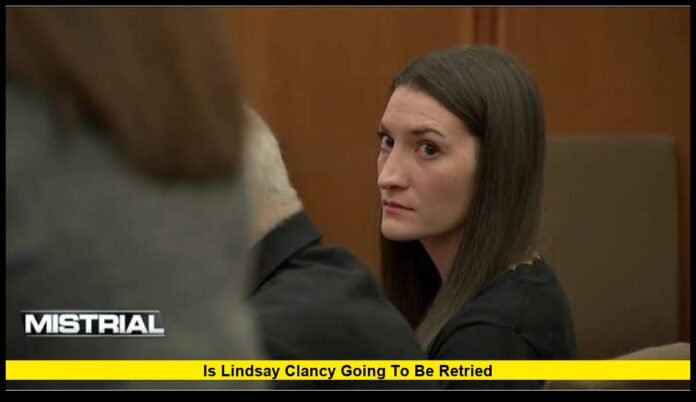

The question is Lindsay Clancy going to be retried remains unanswered after she returned to a Massachusetts courtroom on September 29 following the mistrial in her high-profile murder case. Prosecutors have not committed to a second trial, while Clancy’s defense is asking the judge to end the case rather than allow the state to present it to another jury.
Clancy was originally charged with killing her three young children at the family’s Duxbury home in January 2023. Her first trial lasted nearly six weeks and focused heavily on whether she was criminally responsible for the deaths. The defense argued that she was experiencing postpartum psychosis, while prosecutors maintained that she understood her actions and should be held legally responsible.
The trial ended without a verdict on September 4 after jurors remained divided. The latest hearing has now shifted attention away from the evidence presented during the original trial and toward the legal questions that could determine whether the case continues.
What Happened at Lindsay Clancy’s First Trial?
The first trial centered on the deaths of Cora, Dawson and Callan Clancy.
Cora was 5 years old, Dawson was 3, and Callan was 8 months old when they died in January 2023. Clancy also attempted suicide after the killings and survived with serious injuries that left her paralyzed.
Clancy’s defense did not initially dispute that she had strangled the children. Instead, her attorneys argued that a severe episode of postpartum psychosis had affected her ability to understand the nature and consequences of what she was doing.
The prosecution presented a substantially different account.
Prosecutors argued that Clancy had planned the killings and knew what she was doing. They challenged the defense’s explanation that psychosis made her incapable of criminal responsibility.
The jury was ultimately asked to determine whether Clancy was criminally responsible under Massachusetts law.
After lengthy deliberations, the jurors could not reach a unanimous decision.
Why Was There a Mistrial?
A mistrial was declared on September 4 after the 12-member jury became deadlocked.
The reported division was 11 to 1. Eleven jurors were reportedly prepared to find Clancy not criminally responsible, while one juror remained opposed to that outcome.
The disagreement became particularly important during the final days of deliberations.
Clancy’s attorneys argued that the holdout juror was not properly applying the court’s instructions concerning reasonable doubt. They asked the judge to remove the juror and replace him with an alternate.
The request was rejected.
The defense subsequently sought emergency intervention from the Massachusetts Supreme Judicial Court, but that effort did not prevent the mistrial.
Judge William Sullivan ultimately concluded that the jury could not reach the required unanimous verdict and formally ended the trial.
A mistrial caused by a deadlocked jury is different from an acquittal. Clancy was not found guilty, but she was also not formally found not guilty. Consequently, the criminal case remained unresolved.
What Happened at the September 29 Hearing?
Clancy returned to court on September 29 for the first major hearing since the mistrial.
Instead of simply discussing a new trial date, the defense made a broader argument seeking to end the prosecution.
Defense attorney Kevin Reddington argued that the evidence presented during the first trial did not establish that Clancy committed the killings in the manner alleged by prosecutors. This represents a significant change in emphasis from the defense’s original trial presentation.
During the first trial, the defense largely accepted the underlying physical events while arguing that Clancy was not criminally responsible because of postpartum psychosis.
Following the mistrial, the defense is now also challenging whether prosecutors have sufficient evidence to prove their case.
Reddington argued that there was no adequate evidence establishing that Clancy intentionally committed the murders and pointed to her psychiatric condition, injuries and reported lack of memory surrounding the incident.
The prosecution disputed the defense position.
Judge Sullivan did not immediately resolve the competing arguments. Instead, several motions remain pending, leaving the future of the case uncertain.
Has a Retrial Been Scheduled?
No.
The September 29 hearing did not produce a confirmed second-trial date.
The court scheduled another hearing for November 2, when additional legal issues are expected to be considered.
The judge also indicated that the attorneys should be prepared to discuss the possibility of a future trial date at that time.
That does not mean a retrial has been ordered.
Before another jury could hear the case, several outstanding legal questions must be addressed. Prosecutors must also decide whether they actually want to proceed with another prosecution.
The current situation is therefore best described as an unresolved post-mistrial case rather than a confirmed retrial.
What Are Prosecutors Considering?
Prosecutors have not announced a final decision about Clancy’s future prosecution.
The state could potentially seek another trial, but other possibilities also exist.
Prosecutors could continue with the existing murder charges, consider a different charging strategy, negotiate a resolution or ultimately decide not to proceed.
The first trial required substantial resources and lasted several weeks. The jury’s eventual 11-1 division also means prosecutors would have to consider how a new jury might approach the same evidence.
However, the previous jury’s division does not determine what another jury would decide.
If the case reaches another trial, prosecutors would have an opportunity to present their evidence to a completely different jury.
Why the Defense Wants the Case Dismissed
Clancy’s defense has several reasons for trying to prevent a retrial.
One central argument concerns the sufficiency of the evidence.
Reddington has argued that prosecutors failed to establish the necessary facts beyond a reasonable doubt and that the court should therefore enter a finding that prevents the case from proceeding.
The defense has also raised double-jeopardy concerns.
The constitutional protection against double jeopardy generally prevents prosecutors from repeatedly putting someone on trial for the same offense. However, there are important exceptions.
One of those exceptions involves a mistrial caused by a genuinely deadlocked jury.
Because Clancy’s first trial ended without a verdict after jurors could not reach unanimity, prosecutors may have the ability to retry the case.
The defense is nevertheless challenging whether the circumstances surrounding this particular mistrial should permit another prosecution.
That question remains for the court to resolve.
What Role Does the Holdout Juror Play?
The juror who prevented a unanimous verdict has become a major part of the post-trial legal dispute.
Clancy’s attorneys believe the juror did not properly follow the judge’s instructions during deliberations. They have sought additional information about what occurred inside the jury room and have asked the court to consider further investigation.
The juror has defended his conduct through his attorney.
The issue is legally sensitive because courts generally place significant restrictions on inquiries into jury deliberations.
The defense wants information that could potentially support its argument that the mistrial should not lead automatically to another prosecution.
The prosecution has opposed some of the defense’s requests.
Judge Sullivan is expected to consider additional arguments concerning juror-related materials and other motions at the November hearing.
Could Lindsay Clancy Be Declared Not Guilty Without Another Trial?
That remains one of the possibilities being pursued by the defense.
Clancy’s lawyers are asking the judge to consider whether the evidence from the first trial was legally sufficient to support continued prosecution.
If the judge agrees with the defense, the case could potentially end without a second jury being selected.
That would be a major development because it would remove the uncertainty surrounding another trial.
However, no such ruling has been issued.
The court has not declared Clancy not guilty following the mistrial, and the prosecution has not been formally barred from pursuing another case.
Until Judge Sullivan rules on the pending motions, the case remains open.
What If Prosecutors Decide to Retry Her?
If prosecutors decide to proceed and the court permits the prosecution to continue, Clancy would face another trial before a new jury.
The new jury would not be the same group that heard the first trial.
The prosecution and defense would again present their evidence and arguments, although both sides would have the benefit of knowing how the first proceeding unfolded.
A second trial would likely again focus on Clancy’s mental state, the circumstances surrounding the deaths and whether she should be considered criminally responsible.
The timing is another important issue.
Even if prosecutors eventually decide to pursue another trial, the case is not necessarily heading back to court immediately. Defense attorney Kevin Reddington has indicated that his schedule could make a retrial difficult to begin until 2027.
That means a decision to prosecute again would not necessarily lead to a new trial in the immediate future.
What Does the November 2 Hearing Mean?
The November 2 hearing is now one of the most important upcoming dates in the case.
Several legal questions could receive additional attention.
The judge is expected to consider arguments concerning the defense’s request to prevent a retrial, issues related to double jeopardy and the defense’s efforts to obtain additional information concerning the jury.
The attorneys may also discuss potential scheduling issues if the case survives the pending motions.
The hearing could therefore provide considerably more information about the direction of the prosecution.
However, readers should not assume that November 2 will automatically produce a final answer.
The judge could postpone decisions, request additional arguments or issue rulings at a later time.
What Is Lindsay Clancy’s Current Legal Status?
Clancy remains charged in connection with the deaths of her three children.
The mistrial did not result in a conviction, but it also did not eliminate the underlying charges.
She remains in a state psychiatric facility while the legal proceedings continue.
Her mental health has been a central issue throughout the case.
The defense has argued that postpartum psychosis played a decisive role in what happened in 2023. Prosecutors have disputed that explanation and maintained that Clancy should be held criminally responsible.
The first jury did not reach a unanimous conclusion on that issue.
That leaves the central legal question unresolved.
Is Lindsay Clancy Going to Be Retried?
At the latest stage of the case, is Lindsay Clancy going to be retried is still an open question.
There is no confirmed retrial date, and prosecutors have not announced that they will definitely take the case before another jury.
At the same time, the mistrial does not automatically mean that the charges have disappeared. A deadlocked jury can leave prosecutors with the legal option of pursuing another trial, subject to the court’s rulings and other legal considerations.
The defense is actively trying to prevent that outcome.
The next major development is expected from the court’s handling of the pending motions and the November 2 hearing.
Until those issues are resolved, reports suggesting that a second trial is guaranteed would go beyond what has been established in court.
What Happens Next?
The immediate future of the case depends on several decisions.
First, Judge Sullivan must consider the defense motions seeking to end the prosecution and address the arguments surrounding the mistrial.
Second, the court may decide how much additional information concerning the jury and the holdout juror can be examined.
Third, prosecutors must determine whether they want to continue pursuing Clancy after the first trial ended without a verdict.
Only after those questions are addressed will the possibility of a second trial become clearer.
For now, the case remains in a post-mistrial stage. There is no conviction and no acquittal, and there is no confirmed retrial date.
The November 2 hearing could become a significant turning point, particularly if the judge rules on the defense’s efforts to prevent another prosecution or if prosecutors reveal a clearer position about their plans.
For Clancy, her family and everyone following the case, the legal process is therefore continuing even though the first trial has ended.
Stay tuned for the next Lindsay Clancy court update and share your thoughts on what could happen when the case returns to court in November.