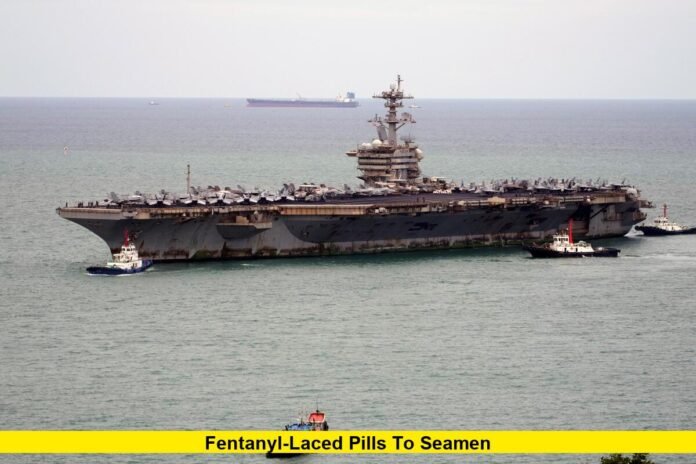

Two former Navy sailors admitted to selling fentanyl-laced pills to seamen assigned to the USS Abraham Lincoln, and one of the young men who bought those pills never made it home.
Bailey A. Szramowski, 29, and his wife, Johnnese H. Poomaihealani, 25, both of Hawaii, stood before a federal judge in San Diego on September 14, 2026. They pleaded guilty to one count each of conspiracy to distribute controlled substances. The case exposes how a small, deadly drug operation moved through the ranks of a nuclear-powered aircraft carrier and cost a young sailor his life.
What Happened Aboard the USS Abraham Lincoln
Court records paint a grim timeline. Szramowski supplied an active-duty sailor with ten pills marketed as oxycodone in December 2022. The buyer, identified only by his initials, A.N., was assigned to the Abraham Lincoln at the time.
A.N. took the pills while on leave, staying with family in San Leandro, California. He died the following month, in January 2023, from acute fentanyl intoxication. A toxicology report later confirmed the counterfeit pills were the cause.
The tragedy did not stop the operation. Szramowski allegedly knew about A.N.’s death and sold three more pills to a second sailor, identified as C.L., just ten days afterward. C.L. suffered an apparent overdose and was hospitalized. He survived.
A Cover-Up Attempt Following the Overdose
What happened next turned a drug case into an obstruction case as well. After C.L.’s hospitalization, Szramowski and Poomaihealani reportedly called him directly. They pressured him to tell investigators the pills came from A.N., the sailor who had already died, rather than from Szramowski himself.
C.L. did not go along with the plan for long. He later cooperated with the Naval Criminal Investigative Service, providing details that helped agents piece together roughly a year of pill sales aboard the carrier, both during its 2022 deployment and after it returned to San Diego.
Investigators say Szramowski purchased the counterfeit pills through the mail, received them at a P.O. box in Coronado, California, and collected payment from other sailors through the mobile app CashApp. The scheme, prosecutors allege, ran quietly beneath the daily routine of one of the Navy’s flagship vessels.
Timeline of the Case
| Date | Event |
|---|---|
| December 2022 | Szramowski sells 10 counterfeit oxycodone pills to sailor “A.N.” |
| January 3, 2023 | A.N. dies of acute fentanyl intoxication while on leave |
| January 2023 (10 days later) | Szramowski sells more pills to sailor “C.L.,” who overdoses and survives |
| January 2025 | Federal complaint filed against Szramowski |
| February 2025 | Grand jury indicts the couple |
| September 14, 2026 | Szramowski and Poomaihealani plead guilty in San Diego federal court |
| December 11, 2026 | Sentencing scheduled before U.S. District Judge Ruth Bermudez Montenegro |
Who Are Bailey Szramowski and Johnnese Poomaihealani?
Szramowski and Poomaihealani are married and both hail from Hawaii. Both previously served in the U.S. Navy before their conduct came to light. Federal prosecutors have not publicly detailed their current employment status, though court filings confirm both left active duty before the guilty pleas were entered.
Their case now sits under docket number 20cr2682-GPC in the Southern District of California.
Charges and Potential Penalties
Each defendant pleaded guilty to conspiracy to distribute controlled substances under federal law. The penalties they face differ sharply, largely because of the death tied to Szramowski’s sales.
- Szramowski faces a mandatory minimum of five years in prison, up to a maximum of 40 years, plus a fine of as much as $5 million.
- Poomaihealani faces up to 20 years in prison and a fine of up to $1 million.
Judge Ruth Bermudez Montenegro will determine the actual sentences at the December hearing. Federal sentencing guidelines, cooperation credit, and the specific role each defendant played will all factor into that decision.
Fentanyl-Laced Pills to Seamen: A Broader Pattern
This case is not an isolated one. Counterfeit pills pressed to resemble prescription opioids like oxycodone or Percocet have flooded illicit markets across the country, and military installations have not been immune. Investigators nationwide continue to warn that pills bought outside a licensed pharmacy carry a real risk of containing lethal doses of fentanyl, often without any visible difference from the real medication.
The Drug Enforcement Administration has repeatedly cautioned that counterfeit pills are one of the leading drivers of overdose deaths among young adults, including service members stationed far from home. A single pill can contain a fatal dose, and buyers frequently have no way of knowing what they are actually taking.
Who Investigated the Case
Homeland Security Investigations San Diego’s Fentanyl Abatement and Suppression Team, known as FAST, led the probe. The task force was created in August 2022 specifically to dismantle fentanyl smuggling and distribution networks operating in San Diego County.
Multiple agencies joined the effort:
- Homeland Security Investigations
- Naval Criminal Investigative Service
- California Department of Justice
The case falls under Operation Take Back America, a nationwide Department of Justice initiative aimed at disrupting cartels and transnational criminal organizations behind the fentanyl trade. Assistant U.S. Attorney Keith D. Ellison is prosecuting the case, with former Special Assistant U.S. Attorney Samson Schatz contributing significantly to the effort before entering guilty pleas were secured.
Why This Case Matters for Military Families
Sailors deploy for months at a time, often with limited access to trusted medical care and far from the support systems that might catch a substance-use problem early. When counterfeit pills enter that environment, the consequences can spread quickly among close-knit crews.
Naval families have raised broader safety concerns about conditions aboard the Abraham Lincoln in recent months, citing issues ranging from food shortages to disruptions in mail service during deployments. Those concerns, while separate from this drug case, underscore the pressures sailors face while serving aboard the carrier.
The Abraham Lincoln itself has continued its normal rotation since the case became public, with the Navy periodically shifting carrier assignments as part of routine fleet operations.
What Comes Next
Both defendants remain free pending sentencing, according to court records reviewed through the Southern District of California’s press office. December 11 will mark the next major milestone in the case, when Judge Montenegro decides how much prison time each defendant will actually serve.
For A.N.’s family, no sentence will undo the loss of a young sailor who believed he was buying a prescription painkiller. For the Navy, the case adds urgency to ongoing efforts to warn sailors about the dangers of buying pills outside official channels, no matter how legitimate they appear.
Have thoughts on this case, or a tip about fentanyl activity in your community? Share your thoughts below and stay tuned as sentencing approaches in December.