
If you’re trying to figure out how much student loan can i get, the amount available to you in 2026 depends on several factors, including whether you are an undergraduate or graduate student, your dependency status, your year in school, your education costs, and how much federal aid you have already received. Federal student loan rules have also changed for the 2026–27 academic year, making it especially important for students and families to understand the current limits before accepting new debt.
Student loans can help cover tuition, housing, books, transportation, supplies, and other eligible education expenses. However, the maximum amount you can borrow is not necessarily the amount your school will offer. Your college or university calculates your financial aid eligibility and determines the amount of federal student loan assistance included in your financial aid package.
Federal Student Loan Limits for 2026
Federal student loans remain one of the most common ways students finance higher education. The amount available varies significantly depending on the type of student and the type of loan.
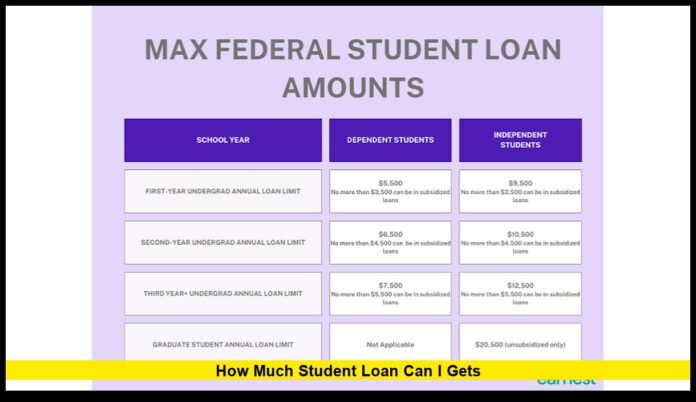
For undergraduate students, the standard Direct Loan limits have not changed under the 2026 federal loan revisions.
| Student status | First year | Second year | Third year and beyond | Total undergraduate limit |
|---|---|---|---|---|
| Dependent undergraduate | $5,500 | $6,500 | $7,500 | $31,000 |
| Independent undergraduate | $9,500 | $10,500 | $12,500 | $57,500 |
These limits include Direct Subsidized and Direct Unsubsidized Loans.
For dependent undergraduate students, the aggregate limit is generally $31,000, with no more than $23,000 available in subsidized loans. Independent undergraduate students have a higher aggregate limit of $57,500, with the same $23,000 subsidized-loan maximum.
The annual limits are maximum federal amounts. They do not guarantee that every student will receive the full amount.
What Determines Your Student Loan Amount?
Your federal loan eligibility is based on more than your tuition bill.
The school considers your financial aid eligibility, cost of attendance, enrollment status, other financial assistance, previous federal borrowing, and applicable annual and lifetime loan limits.
For example, imagine a student has a $20,000 annual cost of attendance. After scholarships, grants, and other financial assistance, only $6,000 remains to cover eligible expenses. The student may not be offered the full federal annual loan maximum if the remaining amount is lower than that limit.
This means the maximum published loan amount should be viewed as a ceiling rather than a guaranteed payment.
Dependent vs. Independent Students
Dependency status is one of the most important factors affecting undergraduate borrowing limits.
Dependent students generally have lower federal Direct Loan limits because the federal financial aid system assumes parents may contribute toward their education costs.
Independent students have higher limits because they are not expected to receive the same level of parental financial support.
A student may qualify as independent under federal rules based on circumstances such as age, military service, marital status, graduate or professional enrollment, having dependents, or certain other qualifying situations.
The FAFSA determines dependency status using federal financial aid rules. Simply living away from your parents or paying your own college expenses does not automatically make you an independent student for federal aid purposes.
Subsidized and Unsubsidized Student Loans
Federal undergraduate borrowing can include both subsidized and unsubsidized Direct Loans.
A Direct Subsidized Loan is generally available to eligible undergraduate students who demonstrate financial need. The federal government generally covers accruing interest during qualifying periods while the borrower is enrolled at least half-time and during certain other eligible periods.
Direct Unsubsidized Loans are not based on demonstrated financial need. Interest generally begins accruing after the loan is disbursed, including while the student is enrolled.
Because interest treatment differs, students should understand which portion of their financial aid package is subsidized and which portion is unsubsidized.
Graduate Student Loan Limits Changed in 2026
One of the biggest changes for the 2026–27 academic year involves graduate and professional students.
Beginning July 1, 2026, new federal borrowing limits apply to graduate and professional students. The traditional Graduate PLUS program is no longer generally available to new borrowers under the new system, subject to applicable transition provisions.
For standard graduate students, the federal Direct Unsubsidized Loan limit is generally:
- $20,500 per academic year
- $100,000 aggregate for graduate study
This is a significant change for students attending programs where annual tuition and living expenses can exceed the new federal borrowing limit.
Students who previously depended on Graduate PLUS borrowing to cover the remaining cost of attendance may need to consider scholarships, institutional aid, savings, employer assistance, payment plans, or other financing sources.
Higher Limits for Certain Professional Programs
Certain professional programs have a separate federal borrowing limit.
Eligible professional students can generally borrow up to:
- $50,000 per academic year
- $200,000 aggregate
The higher limit does not apply simply because a program is described as professional by a college. Federal rules determine which programs qualify for the professional-student category.
This distinction can be particularly important for students planning careers that require advanced degrees. The classification of the specific program can affect the amount of federal financing available.
Students considering graduate or professional school should therefore ask their financial aid office how their program is categorized before building a financing plan around a particular borrowing amount.
New Lifetime Federal Student Loan Cap
Another important 2026 change is a new lifetime maximum aggregate limit for federal student borrowing.
Beginning with the 2026–27 award year, the lifetime maximum for eligible federal student borrowing is generally $257,500. The calculation covers applicable federal student loans received across undergraduate, graduate, and professional education.
The lifetime cap can become important for borrowers who complete several degrees or borrow significant amounts for graduate and professional education.
Reaching the lifetime maximum can affect eligibility for additional federal student loans even if the borrower still has education expenses.
Certain loan types and specific exceptions are treated differently under the federal rules, so students with substantial prior borrowing should review their individual federal loan history before assuming they can borrow up to a new annual maximum.
Parent PLUS Loans Also Have New Limits
Parents who help finance a dependent student’s education face new federal borrowing limits as well.
For new Parent PLUS borrowing, the general limit is now:
- $20,000 per academic year for each dependent undergraduate student
- $65,000 aggregate per dependent undergraduate student
This represents a major change from the previous structure, under which Parent PLUS borrowing could generally reach the student’s remaining eligible cost of attendance after other financial aid.
The new limits mean families may need to plan earlier for the total cost of a college education.
There are also specific exceptions and transition rules. For example, certain dependent students may qualify for additional unsubsidized borrowing when a parent is unable to obtain a Parent PLUS loan because of an adverse credit decision.
2026–27 Federal Student Loan Interest Rates
Borrowing limits are only one part of the cost of a student loan. The interest rate also determines how much a borrower ultimately repays.
For federal loans first disbursed during the 2026–27 federal award year, the fixed rates are:
| Loan type | 2026–27 interest rate |
|---|---|
| Direct Subsidized and Unsubsidized Loans for undergraduates | 6.52% |
| Direct Unsubsidized Loans for graduate and professional students | 8.07% |
| Direct PLUS Loans | 9.07% |
Federal student loan interest rates are set annually for loans first disbursed during the applicable period. Once a particular federal loan is disbursed, its fixed interest rate generally remains unchanged for the life of that loan.
The interest rate therefore matters when comparing how much to borrow and how quickly to repay the debt.
Does the FAFSA Tell You How Much You Can Borrow?
The FAFSA is an important part of the federal financial aid process, but it does not simply approve a fixed loan amount for every student.
After submitting the FAFSA, the school uses the student’s information to prepare a financial aid package. The package may contain grants, scholarships, work-study, federal loans, and other forms of assistance.
The student’s school then determines the amount of federal student loan eligibility based on the applicable rules.
A student should review the actual financial aid offer rather than assuming that the federal maximum is automatically available.
Can Your School Give You Less Than the Maximum?
Yes.
Federal loan limits establish the maximum amount a student may receive, but a school can offer a lower amount.
Several circumstances can lead to a smaller loan offer.
For example, your remaining cost of attendance may be lower than the federal annual limit after other financial aid is considered. Your enrollment may also affect the amount you can receive.
Schools may also have institutional policies affecting how financial aid is packaged, provided those policies comply with federal requirements.
As a result, the number in a federal loan-limit table is not necessarily the amount that will appear on your financial aid offer.
What If You Need More Money for College?
Students who reach their federal borrowing limit may have several alternatives.
Scholarships and grants are generally attractive sources of college funding because they do not normally require repayment. Students can also investigate school-based scholarships, state financial aid programs, employer tuition assistance, and work-study opportunities.
Some schools offer payment plans that allow families to spread tuition payments over several months.
Private student loans are another option, although they operate differently from federal loans. Private lenders determine their own underwriting requirements, interest rates, loan amounts, repayment options, and eligibility standards.
Students should compare the total cost of borrowing instead of focusing only on how much money a lender is willing to provide.
How to Avoid Borrowing More Than You Need
A larger loan offer can make it tempting to borrow the full amount. However, every dollar borrowed can increase future repayment obligations.
Before accepting a federal student loan, calculate how much money you actually need for the upcoming academic period.
Start with tuition and required fees. Then estimate reasonable expenses for housing, food, books, transportation, supplies, and other eligible education costs.
Subtract scholarships, grants, savings, employment income, and other available resources.
The remaining amount can provide a better starting point for determining how much you need to borrow.
If your school offers more federal loan money than you require, you generally do not have to accept the entire amount.
How to Check Your Remaining Federal Loan Eligibility
Students who have borrowed previously should review their federal student loan history before taking out another loan.
Your previous borrowing can count toward annual or aggregate limits. This is especially important for students moving from undergraduate education into graduate or professional programs.
Keeping track of cumulative borrowing can also help prevent surprises when you reach a federal limit.
Your school’s financial aid office can explain how much annual eligibility remains and whether previous loans affect your current eligibility.
What Students Should Know About 2026 Borrowing Rules
The 2026 student loan landscape is different from previous years, particularly for graduate students, professional students, and parents.
Undergraduate Direct Loan limits remain at the familiar annual levels, but new federal lifetime limits and changes to graduate and Parent PLUS borrowing can affect families planning for higher education over several years.
Students entering graduate school should pay particular attention to the new annual and aggregate limits. Families financing undergraduate education should also consider the new Parent PLUS caps when calculating how much of the total college cost can realistically be covered through federal borrowing.
The key is to look at the complete financial aid package rather than focusing on one loan limit.
Final Takeaway
For most undergraduate students, federal Direct Loan limits in 2026 range from $5,500 to $12,500 per academic year depending on year in school and dependency status. The standard undergraduate aggregate limits are $31,000 for dependent students and $57,500 for independent students.
Graduate students generally face a $20,500 annual federal Direct Unsubsidized Loan limit and a $100,000 aggregate limit, while eligible professional students can generally access up to $50,000 annually and $200,000 in aggregate.
Parents using Parent PLUS loans for dependent undergraduate students also face new limits of generally $20,000 annually and $65,000 overall per student.
The exact amount available to an individual borrower can be lower because schools consider cost of attendance, other financial aid, enrollment, previous borrowing, and federal eligibility requirements.
Understanding these limits before accepting a loan can help students and families build a more realistic college financing plan and avoid taking on unnecessary debt.