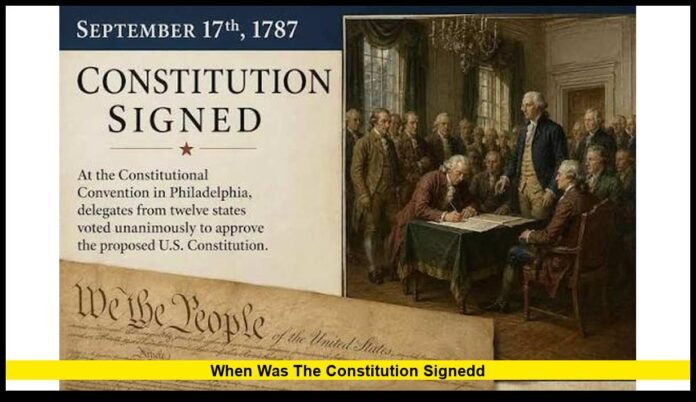

For anyone searching when was the constitution signed, the key date is September 17, 1787. On that day, delegates at the Constitutional Convention in Philadelphia placed their signatures on the completed U.S. Constitution, bringing months of debate and negotiations to a close. The signing marked a major turning point in the creation of the federal government, although the document still had to pass through the state ratification process before it could take effect.
The Constitution remains the foundation of the U.S. federal government. More than two centuries after its signing, its original parchment pages remain preserved in Washington, D.C., while September 17 is observed each year as Constitution Day and Citizenship Day.
The Constitution Was Signed in Philadelphia
The signing occurred at the Pennsylvania State House, the building now known as Independence Hall in Philadelphia.
The Constitutional Convention had assembled there in 1787 with an initial goal of addressing problems within the Articles of Confederation, the nation’s first governing framework after independence. Delegates soon concluded that simply modifying the Articles would not adequately address the country’s political and economic problems.
Instead, they began creating an entirely new system of government.
The convention formally reached a quorum on May 25, 1787. Over the following months, delegates debated representation, federal authority, taxation, executive power, the judiciary and the relationship between national and state governments.
Those discussions eventually produced the Constitution that was approved and signed in September.
September 17 Marked the End of the Convention
The final stage of the convention came after months of closed-door negotiations.
Delegates approved the final draft on September 15, 1787. The parchment copy then had to be prepared for the signing ceremony. The engrossed document was completed in time for September 17.
On that Monday, delegates gathered at the State House and signed the Constitution.
The document contained four pages of parchment. Its text established a federal government divided into legislative, executive and judicial branches and included a system designed to prevent any one branch from exercising unlimited authority.
The signing did not mean that the Constitution immediately became the nation’s operating law. Instead, it formally completed the convention’s work and began the next major phase: ratification by the states.
How Many People Signed the Constitution?
There were 55 delegates who attended sessions of the Constitutional Convention, but only 39 ultimately became signers.
On September 17, 38 delegates physically signed the document. George Read of Delaware also signed on behalf of John Dickinson, who was absent, bringing the total number of signatures to 39.
George Washington, who presided over the convention, was the first to sign.
The group included several prominent figures in early American history, including Benjamin Franklin, James Madison, Alexander Hamilton, James Wilson, Gouverneur Morris and Roger Sherman.
However, the signing ceremony did not have unanimous support among the delegates.
Why Some Delegates Refused to Sign
Three delegates who were present at the convention declined to put their names on the Constitution: George Mason of Virginia, Elbridge Gerry of Massachusetts and Edmund Randolph of Virginia.
One major concern was the absence of a bill of rights.
The Constitution established the structure and powers of the federal government, but the original document did not contain the first ten amendments that Americans now know as the Bill of Rights. Concerns about individual liberties became a significant issue during the subsequent ratification debates.
Thomas Jefferson and John Adams also did not sign the Constitution, but neither was attending the Philadelphia convention. Both were serving diplomatic assignments in Europe.
Signing Was Not the Same as Ratification
One of the most important facts surrounding the Constitution’s history is that signing and ratification were separate events.
Article VII established a specific procedure for bringing the new system into operation. The Constitution required ratification by conventions in nine of the 13 states.
This meant that the delegates’ signatures alone did not put the new government into effect.
The document was sent into the public arena for debate. Supporters and opponents argued over the proposed government’s powers, representation and protections for individual liberties.
The ratification campaign became a major political debate across the states.
New Hampshire Supplied the Ninth Ratification
Delaware became the first state to ratify the Constitution on December 7, 1787.
Pennsylvania followed five days later, and New Jersey ratified on December 18. Georgia and Connecticut also approved the document before the end of the year.
The process continued through 1788.
On June 21, 1788, New Hampshire became the ninth state to ratify the Constitution. That action met the requirement established by Article VII and made the Constitution binding on the ratifying states.
Virginia and New York subsequently joined the new constitutional system, while North Carolina and Rhode Island completed their ratifications after the new federal government had already begun operating.
When Did the Constitution Actually Become the Basis of the New Government?
The answer depends on which milestone is being discussed.
The document was signed on September 17, 1787. The required ninth state ratified it on June 21, 1788. The federal government established under the Constitution began proceedings on March 4, 1789.
That distinction helps explain why the signing date should not be confused with the date the new federal government began operating.
George Washington was inaugurated as the first president under the Constitution on April 30, 1789, in New York City.
The Bill of Rights Came Later
The first ten amendments were not part of the document signed in Philadelphia in 1787.
During the ratification debate, concerns about individual rights helped fuel demands for amendments. James Madison later introduced proposed amendments in Congress.
Congress approved 12 amendments and sent them to the states. Ten were ultimately ratified and became the Bill of Rights in December 1791.
These amendments addressed protections involving freedom of speech and religion, due process, searches and seizures, criminal proceedings and other individual liberties.
As a result, the constitutional framework Americans recognize today developed through multiple stages rather than being completed entirely on September 17, 1787.
Why September 17 Is Constitution Day
September 17 is now officially recognized as Constitution Day and Citizenship Day.
The annual observance commemorates the signing of the Constitution and recognizes American citizenship. Educational institutions and federal agencies use the occasion to highlight the history and significance of the founding document.
The date also provides a reminder that the Constitution was created through extensive debate and compromise among representatives of states with different interests.
The Constitution’s Structure Still Defines Federal Government
The document signed in Philadelphia established three branches of the federal government.
Article I created Congress and addressed legislative powers.
Article II established the presidency and executive authority.
Article III established the federal judiciary and Supreme Court.
The Constitution also established mechanisms involving federalism, elections, amendments and relationships between the national government and the states.
Its framework has been modified over time through amendments and interpreted through legislation, judicial decisions and constitutional practice.
The Constitution in the United States Today
The original Constitution is preserved as one of the nation’s most important founding documents. Its four parchment pages are maintained by the National Archives in Washington, where they remain a central part of the country’s documentary heritage.
The Constitution has also been amended 27 times. The amendments have addressed major issues ranging from individual rights and voting to presidential succession and congressional procedures.
Despite the changes made through amendments, the original 1787 document remains the starting point for understanding the structure of the U.S. government.
The Bottom Line on the Constitution’s Signing Date
The answer to when was the constitution signed is September 17, 1787.
The signing took place at the Pennsylvania State House in Philadelphia at the conclusion of the Constitutional Convention. Thirty-eight delegates signed in person, while George Read signed for the absent John Dickinson, producing 39 signatures in total.
The event was a major milestone, but it was not the final step in establishing the constitutional government. Nine states had to ratify the document, a threshold reached when New Hampshire approved it on June 21, 1788. The new federal government began operating under the Constitution on March 4, 1789.
More than two centuries later, September 17 continues to be recognized as Constitution Day and Citizenship Day, connecting a historic signing ceremony in Philadelphia with the continuing constitutional framework of the United States.