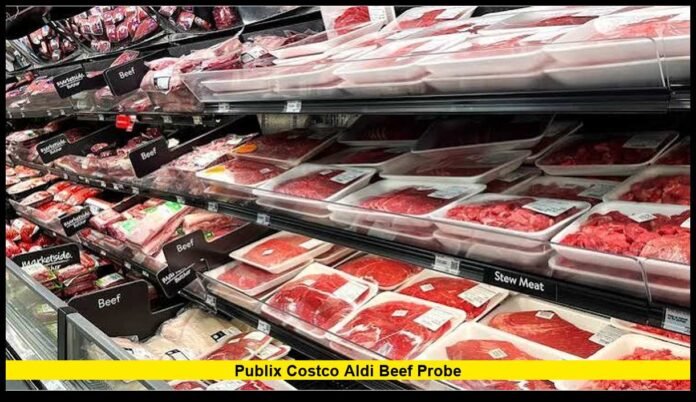

publix costco aldi beef probe has expanded into a broader federal examination of retail beef pricing across the United States. The Department of Justice has brought eight major grocery retailers into its ongoing investigation into beef affordability, extending scrutiny beyond meat processors and into the stores where Americans buy beef.
The retailers now included are Publix, Costco, Aldi, Walmart, Kroger, Albertsons, Ahold Delhaize USA and Amazon. Federal officials are seeking information about retail beef prices, purchasing activity, costs, margins and pricing strategies.
The development arrives as beef remains one of the most expensive items in many American grocery carts. Federal inflation data show that beef and veal prices were 9.4% higher in July 2026 than a year earlier.
That sharp increase has placed additional attention on every stage of the beef supply chain.
The latest federal action does not establish that any of the eight retailers committed an antitrust violation. Instead, investigators are collecting information to understand why retail beef prices have risen so substantially and whether competition problems may be contributing to those increases.
Why the Beef Investigation Has Expanded to Retailers
The Justice Department originally focused its investigation on major beef processors.
The investigation examined JBS, Cargill, Tyson Foods and National Beef. Those four companies occupy a dominant position in U.S. beef processing, handling roughly 85% of grain-fed cattle that become many of the beef products sold to consumers.
The retail expansion changes the scope of the investigation.
Rather than examining only what happens at processing facilities, federal officials are now looking at what happens after beef reaches major retailers.
That distinction is important because the price paid by a consumer reflects several stages of the supply chain.
Cattle producers sell animals into the market. Processors turn cattle into beef products. Retailers purchase those products and sell them through stores and online channels.
Each stage can affect the final price.
The Justice Department wants more information about the retail stage as it continues examining the reasons behind high beef costs.
Publix, Costco and Aldi Among Eight Retailers
The federal inquiry now includes eight major retail companies.
The list consists of:
- Publix
- Costco
- Aldi
- Walmart
- Kroger
- Albertsons
- Ahold Delhaize USA
- Amazon
Publix, Costco and Aldi stand out because each has a significant U.S. grocery operation but uses a different retail model.
Publix operates traditional supermarkets, particularly across the Southeast. Costco operates membership warehouse clubs with a large grocery business. Aldi uses a discount-focused format with a comparatively streamlined product selection.
Those differences could give investigators useful information when comparing retail pricing behavior.
The government can examine whether changes in beef costs and retail prices followed similar patterns across different companies.
The comparison may also help investigators understand whether higher prices reflect broader market conditions or differences in individual retailers’ pricing and purchasing practices.
What the DOJ Is Asking Retailers to Provide
The information requests cover the retailers’ beef operations.
Federal investigators are seeking data involving retail beef sales and prices. They also want information about wholesale purchases and prices.
The requests extend to costs and margins for beef products.
Pricing and purchasing strategies are also part of the inquiry.
The retailers have also been asked about their analysis of wholesale and retail beef-price trends.
The requests reach back to 2020 and extend into 2026.
That long period gives investigators the ability to examine pricing patterns before and during the recent surge in beef prices.
A six-year review can show whether changes in retail pricing followed changes in wholesale costs or moved differently.
It can also help investigators examine how margins changed as beef prices climbed.
Why the 2020-2026 Period Matters
The period under review covers major changes in the U.S. food market.
The beef industry experienced supply disruptions, changing consumer demand, inflation and continuing pressure from tight cattle supplies during these years.
Beef prices did not move in isolation.
Retailers faced changes in wholesale costs and other expenses while consumers faced broader increases across the grocery sector.
By examining multiple years of data, federal investigators can establish a baseline for normal pricing patterns.
The data can also show how individual retailers responded when beef costs increased.
This is one reason the information requested from Publix, Costco and Aldi could be important to the investigation.
The government is not simply looking at today’s shelf prices.
It is examining the history behind those prices.
Beef Prices Remain Well Above Year-Earlier Levels
The investigation comes at a time when consumers are already paying considerably more for beef.
The latest available federal Consumer Price Index data cover July 2026.
Beef and veal prices increased 9.4% over the previous year.
Several categories recorded even larger increases.
Uncooked beef steaks were up 9.6% from a year earlier. Uncooked beef roasts increased 13.5%.
Ground beef also remained significantly more expensive.
The federal data showed the average price of ground beef at about $6.89 per pound in July.
These increases are particularly noticeable because food shoppers often use ground beef, steaks and roasts as staples for household meals.
When those products rise faster than overall inflation, consumers feel the difference quickly.
The broader all-items Consumer Price Index increased 3.4% over the same 12-month period.
Beef therefore continued to rise substantially faster than overall consumer prices.
What Is Driving the Pressure on Beef Prices?
The Justice Department’s investigation is examining whether competition issues may be contributing to beef prices.
However, market supply remains a major factor.
The U.S. cattle herd has contracted sharply over recent years.
Fewer cattle can mean less beef available for processors.
When supplies are tight, processors compete for available cattle. Higher cattle costs can then work their way through the supply chain.
Retailers may ultimately face higher wholesale prices.
This creates an important distinction in the federal investigation.
A high grocery-store price does not automatically indicate illegal conduct.
Prices can rise because of legitimate supply and demand forces.
The DOJ is examining whether additional factors involving market structure or business practices have also contributed to the situation.
Why Cattle Supplies Matter to the Investigation
The U.S. cattle supply has reached historically tight levels.
Years of herd reductions have limited the number of cattle available for slaughter.
Rebuilding the herd also takes time.
A producer cannot rapidly increase cattle supplies in response to a sudden increase in beef prices. Raising additional cattle requires years of breeding and production.
That means the supply shortage cannot be solved immediately.
Tight supplies can therefore keep pressure on beef prices even if retailers compete aggressively.
The federal investigation must consider that market reality when evaluating retail prices.
This is particularly important for Publix, Costco and Aldi because each retailer purchases beef in a market affected by the availability of cattle and processed beef.
The Difference Between an Investigation and a Finding of Wrongdoing
The inclusion of Publix, Costco or Aldi in a federal investigation does not mean the companies have been found guilty of price fixing.
The Justice Department has requested information from the retailers.
That is different from announcing charges or a final enforcement action.
No federal finding has established that Publix illegally manipulated beef prices.
The same applies to Costco and Aldi.
The current confirmed development is that all three retailers are included in the expanded investigation.
Consumers should therefore be cautious about social-media claims suggesting that the DOJ has already determined that these companies engaged in illegal conduct.
The investigation remains a fact-finding process.
Future action would depend on what federal investigators discover.
Publix’s Role in the Retail Beef Inquiry
Publix is one of the largest supermarket operators in the United States and has a particularly strong presence in the Southeast.
Its inclusion gives investigators access to information from a traditional supermarket operation.
The government can examine how Publix’s beef purchasing costs changed between 2020 and 2026.
It can also examine how those costs compared with retail prices.
The investigation can look at margins and pricing strategies as well.
Those records could help federal officials understand whether Publix’s pricing movements reflected broader wholesale market conditions or followed a different pattern.
There has been no announced finding that Publix violated antitrust law.
Its presence in the investigation reflects the wider retail scope adopted by the Justice Department.
Costco’s Role in the Investigation
Costco brings a different business model into the federal review.
The warehouse retailer sells large volumes of grocery products through its membership-based stores.
Its beef business is therefore relevant to questions about retail pricing, purchasing and margins.
Federal investigators can compare Costco’s beef data with information from traditional supermarkets and discount grocers.
That comparison could provide a broader picture of how retailers responded to the same underlying wholesale market.
If beef costs rose across the industry, investigators can examine how retail prices moved in response.
If margins changed significantly, those changes could also become part of the federal analysis.
At present, there is no announced finding that Costco engaged in unlawful pricing activity.
The company is part of the information-gathering stage of the expanded inquiry.
Aldi’s Role in the Beef Probe
Aldi is another major retailer included in the Justice Department’s request for information.
Its discount-oriented business model makes it a useful point of comparison with other large retailers.
Investigators are seeking information about Aldi’s beef sales and prices, wholesale purchases, costs, margins, and pricing and purchasing strategies.
The company is also being asked to provide analysis concerning wholesale and retail beef-price trends.
That information could help federal officials compare pricing behavior across retailers operating under different business models.
Aldi’s participation in the investigation does not mean federal officials have accused the company of price fixing.
The government is seeking records as part of the larger beef affordability review.
The Earlier Focus on Major Meatpackers
The retail expansion follows the DOJ’s earlier investigation into the country’s largest beef processors.
JBS, Cargill, Tyson Foods and National Beef have been at the center of federal scrutiny.
The four companies collectively control roughly 85% of the U.S. grain-fed cattle slaughter market tied to many retail beef products.
The high concentration has attracted government attention because a relatively small number of processors handle a large share of the market.
The DOJ has previously said it reviewed more than three million documents and interviewed industry participants during the investigation.
That work provides the foundation for the expanded retail inquiry.
Federal officials can now examine whether developments at the processing level correspond with what retailers experienced when purchasing beef.
Tyson Settlement Adds Context
The broader beef investigation also follows legal disputes involving meat processors.
Tyson Foods agreed earlier in 2026 to pay $82.5 million to resolve a proposed class-action lawsuit brought by grocery retailers and other businesses.
The case involved allegations that Tyson conspired to inflate beef prices by restricting supply.
The settlement did not establish that the company committed wrongdoing.
That distinction is important when discussing the current federal investigation.
The DOJ’s retail inquiry remains separate from a private civil settlement.
Federal investigators are now examining information from major retailers as they continue looking into beef pricing and competition.
What the Retail Data Could Tell Investigators
The information from Publix, Costco and Aldi could help answer several important questions.
One issue is whether retail prices moved in line with wholesale costs.
Another is whether retail margins changed substantially during periods of rising beef prices.
Investigators can also examine purchasing arrangements with meat suppliers.
Pricing strategies are another area of interest.
The DOJ can compare these factors across multiple retailers.
That could help distinguish industry-wide price pressure from company-specific pricing patterns.
The investigation may also provide insight into how the retail sector responded to the same cattle shortage and wholesale market conditions.
Could the Investigation Lower Beef Prices?
There is no immediate government order requiring Publix, Costco, Aldi or the other retailers to lower beef prices.
The investigation itself does not create a guaranteed price reduction.
Any future effect would depend on the results of the federal review.
If investigators identify conduct that violates antitrust law, the government could pursue appropriate enforcement action.
If the evidence instead shows that high prices primarily reflect tight cattle supplies and other legitimate costs, the investigation could lead to a different conclusion.
For consumers, the important point is that no final outcome has been announced.
The review is still underway.
What Consumers Should Know Right Now
For Americans shopping for beef, the current situation can be summarized simply.
Publix, Costco and Aldi are among eight major retailers included in the DOJ’s expanded beef investigation.
Federal officials are examining pricing, purchasing, costs, margins and related market information.
The requests cover activity from 2020 through 2026.
Beef prices remain significantly higher than they were a year earlier.
At the same time, the U.S. cattle supply remains tight, creating legitimate upward pressure on beef costs.
The federal government has not announced that Publix, Costco or Aldi committed an antitrust violation.
There is also no announced requirement for the retailers to immediately reduce prices.
The investigation is instead aimed at understanding how prices are formed across the retail and processing sides of the beef market.
What Comes Next for the Publix Costco Aldi Beef Probe
The next major step will be the federal review of information supplied by the retailers.
That information can be compared with the evidence already collected from the meat-processing industry.
Investigators will be looking for patterns in wholesale costs, retail prices, margins and purchasing arrangements.
The broader goal is to determine whether the U.S. beef market is functioning competitively and whether any unlawful conduct has contributed to higher prices.
For Publix, Costco and Aldi, their inclusion places their beef operations under the same federal spotlight as several other major grocery businesses.
For consumers, the investigation offers the possibility of greater clarity about one of the most noticeable grocery-price increases in recent years.
But the final answer will depend on the evidence.
For now, the confirmed story is that federal scrutiny has moved deeper into the retail beef market while beef prices remain elevated and cattle supplies remain constrained.
Have you noticed higher beef prices at Publix, Costco or Aldi? Share your experience and stay informed as this federal investigation develops.