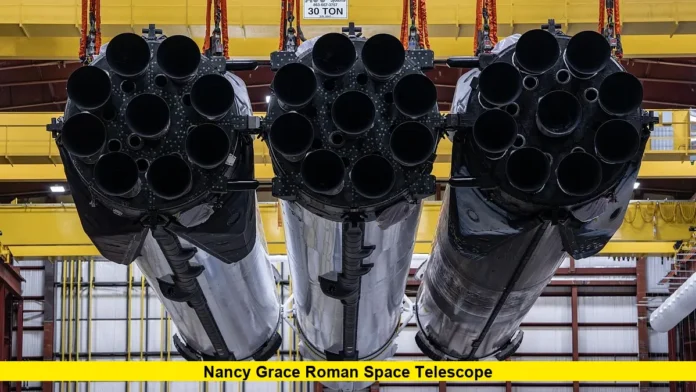

The Nancy Grace Roman Space Telescope is at the center of one of NASA’s most important space missions of 2026. As of the latest NASA update on August 30, 2026, the telescope is on the launch pad at NASA’s Kennedy Space Center in Florida, with liftoff targeted for 7:26 a.m. EDT today aboard a SpaceX Falcon Heavy rocket.
NASA’s live launch coverage has already begun, and the mission is currently progressing toward the planned launch window. The U.S. Space Force’s 45th Weather Squadron had most recently improved the weather outlook to 70% favorable conditions.
The mission is significant because Roman is designed to conduct enormous surveys of the universe, helping scientists investigate dark energy, dark matter, galaxies, exoplanets and the evolution of the cosmos.
Nancy Grace Roman Space Telescope Latest Update
The latest official NASA information shows that the Nancy Grace Roman Space Telescope remains targeted for launch on Sunday, August 30, 2026, at 7:26 a.m. EDT.
The spacecraft is enclosed inside the payload fairing of a SpaceX Falcon Heavy at Launch Complex 39A at Kennedy Space Center.
NASA’s launch broadcast began at 6:20 a.m. EDT, with the agency providing live coverage as teams worked through the final stages of the countdown. NASA reported that weather conditions had improved to a 70% “go” assessment shortly before the launch preparations moved forward.
NASA’s official launch schedule identifies several critical milestones leading to liftoff, including propellant loading, liquid oxygen loading, engine chilldown, final flight-computer checks, tank pressurization and ignition.
If the countdown proceeds as planned, Roman is scheduled to separate from the Falcon Heavy approximately 31 minutes and 31 seconds after liftoff.
At the time of this latest update, the launch had not yet occurred, so it would be inaccurate to describe Roman as already launched.
When Will the Nancy Grace Roman Space Telescope Launch?
NASA and SpaceX are targeting the following launch time:
- Date: Sunday, August 30, 2026
- Target liftoff: 7:26 a.m. EDT
- UTC: 11:26 a.m. UTC
- Rocket: SpaceX Falcon Heavy
- Launch site: Launch Complex 39A, Kennedy Space Center, Florida
- Destination: Sun-Earth Lagrange Point 2, or L2
NASA’s official Roman mission page continues to list August 30 at 7:26 a.m. EDT as the launch target.
A backup launch opportunity is available on Monday, August 31, if the Sunday attempt cannot proceed. Space.com reported the backup target as approximately 7:22 a.m. EDT.
Why Is the Nancy Grace Roman Space Telescope Important?
Roman is being developed to answer some of astronomy’s biggest questions.
One of its primary objectives is to investigate dark energy, the poorly understood phenomenon associated with the accelerating expansion of the universe.
Scientists also want Roman to improve their understanding of dark matter, which cannot be directly observed with conventional telescopes but whose gravitational influence affects galaxies and large-scale cosmic structures.
Roman will combine a very wide field of view with high-resolution infrared observations. That combination will allow researchers to survey enormous areas of the sky much faster than earlier space telescopes.
NASA says Roman’s surveys will map billions of galaxies while providing data that can be used for studies ranging from cosmology and black holes to stars and planetary systems.
Nancy Grace Roman Space Telescope and Dark Energy
Dark energy is one of the biggest mysteries in modern cosmology.
Scientists know that the expansion of the universe is accelerating, but they do not yet understand the underlying cause. Roman will study this problem by making large-scale observations of galaxies and the distribution of matter across cosmic history.
By examining how galaxies are distributed and how cosmic structures evolved, researchers hope to place tighter constraints on competing explanations for cosmic acceleration.
Roman’s wide-area surveys are particularly important because studying the universe on a massive scale can reveal patterns that smaller observations may miss.
The mission is therefore not simply another deep-space imaging project. It is designed to produce a statistical view of the universe that can help scientists test fundamental ideas about cosmology and gravity.
Roman Will Study Dark Matter
Dark matter is another major target for the mission.
Although dark matter does not emit or reflect light in a way that conventional telescopes can directly detect, its gravitational effects can be observed through the behavior of galaxies and other cosmic structures.
Roman will survey large portions of the sky and measure how matter is distributed. Those observations will help researchers investigate how galaxies formed and evolved and how dark matter shaped the large-scale structure of the universe.
NASA describes Roman’s mission as an effort to trace the influence of dark matter while mapping how galaxies form, cluster and change over cosmic time.
Nancy Grace Roman Space Telescope and Exoplanets
Roman will also play an important role in the search for planets beyond our solar system.
One of its major techniques will be gravitational microlensing. When a star passes in front of a more distant star from Earth’s perspective, its gravity can magnify the background star’s light. A planet orbiting the foreground star can produce a small additional signal.
By conducting a large microlensing survey, Roman is expected to find thousands of planets and help scientists build a statistical picture of planetary systems throughout the Milky Way.
NASA estimates that Roman’s surveys could uncover approximately 100,000 new exoplanets.
This could include planets that are difficult to find using other methods, including distant worlds and potentially free-floating or rogue planets that do not orbit a star.
Roman’s Coronagraph Could Directly Image Exoplanets
Another particularly interesting part of the mission is Roman’s Coronagraph Instrument.
A coronagraph is designed to block or suppress the overwhelming light coming from a star so that much fainter objects near the star can potentially be observed.
Roman’s coronagraph is an advanced technology demonstration intended to test techniques that could eventually support future missions designed specifically to directly image Earth-like planets.
This makes Roman important not only for its immediate science objectives but also for the development of future space observatories.
How Does Roman Compare With Hubble and James Webb?
Roman is not designed to replace the Hubble Space Telescope or the James Webb Space Telescope.
Instead, the three observatories provide complementary capabilities.
Hubble has transformed astronomy through decades of high-resolution observations across multiple wavelengths. Webb provides exceptionally powerful infrared observations and is optimized for detailed studies of distant galaxies, stars, planets and other objects.
Roman will focus heavily on wide-field surveys.
That means Roman can examine huge sections of the sky and collect enormous datasets, while Webb can then potentially conduct more detailed follow-up observations of individual objects identified by surveys.
NASA describes Roman as a next-generation observatory with a deep, panoramic view of the cosmos.
Where Will the Roman Space Telescope Go?
After launch, Roman will travel approximately 1 million miles from Earth toward the second Sun-Earth Lagrange point, known as L2.
L2 is located about 1.5 million kilometers from Earth on the side of Earth opposite the Sun.
This location is also associated with the operating environment used by the James Webb Space Telescope.
Once Roman reaches its destination, it will undergo a lengthy commissioning process involving spacecraft deployments, instrument activation, calibration and testing.
NASA expects the commissioning period to take approximately three months.
What Happens After Roman Launches?
The launch is only the beginning of the mission.
According to NASA’s published flight plan, the Falcon Heavy’s side boosters are expected to separate shortly after liftoff and return to landing zones at Cape Canaveral.
The second stage will perform additional burns to place Roman on its trajectory.
Approximately 31 minutes and 31 seconds after liftoff, Roman is scheduled to deploy from the rocket.
After separation, the spacecraft will begin a carefully planned sequence of deployments and checks.
NASA says Roman will then travel toward L2 while the mission team completes the spacecraft’s deployment, activation, calibration and testing activities.
Only after those steps are completed will Roman begin its primary scientific observations.
Roman Is Launching Ahead of Earlier Plans
One notable aspect of the current mission is how quickly Roman has reached launch.
NASA says Roman is launching nine months ahead of schedule. Earlier in August, NASA reported that teams had begun integrated operations with SpaceX hardware in preparation for the mission.
By August 25, the encapsulated telescope had been moved to the SpaceX hangar at Launch Complex 39A.
NASA subsequently confirmed that the mission had passed its Launch Readiness Review and was “go” for launch on August 28.
On August 29, the Falcon Heavy carrying Roman was moved to the launch pad and raised vertically in preparation for the countdown.
Who Was Nancy Grace Roman?
The telescope is named after Nancy Grace Roman, an influential NASA astronomer who played a major role in establishing the agency’s space astronomy program.
Roman became known as NASA’s first chief astronomer and was instrumental in advancing the development of space-based astronomical observatories.
Her work helped establish the scientific foundation and organizational support that eventually contributed to missions such as Hubble.
Naming NASA’s next major space observatory after her recognizes her role in making space-based astronomy a central part of modern astrophysics.
How to Watch the Nancy Grace Roman Space Telescope Launch
NASA began live coverage at 6:20 a.m. EDT on August 30, ahead of the targeted 7:26 a.m. EDT liftoff.
The agency is providing coverage through NASA+ and other official NASA platforms. NASA’s launch coverage page provides the latest webcast information and mission updates.
Because launch schedules can change during the final countdown, viewers should rely on NASA and SpaceX for the latest status rather than assuming that the published target time guarantees liftoff.
What Could the Roman Space Telescope Discover?
The most exciting aspect of Roman may be discoveries that scientists cannot predict today.
The telescope is designed to survey such enormous areas of the universe that researchers expect it to reveal unexpected objects and phenomena.
Potential discoveries could include:
- Previously unknown exoplanets
- Rogue planets
- New insights into galaxy formation
- Previously unidentified black holes
- Better measurements of cosmic expansion
- New clues about dark matter
- Improved constraints on dark energy
- Unexpected transient astronomical events
- New populations of stars and galaxies
The mission’s enormous public scientific archive could also allow researchers around the world to investigate questions that have not yet been formulated.
That is one reason Roman is being described as a major survey observatory rather than simply another powerful space telescope.
Nancy Grace Roman Space Telescope Latest Status
As of the latest verified NASA information available on August 30, 2026, the Nancy Grace Roman Space Telescope is in the final countdown for its planned launch aboard SpaceX’s Falcon Heavy.
NASA’s latest launch update says the telescope is standing vertically at Launch Complex 39A, while live coverage is underway. Weather conditions had improved to a 70% favorable assessment shortly before the countdown entered its critical phases.
The planned liftoff remains 7:26 a.m. EDT on August 30.
Because the target time had not yet arrived at the time of the latest verified NASA update, the mission should be described as pre-launch, rather than already in orbit.
If the launch proceeds successfully, Roman will begin its journey toward L2 and eventually start a scientific program expected to reshape studies of dark energy, dark matter, galaxies and planetary systems.
The telescope’s first major results will take time because deployment, commissioning and calibration must be completed before full scientific operations begin. But the launch itself marks the beginning of a mission expected to generate an extraordinary amount of astronomical data for scientists and the public.
The Nancy Grace Roman Space Telescope is about to open a much wider window on the universe—share your thoughts on what you think Roman will discover, and stay tuned for the latest mission updates.