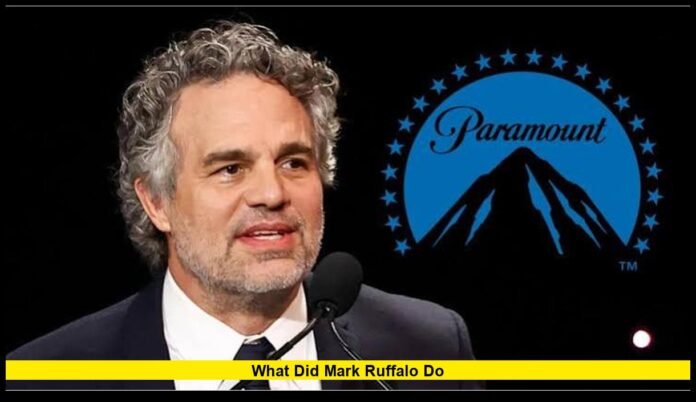

What did Mark Ruffalo do? The actor recently criticized Paramount Skydance, the Ellison family, and Oracle over their connections to a proposed Warner Bros. Discovery merger and technology provided to Israel, triggering a public dispute over accusations of antisemitism.
The controversy has quickly become one of Ruffalo’s most prominent recent public disputes. It centers on social-media comments he made while challenging Paramount Skydance’s proposed acquisition of Warner Bros. Discovery, a transaction valued at roughly $110 billion.
Paramount responded by accusing Ruffalo of invoking antisemitic tropes. Ruffalo rejected that characterization and said his criticism targeted government actions, military technology contracts, and corporate decision-making rather than Jewish people.
As of the latest update, there is no verified finding that Ruffalo committed a crime or that he has been formally disciplined by a government authority over the comments. The dispute remains a public argument between the actor and Paramount, with other entertainment figures taking positions on both sides.
Why Mark Ruffalo Is in the News
Ruffalo entered the latest controversy after publicly criticizing the proposed Paramount Skydance acquisition of Warner Bros. Discovery.
The actor has argued that the transaction raises questions about media consolidation, political influence, corporate power, and editorial independence. He also connected the proposed merger to Oracle because Oracle co-founder Larry Ellison is the father of Paramount Skydance CEO David Ellison.
Ruffalo’s criticism went beyond the business side of the transaction.
He shared a video involving Oracle executive vice chair Safra Catz discussing technology supplied by Oracle to Israel after the Hamas-led October 7, 2023, attack. Ruffalo used the post to criticize the Ellison family’s business and political connections and to express opposition to the proposed media merger.
The comments prompted Paramount Skydance to issue a strong response.
The company accused Ruffalo of using antisemitic rhetoric and objected to his use of terms including “genocide” and “apartheid” in discussing Israel and the wider corporate relationship.
That response moved the dispute from a debate about a corporate merger into a broader argument about antisemitism, criticism of Israel, and the boundaries of political speech by public figures.
What Did Mark Ruffalo Do on Social Media?
To understand what happened, it is important to separate Ruffalo’s verified actions from the accusations made against him.
Ruffalo posted material on social media criticizing the proposed Paramount-Warner Bros. transaction. He also highlighted Oracle’s relationship with Israel and questioned the involvement of the Ellison family in the media deal.
His posts connected several issues that he believes deserve public scrutiny:
- Paramount Skydance’s proposed acquisition of Warner Bros. Discovery
- David Ellison’s leadership of Paramount Skydance
- Larry Ellison’s role as Oracle co-founder
- Oracle’s technology and contracts involving Israel
- The potential concentration of media power
- Concerns about editorial independence and political influence
- The broader Israel-Gaza conflict
Ruffalo’s argument was political and corporate in nature. He did not announce that he had taken physical action against Paramount or Warner Bros. Discovery.
Instead, he used his public platform to criticize the people and companies connected to the proposed transaction.
The actor’s comments became controversial because Paramount interpreted some of the language as invoking antisemitic tropes. Ruffalo strongly rejected that interpretation.
Why Did Paramount Accuse Ruffalo of Antisemitism?
Paramount’s accusation followed Ruffalo’s criticism of the Ellison family and Oracle.
The studio argued that his comments crossed a line by linking Jewish individuals and institutions to controversial political and military activity. Paramount also objected to his references to Israel’s conduct in Gaza and to the use of terms such as “genocide” and “apartheid.”
The company described his remarks as antisemitic rather than simply political criticism.
That distinction is central to the dispute.
Ruffalo, however, said the accusation was fundamentally dishonest. In his response on X, he argued that criticizing the actions of an Israeli prime minister, a military technology contract, or executives involved with such contracts does not amount to hostility toward Jewish people.
Ruffalo also said his views came from his political convictions and emphasized his respect for Jewish people.
The dispute therefore involves competing interpretations of the same public comments. Paramount says Ruffalo’s language crossed into antisemitic rhetoric, while Ruffalo says his criticism was directed at political and corporate actions.
There has not been a government ruling establishing Paramount’s allegation as fact.
What Did Mark Ruffalo Do After Paramount Responded?
Ruffalo did not withdraw his criticism.
Instead, he responded publicly and rejected the accusation.
His response emphasized that he distinguishes between criticism of Israeli government policy and hostility toward Jewish people. He also defended his right to discuss military technology, corporate contracts, and the proposed media merger.
The actor’s response became another major part of the controversy because it made clear that he intended to continue challenging the merger and the relationships he believes are relevant to it.
Reuters footage published in connection with the controversy shows Ruffalo rejecting the antisemitism accusation and describing it as “appalling and fundamentally dishonest.”
Ruffalo’s response also referenced his relationships with Jewish friends, colleagues, and loved ones. He said those relationships have influenced his understanding of acting, activism, and humanism.
The statement did not end the controversy.
Instead, it generated additional reactions from actors and entertainment-industry figures.
Other Actors Have Defended Mark Ruffalo
The dispute has attracted support from several people in Hollywood.
Actor John Cusack publicly expressed solidarity with Ruffalo after Paramount’s accusation. People reported that Cusack rejected the characterization of Ruffalo’s comments as antisemitic.
Paul Walter Hauser has also been identified among those supporting Ruffalo’s position.
Hannah Einbinder has separately defended Ruffalo. Her comments focused on what she viewed as the distinction between criticism of political and corporate power and attacks based on Jewish identity.
At the same time, critics of Ruffalo’s statements have argued that his language was inappropriate and relied on harmful stereotypes.
That disagreement is important because the current controversy does not have a single accepted interpretation across Hollywood.
Instead, Ruffalo’s comments have become part of a larger debate involving Israel, antisemitism, corporate power, media ownership, and political speech.
How the Warner Bros. Merger Fits Into the Controversy
The Paramount-Warner Bros. dispute is central to understanding why Ruffalo made the comments.
Paramount Skydance has proposed acquiring Warner Bros. Discovery for approximately $110 billion. The transaction would combine major entertainment assets and create one of the largest media companies in Hollywood.
The deal has faced major antitrust scrutiny.
In July, a coalition of 12 state attorneys general sued to block the transaction. The states argued that combining Paramount and Warner Bros. Discovery could reduce competition in film and television and harm consumers, workers, theaters, and other businesses.
The coalition includes California, New York, Washington, Arizona, Minnesota, and other states.
The states’ argument is separate from Ruffalo’s personal criticism, but it helps explain why the merger has become a major political and entertainment-industry issue.
California Attorney General Rob Bonta has been particularly outspoken against the transaction.
On July 20, a federal court issued a temporary restraining order preventing Paramount Skydance from completing the merger while the legal proceedings continued.
The legal situation remained active in August.
The Merger Has Received Regulatory Approvals Too
One important detail is that the merger’s regulatory history is complicated.
Paramount Skydance announced on August 14 that it had obtained regulatory clearances required under its merger agreement after reviews in 68 countries. The company said those approvals included the European Union, United Kingdom, Australia, Canada, Brazil, China, Mexico, and the U.S. Department of Justice.
Those approvals did not end the legal fight.
A coalition of U.S. states continued challenging the transaction in court.
That distinction matters when discussing Ruffalo’s comments. The actor has criticized the merger, but the transaction itself is also the subject of independent legal proceedings that do not depend on Ruffalo.
The state’s lawsuit represents a government antitrust challenge, while Ruffalo’s statements represent the political and personal views of a prominent actor.
Why Oracle Is Part of the Story
Oracle’s involvement is another major piece of the controversy.
Larry Ellison co-founded Oracle, while his son David Ellison leads Paramount Skydance.
Ruffalo highlighted Oracle’s relationship with Israel while criticizing the proposed media transaction. He referenced comments from Safra Catz, Oracle’s executive vice chair and former CEO, concerning technology provided to Israel following the October 7, 2023, attack.
Oracle has supplied technology to Israeli government and military entities. That relationship has become a point of criticism from activists who oppose Israel’s military campaign in Gaza.
Ruffalo used that corporate relationship to argue that the proposed Paramount-Warner Bros. transaction deserves broader scrutiny.
Paramount rejected his framing.
The studio’s response focused on what it described as antisemitic elements in his rhetoric rather than accepting his characterization of the corporate relationships.
That disagreement is the immediate reason Ruffalo has remained in the headlines.
What Did Mark Ruffalo Do That Is Actually Confirmed?
For readers searching for a straightforward answer, the confirmed sequence is relatively clear.
Ruffalo criticized the proposed Paramount Skydance acquisition of Warner Bros. Discovery.
He criticized the Ellison family’s business connections and highlighted Oracle’s relationship with Israel.
He shared a video involving Safra Catz discussing Oracle technology provided to Israel.
Paramount responded by accusing him of using antisemitic tropes.
Ruffalo rejected the accusation and defended his comments as political and corporate criticism.
Other actors and public figures subsequently expressed support for Ruffalo.
Those are the central verified developments.
It would be inaccurate to describe the situation as an established finding that Ruffalo is antisemitic. That is Paramount’s characterization of his remarks, which Ruffalo has explicitly denied.
It would also be inaccurate to say that Ruffalo was arrested, charged, fired from a major production, or legally punished because of the dispute. No such verified development has been reported in the latest coverage.
Did Mark Ruffalo Commit a Crime?
There is no verified indication that Ruffalo committed a crime through the comments at the center of the controversy.
The dispute is primarily about political speech, social-media posts, corporate criticism, and allegations of antisemitic rhetoric.
Being accused of antisemitism is not the same as being convicted of a crime.
The current reporting describes a public confrontation between Ruffalo and Paramount. It does not establish criminal wrongdoing by the actor.
That distinction is especially important because online discussions can quickly transform allegations into statements of fact.
For now, the verified information supports describing Ruffalo as an actor who made controversial political and corporate comments, faced a public accusation from Paramount, and then denied the allegation.
Why the Controversy Has Become So Significant
Ruffalo is not simply commenting on an ordinary corporate acquisition.
The Paramount-Warner Bros. transaction has implications for the U.S. entertainment industry, including film production, television, streaming, cable networks, theaters, workers, and consumers.
The state attorneys general challenging the deal have argued that the combined company could control nearly one-third of U.S. theatrical motion pictures and nearly one-third of basic cable programming.
That makes the transaction significant even without Ruffalo’s involvement.
His comments have added another layer because they connect the merger to questions about political influence and international affairs.
Paramount, meanwhile, has argued that Ruffalo’s language crossed a serious line.
The resulting dispute has therefore brought together several highly sensitive subjects at once.
The Latest Status as of August 26, 2026
The latest update is that Ruffalo continues to reject Paramount’s antisemitism accusation.
The controversy has not resulted in a verified criminal charge against him.
The Paramount-Warner Bros. merger also remains subject to legal and political scrutiny in the United States. On August 25, California Attorney General Rob Bonta said settlement talks with Paramount were not currently scheduled after a dispute over confidential negotiations. Reuters reported that the antitrust case could proceed toward trial if the parties do not reach a resolution.
That development keeps the merger dispute active.
It also means Ruffalo’s criticism remains relevant to an ongoing corporate and legal battle rather than a transaction that has already been completed.
At the same time, the public disagreement over his comments continues independently of the antitrust case.
Paramount maintains its criticism of Ruffalo’s remarks. Ruffalo maintains that his comments were aimed at political actions, corporate relationships, and military technology rather than Jewish people.
The Bottom Line
So, what did Mark Ruffalo do?
He publicly opposed the proposed Paramount Skydance acquisition of Warner Bros. Discovery and used social media to criticize the Ellison family’s corporate connections, including Oracle’s relationship with Israel. His posts prompted Paramount to accuse him of invoking antisemitic tropes.
Ruffalo strongly rejected that accusation.
He argued that criticizing Israeli government policy, military technology contracts, and corporate executives is different from attacking Jewish people. Several entertainment figures have publicly supported his position, while critics continue to object to his language.
The most important point is that the controversy involves an accusation and a denial, not a confirmed finding of criminal wrongdoing.
Meanwhile, the larger Paramount-Warner Bros. merger remains tied up in legal and regulatory disputes, making the subject likely to remain in the spotlight.
What do you think about the Mark Ruffalo controversy and his criticism of the Paramount-Warner Bros. merger? Share your thoughts in the comments and stay updated as the dispute develops.