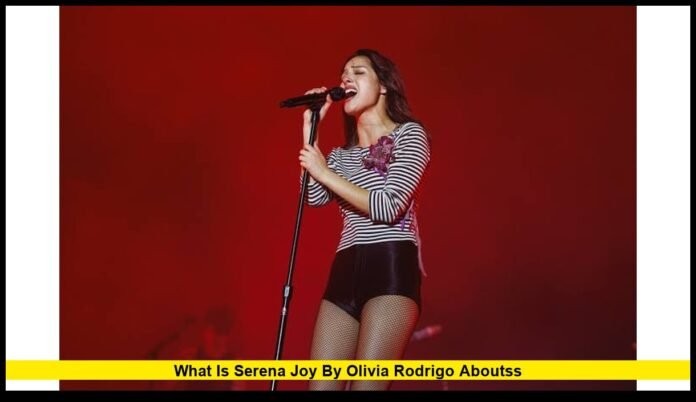

What is Serena Joy by Olivia Rodrigo about? The newly released song is a politically charged, punk-spirited track inspired by Serena Joy Waterford, the complicated character from Margaret Atwood’s The Handmaid’s Tale. Rather than simply retelling the fictional character’s story, Rodrigo uses Serena Joy as a symbol of complicity, privilege, political complacency and the danger of supporting an oppressive system without considering where that system could ultimately lead.
The song has become one of Rodrigo’s most intriguing releases because it combines literary inspiration with a direct social message. It was written with longtime collaborator Dan Nigro during sessions for Rodrigo’s third studio album, you seem pretty sad for a girl so in love, but it was ultimately left off the finished record. In August 2026, Rodrigo unexpectedly brought the track back into the spotlight, first through an extremely limited physical release and then with its worldwide streaming debut.
Key Points Summary
╔════════════════════════════════════════════════════════════════════╗
║ – “Serena Joy” takes its name from Serena Joy Waterford in Margaret Atwood’s The Handmaid’s Tale. ║
║ – Olivia Rodrigo uses the character to examine complicity, privilege, conformity and the consequences of ignoring injustice. ║
║ – The song was written with Dan Nigro during sessions for Rodrigo’s third studio album but did not make the final track list. ║
║ – The track received a highly limited CD release before becoming available globally on streaming services. ║
║ – Its release comes just before Rodrigo’s Daisy Chain Fields festival, giving the song an especially strong connection to its themes of women’s rights and collective action. ║
╚════════════════════════════════════════════════════════════════════╝
Who Is Serena Joy Waterford?
Serena Joy Waterford is a former public figure whose beliefs are closely connected to the ideology that establishes Gilead, an authoritarian society where women are stripped of fundamental freedoms and assigned rigid social roles.
Her character is deliberately complicated.
She is not presented simply as a powerless victim. Serena Joy has influence and status, and she participates in a political and religious movement that helps create the society around her. Yet the same system eventually restricts her own choices.
That contradiction is central to understanding Rodrigo’s song.
Serena Joy represents what can happen when somebody supports a powerful system because they believe they will benefit from it, only to discover that the system’s rules can eventually become restrictive for everyone.
The Main Meaning Behind “Serena Joy”
At its heart, the song is a warning about complacency.
Rodrigo’s message centers on the idea that people should not assume injustice is irrelevant simply because it is happening to someone else.
The track presents a world in which people can remain distracted by entertainment, comfort and everyday pleasures while serious problems develop around them. That contrast gives the song its urgency.
The message can be interpreted as:
If society accepts the removal of another person’s rights, nobody should assume they will always remain outside the consequences.
That idea closely mirrors Serena Joy’s journey in The Handmaid’s Tale.
She initially benefits from the social order that develops around her. But eventually, she experiences restrictions created by the very ideology she helped support.
Rodrigo turns that fictional contradiction into a broader political warning.
Why Olivia Rodrigo Chose Serena Joy as the Title
The title is more than a reference to a popular television character.
Serena Joy is useful as a symbol because her story contains an important contradiction: she has a role in creating and supporting an oppressive structure, yet she is ultimately constrained by it.
That makes her an unusually effective character for a song about political indifference.
Rodrigo could have written a conventional protest song with a straightforward political message. Instead, she chose a recognizable literary figure whose story already carries complicated questions about power and responsibility.
The result is a song that asks listeners to think about how systems are created, who supports them and what happens when those systems become impossible to control.
The Importance of Complicity
One of the strongest themes surrounding “Serena Joy” is complicity.
The song does not focus exclusively on people who openly commit injustice. It also considers those who stand nearby, remain comfortable or assume that the consequences will never affect them.
That is an important distinction.
Oppressive systems rarely depend only on the people at the very top. They can also depend on people who accept gradually changing rules, look away from discrimination or decide that someone else’s suffering is not their concern.
Serena Joy embodies that complicated position.
She is powerful enough to influence the system, but she eventually discovers that participating in it does not guarantee permanent protection.
Rodrigo’s song uses that contradiction to create a much wider message about responsibility.
A Warning About “Us” and “Them”
Another major idea in the song is the danger of dividing society into people who deserve protection and people who do not.
The song’s central warning suggests that mistreatment does not necessarily remain confined to its original targets.
Once a society accepts the idea that one group can lose rights or freedoms, the same principle can potentially be applied elsewhere.
That makes the track’s message broader than the story of Gilead.
It can be read as a reminder that civil rights and personal freedoms are interconnected. Protecting one group is not merely an act of sympathy toward strangers; it can also be part of protecting the principles that affect everyone.
Why the Song Has a Punk Feel
“Serena Joy” has been described as a track with a punk spirit, giving it an angrier and more urgent character than some of Rodrigo’s more introspective pop songs.
That musical approach suits the subject.
Punk music has a long history of questioning authority, confronting social problems and challenging political complacency. A song about refusing to ignore injustice naturally fits within that tradition.
The energy of the track also separates it from the romantic storytelling that dominates much of Rodrigo’s catalog.
Instead of concentrating on a breakup or the emotional aftermath of a relationship, “Serena Joy” turns its attention toward society itself.
Why It Was Not Included on Rodrigo’s Album
“Serena Joy” originated during the creative period surrounding Rodrigo’s third studio album, you seem pretty sad for a girl so in love.
However, the song ultimately did not belong to the album’s main narrative.
The record is strongly connected to romantic experiences and the emotional progression of a relationship. “Serena Joy” moves in an entirely different direction.
Its focus is political, social and collective rather than primarily personal.
That difference helps explain why the song can sound like a separate chapter of Rodrigo’s songwriting rather than a missing piece of the album.
The decision to leave it off the record did not mean the song had disappeared permanently.
Instead, it remained an unreleased track until Rodrigo found a new context for it.
The Surprise 2026 Release
The song’s eventual release was anything but conventional.
On August 21, 2026, Rodrigo made “Serena Joy” available as a limited-edition CD at Analog Music Shop in Tustin, California.
Only 500 copies were produced for the initial physical release, making the track instantly attractive to collectors and dedicated fans.
The limited release also created an unusual situation for a major pop artist: a new song existed physically in a tiny quantity before it was broadly available to the public.
The move generated considerable fan attention because many listeners knew the title but had not previously been able to hear the finished recording.
“Serena Joy” Is Now Available Globally
The biggest development came on August 24, 2026, when Rodrigo officially released “Serena Joy” worldwide on streaming platforms.
That transformed the song from an ultra-limited collector’s item into a widely accessible release.
The timing is significant because it arrives only days before Rodrigo’s inaugural Daisy Chain Fields festival in Irvine, California.
The release therefore feels connected to a larger moment in Rodrigo’s career rather than simply being an old song finally uploaded to streaming services.
How Daisy Chain Fields Connects to the Song
Daisy Chain Fields is scheduled for August 29, 2026, at Great Park in Irvine.
The festival is built around women in music and includes an all-women lineup alongside nonprofit organizations, vendors, art experiences and community activities.
The event’s focus is supporting women and girls, with net proceeds directed toward organizations working on issues affecting them.
That context makes “Serena Joy” particularly relevant.
A song inspired by a character from The Handmaid’s Tale naturally connects to discussions about women’s autonomy, political power and the consequences of restricting women’s rights.
The timing gives the release an additional layer of meaning.
Rather than arriving without context, the song enters the public conversation immediately before an event centered on women, music and activism.
Is “Serena Joy” a Feminist Song?
It can certainly be interpreted that way.
The song draws inspiration from a story that is fundamentally concerned with women’s freedom and institutional control. Its central character is part of a society that drastically restricts women while also discovering that even privileged women are not immune from its rules.
Those ideas make feminism an important part of the song’s interpretation.
However, “Serena Joy” is not limited to one issue.
It also deals with political responsibility, privilege, silence, social division and the consequences of accepting injustice.
Its feminist themes therefore operate alongside a larger argument about how people respond when their society begins changing in troubling ways.
How the Song Fits Olivia Rodrigo’s Career
Rodrigo has established herself as an artist capable of moving between intensely personal songwriting and larger cultural commentary.
Her earliest major hits were often driven by heartbreak, jealousy, frustration and coming-of-age experiences.
As her career has developed, her music has increasingly demonstrated an interest in wider social issues.
“Serena Joy” is significant because it places that side of her songwriting front and center.
The song is not built around a romantic confession. Its subject is a fictional woman, an authoritarian society and the behavior of people who watch political change unfold around them.
That makes it one of the more outward-looking songs in Rodrigo’s recent body of work.
Why Fans Are Interested in the Lyrics
The song’s lyrics have attracted attention because they contain a direct warning about the spread of injustice.
Rather than describing oppression as something distant and abstract, Rodrigo frames it as something capable of moving from one group to another.
That makes the song easy to connect with the central idea behind Serena Joy’s character.
Listeners familiar with The Handmaid’s Tale are likely to recognize the reference immediately, while people unfamiliar with the story can still understand the song as a warning about political complacency.
This gives “Serena Joy” two levels of meaning.
On one level, it is a song inspired by a specific fictional character.
On another, it is a broader commentary about what happens when people allow injustice to become normalized.
What Is Serena Joy by Olivia Rodrigo About? A Closer Look at the Message
For listeners searching for a simple explanation, what is Serena Joy by Olivia Rodrigo about can be answered in one sentence: it is a warning against complacency and complicity, using Serena Joy from The Handmaid’s Tale to illustrate how supporting an oppressive system can ultimately have consequences for everyone.
But the song goes beyond that basic interpretation.
It asks listeners to think about privilege and whether personal security is meaningful when other people’s rights are being taken away.
It also challenges the assumption that political decisions remain confined to the people initially targeted by them.
That is what makes the song’s title so effective.
Serena Joy is not merely a character Rodrigo happens to reference. She represents a contradiction: someone who believes she has a protected place inside a system, only to discover that the system’s rules can eventually turn against her.
Why the Timing Matters in 2026
The release comes at a particularly important point in Rodrigo’s year.
Her third studio album has already established the emotional world she wanted to explore through the record. “Serena Joy” now provides an opportunity to highlight a different side of her artistic identity.
At the same time, Daisy Chain Fields is about to become a major live event.
The combination means the song arrives with a clear thematic backdrop.
The track’s message about women, power and social responsibility is being introduced just days before Rodrigo takes the stage at a festival designed around women in music and support for women and girls.
That makes the release feel intentional even though the song itself was recorded earlier.
Could “Serena Joy” Become a Major Fan Favorite?
It has several qualities that could give it a lasting place in Rodrigo’s catalog.
It has a distinctive literary reference, a politically charged message and a different sound from much of her relationship-focused material.
Its unusual release history also makes it memorable.
The fact that only 500 physical copies were initially available created a rare collectible moment around a contemporary pop single. Now that the track is globally available, a much larger audience can experience the song without needing one of those original CDs.
Whether it eventually becomes part of Rodrigo’s regular concert repertoire remains a separate question, but its connection to Daisy Chain Fields gives it an obvious opportunity for a high-profile live debut.
The Bigger Meaning of “Serena Joy”
Ultimately, Rodrigo’s song is less interested in Serena Joy as an individual than in what she represents.
She symbolizes the danger of assuming that power will always remain on your side.
She represents the contradiction of supporting a system that promises security while helping create restrictions that can eventually affect you.
And she becomes a warning against believing that another person’s loss of freedom has nothing to do with your own.
That makes “Serena Joy” a song about responsibility as much as protest.
Its central question is not simply whether a listener agrees with one political position. It is whether people are willing to pay attention when others are being harmed, even when they personally remain comfortable.
Final Takeaway
“Serena Joy” is one of Olivia Rodrigo’s most politically focused songs, using a well-known fictional character to explore the consequences of silence, privilege and participation in oppressive systems. Its connection to The Handmaid’s Tale gives the track a powerful narrative foundation, while its punk-inspired energy reinforces the sense of urgency.
The song’s unusual journey from an unreleased album outtake to a 500-copy CD and finally a global streaming release has made it a standout music story in August 2026.
Its arrival just before Daisy Chain Fields adds another important dimension. The festival’s focus on women in music and organizations supporting women and girls provides a natural setting for a song whose central themes involve women’s rights, power and collective responsibility.
Rather than simply asking listeners to identify with Serena Joy, Rodrigo appears to use her as a cautionary example. The broader lesson is that injustice does not always remain confined to the people who experience it first, and ignoring it does not guarantee protection from its eventual consequences.
What do you think Olivia Rodrigo is saying through “Serena Joy”? Share your interpretation and keep checking back for the latest music updates.