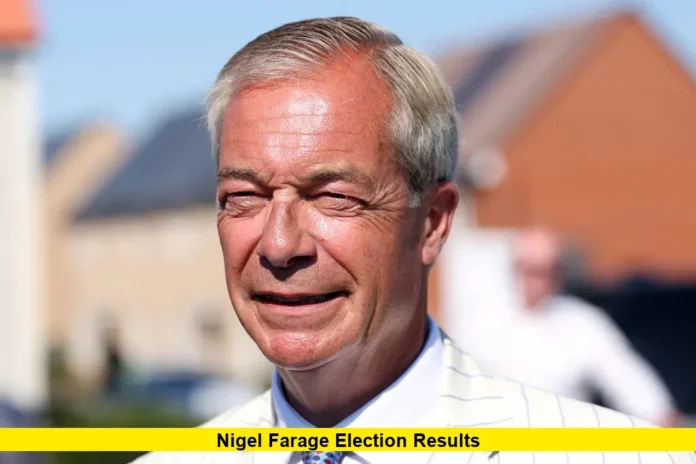

Nigel Farage election results confirmed a decisive victory for the Reform UK leader in the Clacton by-election held on August 13, 2026. Farage secured his return to the House of Commons just hours after polls closed, beating satirical candidate Count Binface and 32 other contenders in a race that major British parties refused to enter.
The declaration came shortly after 6:00 a.m. local time on August 14, 2026, at the count in Tendring, Essex. Farage received 22,239 votes, while Count Binface finished second with 9,455 votes. The remaining 32 candidates split the rest of the ballots in what officials called the largest field ever assembled for a single UK parliamentary contest.
Why Farage Triggered His Own By-Election
Farage did not lose his seat through a normal challenge. He resigned from Parliament voluntarily on July 8, 2026, one day after announcing his decision on July 7, 2026. He then chose to stand again in the resulting by-election.
The move followed scrutiny from the parliamentary standards commissioner. Investigators had been examining a £5 million gift Farage reportedly received before he first became an MP in 2024, along with broader questions about undeclared financial support.
Farage denied any wrongdoing throughout the process. He argued that voters in Clacton, not journalists or parliamentary watchdogs, should decide whether he stays in office. His resignation paused the standards probe. That investigation is expected to resume now that the by-election result is confirmed.
A By-Election the Major Parties Refused to Fight
One of the strangest features of this contest was who did not show up. Labour, the Conservatives, the Liberal Democrats, the Green Party, and Restore Britain all declined to field candidates against Farage.
Party officials described the by-election as a stunt designed to distract attention from the standards case rather than a genuine democratic test. Their absence left Count Binface, a well-known novelty candidate who has run in previous UK elections, as the closest thing to a serious opponent.
With no mainstream rival on the ballot, the field ballooned. A record 34 candidates were confirmed in the official Statement of Persons Nominated on July 17, 2026. That total broke the previous UK record of 26 candidates, set at the 2008 Haltemprice and Howden by-election.
How the Numbers Compare to 2024
Farage’s Clacton victory margin actually grew compared to his first win in the seat. Here is a side-by-side look at both contests:
| Election | Farage Votes | Vote Share | Runner-Up | Runner-Up Votes |
|---|---|---|---|---|
| 2024 General Election | 21,225 | 46.2% | Giles Watling (Conservative) | 12,820 |
| 2026 By-Election | 22,239 | Not yet finalized | Count Binface | 9,455 |
In 2024, Farage won Clacton on his eighth attempt at a Commons seat, defeating sitting Conservative MP Giles Watling by a margin of 8,405 votes. That victory made him a Reform UK MP for the first time and gave the party its initial foothold in Westminster.
The 2026 by-election result shows Farage widening his personal vote total even without a Conservative or Labour candidate splitting the anti-Reform vote in the traditional sense. Analysts note that turnout was notably lower this time, given the unusual, single-candidate-versus-novelty-field structure of the race.
Turnout Numbers Tell Their Own Story
Early estimates from the count put turnout at roughly 43%. For comparison, that figure sits close to turnout levels recorded at the 2008 Haltemprice and Howden by-election, the last UK contest where major parties similarly stepped aside.
Pre-election polling from Survation, conducted for Mandate Research and reported on August 2, 2026, had projected Farage capturing around 73% of the vote on a low turnout, with Count Binface trailing at roughly 20%. The same survey found that in a hypothetical scenario where major parties did field candidates, Clacton voters put Farage at about 56%, followed by the Conservatives at 10% and Labour at 8%.
Farage Responds to Disruption Claims
Farage described his win as a victory over establishment interference. He referenced what his campaign called an organized effort to disrupt the vote count, though full details of those claims had not been independently verified by election authorities as of the morning of August 14, 2026.
He framed the entire episode publicly as a “people versus Establishment” contest. Farage has used similar language throughout his political career, dating back to his time leading UKIP and later the Brexit Party, both predecessors to today’s Reform UK.
Political Reaction and What Comes Next
Reaction to the Nigel Farage election results split sharply along familiar lines. Supporters framed the outcome as proof that Farage retains a firm grip on Clacton voters despite months of negative headlines regarding his finances.
Critics offered a different reading. Some commentators, including political scientist Sir John Curtice, had predicted before polling day that Farage would win comfortably given Clacton’s strong pro-Brexit voting history. Others argued the low-turnout, boycotted format made any claim of a resounding mandate harder to sustain.
Reform UK enters the fall of 2026 riding high in national polling, having led surveys since early 2025. The party also made major gains in local elections held across England in May 2025, winning control of ten local authorities and hundreds of council seats.
A few key details from the broader Reform UK landscape heading into this by-election:
- Reform UK currently holds a handful of House of Commons seats gained in the 2024 general election.
- The party topped 20% of the national vote share in several recent polling averages.
- Local election gains in May 2025 gave Reform UK control of ten English councils.
- National polling has shown Reform UK ahead of both Labour and the Conservatives at various points since early 2025.
Standards Investigation Still Looms
Winning back his seat does not end Farage’s legal and procedural troubles. The parliamentary standards commissioner’s inquiry into the disputed £5 million gift was only paused, not closed, when Farage resigned in July.
With Farage now confirmed as Clacton’s MP once again, that investigation is expected to restart in the coming weeks. Any findings could reignite the same scrutiny that prompted this unusual by-election in the first place.
For now, Farage returns to Westminster with a fresh mandate and a bigger raw vote count than he received in 2024. Whether that translates into lasting political capital, or simply postpones a bigger reckoning over his finances, remains an open question heading into the rest of 2026.
Have thoughts on the Nigel Farage election results and what they mean for British politics? Share your take in the comments below.