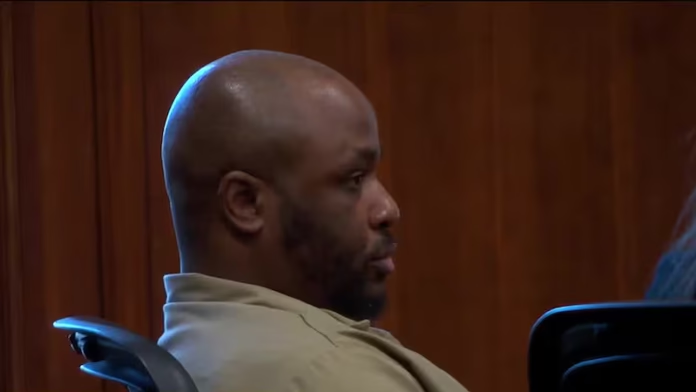

The Jeremy Williams execution in Alabama took place on August 13, 2026, closing a chapter on one of the most disturbing child murder cases in the Chattahoochee Valley in recent years. Williams, 42, was scheduled to die by lethal injection at approximately 6 p.m. CT at the William C. Holman Correctional Facility in Atmore, Alabama, for the December 2021 kidnapping, rape, and murder of 5-year-old Kamarie Holland. The case drew national attention not only because of the horrific nature of the crime but also because Williams voluntarily pleaded guilty, waived his appeals, and personally petitioned the state to move his execution forward.
Who Was Jeremy Williams
Jeremy Tremaine Williams was a Phenix City, Alabama resident with a documented history of child abuse allegations spanning several years before his conviction in the Kamarie Holland case. Court records reviewed during his trial revealed that Williams had previously been convicted of child abuse and sentenced to life in prison in a separate case. Investigators also said he had been a suspect in the 2005 death of his infant daughter in Alaska, although charges in that matter were reportedly not filed until 2022. During the Kamarie Holland trial, prosecutors presented additional evidence that Williams had abused another child roughly two decades earlier, a survivor who later came forward to investigators after Williams disclosed the earlier assault himself.
Williams pleaded guilty to all four capital murder counts against him on March 13, 2024. Because Alabama law requires a jury trial before a death sentence can be imposed, even in cases involving a guilty plea, the case still proceeded to trial so that prosecutors could present evidence to jurors. Williams reportedly instructed his defense attorneys not to object to the state’s evidence and not to present mitigating evidence on his behalf, a decision that left much of the trial process unusually one-sided. In April 2024, the jury found him guilty on all charges, and a judge subsequently sentenced him to death.
The Murder of Kamarie Holland
Kamarie Holland was reported missing from her mother’s home in Columbus, Georgia, on December 13, 2021, an event that triggered a large-scale search across the Chattahoochee Valley region spanning Georgia and Alabama. Investigators reviewing phone records determined that Williams and Kamarie’s mother, Kristy Siple, had been in contact the night before the child disappeared. According to prosecutors, Siple agreed to let Williams sexually abuse her daughter in exchange for $2,500 and, in some accounts, additional drugs, though the final negotiated amount and payment details varied across testimony.
Investigators tracked Williams’ cellphone to the Bamboo Motel on Opelika Road in Phenix City, where deputies found him along with his uncle. Authorities later obtained Williams’ phone and discovered videos recorded on the day of Kamarie’s disappearance, footage that reportedly documented the assault itself. The investigation led law enforcement to an abandoned home connected to Williams, where Kamarie’s body was found in a storage area behind the residence. Prosecutors said Williams had strangled the child and continued to abuse her body after her death, details that jurors described as some of the most disturbing evidence presented during the trial.
Kristy Siple, Kamarie’s mother, was separately charged in connection with her daughter’s death. On July 18, 2024, Siple was sentenced to 20 years in prison after pleading guilty to sex trafficking charges; in exchange for her plea, prosecutors dismissed a felony murder charge against her. She was also ordered to pay restitution and register as a sex offender following her eventual release.
Why Williams Waived His Appeals
What set the Jeremy Williams case apart from most Alabama death penalty cases was his decision to expedite his own execution. In April 2025, Williams appeared before Russell County Circuit Court Judge David Johnson and asked to waive nearly all of his remaining appeals, telling the judge he understood this would speed up his death sentence. Alabama death penalty cases typically take two decades or more to reach execution due to the standard appeals process, but Williams’ decision compressed that timeline dramatically.
The Alabama Court of Criminal Appeals upheld his conviction and death sentence on March 27, 2026. Because Alabama law requires an automatic appellate review in any capital case, this step could not be skipped even though Williams did not want to pursue it. Williams represented himself during this stage and did not file a brief challenging the ruling. On June 16, 2026, the Alabama Supreme Court found it appropriate to proceed with his execution despite receiving no evidence or argument regarding his background or mental health. Two days later, on June 18, Governor Kay Ivey set Williams’ execution date for August 13, 2026.
Robin Maher, executive director of the Death Penalty Information Center, described Williams’ choice to drop his appeals as highly unusual, noting that most death row inmates pursue every available avenue to delay or overturn their sentences. Investigators who worked the case said Williams had, in earlier conversations, expressed a desire to be put to death rather than continue serving time, a sentiment consistent with his later legal decisions.
Public Interest and Reaction
The case has generated significant public interest across Alabama and Georgia, particularly in the Columbus and Phenix City communities where Kamarie Holland’s disappearance was covered extensively in real time in December 2021. Corey Holland, Kamarie’s father, has remained a visible figure throughout the years-long legal process, including advocating for what he has called “Kamarie’s Law,” a proposed measure related to child protection. In the days leading up to the execution, Holland spoke publicly about being barred from witnessing Williams’ death due to a separate, unrelated indictment involving a custody dispute, calling the decision painful given his role as Kamarie’s father.
Russell County District Attorney Rick Chancey, who could not legally witness the execution himself under Alabama rules governing prosecutors, traveled to Atmore to be present with victims and family members outside the execution chamber. Chancey has described Williams as someone who caused “a tremendous amount of damage” over many years and said the cumulative weight of Williams’ history, not just the Kamarie Holland case alone, made his death sentence inevitable in the eyes of investigators.
The execution also drew attention because it coincided with two other scheduled executions on the same day, one in Tennessee and one in Oklahoma. If all three proceeded as planned, it would mark the first time in nearly 16 years that three separate executions occurred in the United States on a single day, a fact that added national context to local Alabama coverage of the Williams case.
Method of Execution and Safety Concerns
Williams’ execution was carried out by lethal injection, one of three methods currently authorized under Alabama law alongside electrocution and nitrogen hypoxia. Nitrogen hypoxia, a method Alabama had used in a small number of prior executions, was found unconstitutional in a ruling issued in June 2026 because of concerns that it causes inmates to suffocate. Lethal injection has itself been the subject of ongoing criticism in Alabama following a series of problematic executions in 2022, including one case that reportedly became the longest botched lethal injection in the country’s history, lasting roughly three hours.
Advocacy organizations, including the Death Penalty Information Center, have raised concerns about the lack of transparency in Alabama’s execution protocols. The Alabama Department of Corrections keeps details of its lethal injection drug combinations confidential, and the limited protocol information that has been released to the public is heavily redacted. Critics argue this secrecy makes it difficult to evaluate execution safety, while state officials maintain that current procedures meet legal and constitutional requirements.
Latest Updates
As of the most recent reporting, Jeremy Williams’ execution was scheduled for the evening of August 13, 2026, with his death warrant remaining valid through 6 a.m. on August 14, 2026. In the final 24 hours before his scheduled execution, Williams reportedly received visits from his wife, mother, father, stepmother, and brother, and spoke by phone with additional family members. There is no official confirmation available at this time detailing the exact time of death or Williams’ final statement, and readers should treat any unverified secondhand reports about the specific details of the execution itself with caution until official statements from the Alabama Department of Corrections or credible news outlets are published. This article will reflect confirmed details as they become available through verified sources.
Final Thoughts
The Jeremy Williams execution in Alabama represents the conclusion of a case that shocked communities on both sides of the Georgia-Alabama border and forced a painful public reckoning with the details of Kamarie Holland’s death. Williams’ decision to plead guilty, request the death penalty, and waive his appeals set his case apart from the majority of capital punishment proceedings in the state, compressing what typically takes decades into a period of roughly two years. For Kamarie’s family, particularly her father Corey Holland, the case has remained an ongoing source of grief and advocacy, even as questions about who was allowed to witness the execution added another layer of difficulty to an already painful process.
Beyond the individual case, the Williams execution has renewed broader conversations about Alabama’s execution methods, the transparency of its protocols, and the rare circumstance of a death row inmate actively working to speed up his own death. As more details emerge from official sources, the full picture of how the execution was carried out will become clearer.
Stay tuned for updates on this developing story, and share your thoughts in the comments below.