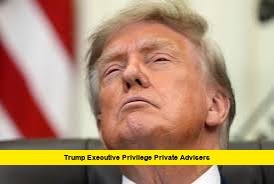

The Justice Department has opened a new front in the fight over presidential secrecy. On August 10, 2026, the Department of Justice’s Office of Legal Counsel (OLC) issued a 21-page opinion stating that President Donald Trump can invoke executive privilege to shield his confidential communications with private advisers who work entirely outside the federal government. The memo, first reported by Punchbowl News on August 11, 2026, marks the first time the Justice Department has explicitly extended executive privilege protections to individuals who hold no official government position, a significant break from decades of legal precedent that limited the privilege to the president and his immediate White House staff.
What the New OLC Memo Actually Says
The opinion lays out three conditions that must all be met before a communication with an outside adviser can be shielded under executive privilege. According to the memo, the protection applies when the communication relates to official presidential decision-making, involves or reflects communications with the president or his direct advisers, and remains confidential. The OLC defines “private advisers” broadly as individuals the president consults outside the executive branch, a category that could include business figures, longtime friends, outside lawyers, and informal political allies who never held a government title.
The memo argues that limiting executive privilege strictly to communications within the government would unfairly restrict the president’s ability to seek advice from a wide range of sources. The OLC wrote that restricting the privilege to purely intragovernmental communications would prevent the president from relying on outside voices he considers necessary to carry out his official duties.
Why This Is a Major Departure From Precedent
Executive privilege is not written into the Constitution. Instead, it stems from Supreme Court rulings recognizing that the separation of powers allows a president to keep certain communications confidential from Congress and the courts. The Supreme Court’s landmark 1974 ruling in United States v. Nixon established that the privilege is not absolute and does not apply in criminal proceedings, and for the five decades since, the protection has generally been understood to apply only to the president and his closest White House advisers.
Jonathan Shaub, a University of Kentucky law professor who previously served in the OLC during the Obama administration, told reporters that while the underlying legal position may echo past internal OLC thinking, it has never before been stated so publicly, because the office has historically understood how far outside the mainstream this interpretation is. Shaub also noted that the specific question of whether privilege can protect a president’s communications with outside advisers has never been directly tested in court, meaning the new memo is venturing into largely uncharted legal territory.
The Political Timing: Midterms and a Divided Congress
The timing of the memo is drawing significant attention in Washington. Democrats have publicly signaled plans to use subpoena power against companies, universities, and private citizens connected to the Trump administration if they retake control of the House of Representatives in the November 2026 midterm elections, a outcome many political analysts currently favor. The new OLC opinion could give the administration a fresh legal argument to resist those subpoenas before they are even issued.
Jonathan Shaub described the memo as potentially “a pretty significant weapon” for the administration to deflect congressional investigations into private parties connected to Trump. Government watchdog groups reacted with alarm. Scott Amey, general counsel for the Project on Government Oversight, said the move fits a broader pattern of the administration reducing transparency, pointing to prior actions such as cutting resources tied to public access to government information, removing information from public websites, and arguing that the Presidential Records Act itself is unconstitutional.
Senate Minority Leader Chuck Schumer responded sharply to the memo, saying that Trump is “scared” and that the move reflects the actions of someone with something to hide, framing it as evidence the administration is bracing for accountability efforts tied to the midterms.
Immediate Legal Application: The ABA Subpoena Fight
The new OLC opinion is not merely theoretical. It is already being deployed in an active legal dispute. The Trump administration is invoking the memo in an ongoing lawsuit brought by the American Bar Association, which issued a subpoena to Boris Epshteyn, Trump’s senior personal counsel, as part of litigation over deals the administration reportedly struck with law firms. The memo’s release appears timed to bolster the administration’s position in that case, giving DOJ lawyers a fresh legal basis to argue that Epshteyn’s communications should remain confidential.
Where the Privilege Claim Has Limits
Even supporters of the OLC’s reasoning acknowledge the opinion is not unlimited. The memo states that privilege only applies when communications relate to official presidential decision-making, which legal experts say creates a meaningful boundary. Jonathan Shaub suggested that investigations into Trump’s personal business interests, including his cryptocurrency holdings, would likely be harder for the administration to shield under this theory, since those matters fall outside the scope of official presidential functions rather than governmental decision-making.
Before the Trump administration, disputes over privilege protections for communications with private advisers were relatively rare, largely because past presidents did not routinely depend on individuals entirely outside the executive branch to help shape public policy. Legal observers note that Trump has consistently leaned on a wider, more informal network of outside allies, spanning members of Congress, business leaders, and longtime personal friends, which is part of why this legal question is surfacing now in a way it rarely has before.
Will the Courts Accept the Expanded Privilege Claim?
The central unresolved question is whether federal courts will actually uphold this broader definition of executive privilege. The OLC opinion itself is not legally binding on courts; it represents the Justice Department’s internal legal guidance to the executive branch, not a judicial ruling. Shaub, despite acknowledging the memo’s potential strategic value for the administration, expressed doubt that courts will ultimately accept the OLC’s theory when it is tested in litigation.
Legal analysts widely expect the policy to prompt court challenges, particularly if House Democrats gain subpoena power after the midterms and attempt to compel testimony or documents from Trump’s outside advisers. How judges rule on the boundaries of “official presidential decisionmaking” versus personal or business-related communications will likely determine how much practical protection the memo actually provides.
What Comes Next
With the November 2026 midterms approaching and the ABA lawsuit already testing the new legal theory, the coming months are likely to bring the first real court tests of this expanded executive privilege claim. If Democrats win back the House, expect subpoenas targeting individuals in Trump’s orbit to trigger swift privilege claims citing this memo, followed by litigation that could ultimately reach the appellate courts. For now, the OLC opinion stands as one of the most aggressive expansions of presidential secrecy claims in recent history, and its fate will hinge on how federal judges interpret a legal doctrine that the Supreme Court itself has never fully defined.
Stay tuned as this story develops. What do you think of the DOJ’s move to expand executive privilege to private advisers? Share your thoughts in the comments below and check back for the latest updates.