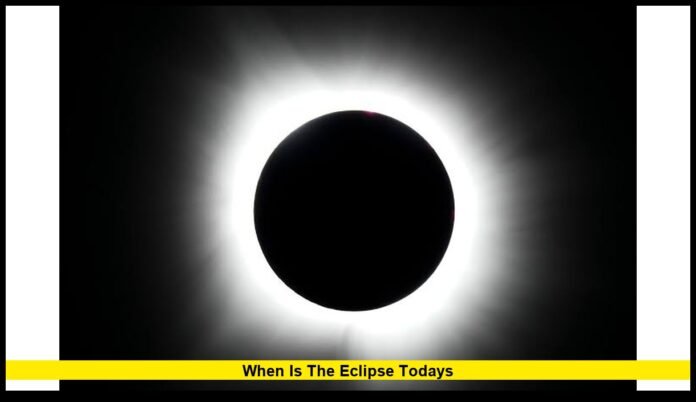

when is the eclipse today is one of the most searched questions as skywatchers around the world prepare for the only total solar eclipse of 2026. Taking place on Wednesday, August 12, the event will sweep across the Northern Hemisphere, bringing a spectacular period of darkness to parts of Greenland, Iceland, northern Spain and a small section of Portugal, while a much larger region will experience a partial solar eclipse.
╔════════════════════════════════════════════════════════════════════╗
║ – August 12, 2026, brings the only total solar eclipse of the year. ║
║ – Totality will cross parts of Greenland, Iceland, northern Spain and northeastern Portugal. ║
║ – Northern Russia and surrounding Arctic areas are also included in the path of totality. ║
║ – The longest total phase will last about 2 minutes and 18 seconds. ║
║ – Parts of the United States will see a partial eclipse, while many other regions will not see the event at all. ║
║ – The exact viewing time depends on the observer’s location. ║
║ – Proper solar viewing protection is essential during every partial phase. ║
╚════════════════════════════════════════════════════════════════════╝
August 12, 2026 Solar Eclipse: What Is Happening?
That alignment will happen today, creating a narrow corridor where observers can experience totality. Inside this corridor, daylight can rapidly fade as the Moon blocks direct sunlight. The Sun’s outer atmosphere, known as the corona, becomes visible around the dark silhouette of the Moon.
Outside the path of totality, the spectacle is different. The Moon will cover only part of the Sun, creating a partial solar eclipse. Depending on location, the amount of sunlight blocked can range from a small fraction to most of the solar disk.
The August 2026 eclipse is particularly significant because it is the year’s only total solar eclipse and because its path reaches several destinations with large populations and strong astronomy communities.
What Time Is the Eclipse on August 12?
There is no universal start time for the eclipse because the Moon’s shadow moves across Earth.
The event begins with a partial eclipse in one region before the shadow progresses toward other parts of the planet. Totality then arrives at different local times as the shadow travels across the Arctic, Greenland, Iceland and Europe.
For viewers in the United States, portions of Alaska begin experiencing the eclipse during the morning. In parts of the northeastern United States and Mid-Atlantic region, the partial eclipse occurs later in the day.
European observers see the event much later, with totality arriving in Iceland during the afternoon and reaching northern Spain during the evening.
The precise timing can differ considerably between nearby towns. Someone standing close to the centerline of the eclipse can experience a longer period of totality than someone only a few miles away.
For that reason, anyone planning to watch should check the timing for their specific city rather than relying on a general national schedule.
Where Will the Total Eclipse Be Visible?
The path of totality is narrow compared with the enormous region where a partial eclipse can be observed.
Today’s total eclipse crosses a remarkable collection of northern locations, including:
- Northern Russia
- Greenland
- Western Iceland
- The North Atlantic
- Northern Spain
- Northeastern Portugal
The eclipse then continues toward the Mediterranean region as the Moon’s shadow moves across the planet.
Greenland and Iceland are especially important viewing locations because they offer some of the clearest opportunities to experience totality before the eclipse reaches Europe.
Northern Spain is expected to attract enormous crowds, with cities and communities along the path preparing special viewing areas and astronomy events.
Total Solar Eclipse in Iceland
Iceland is one of the most anticipated destinations for the 2026 eclipse.
The eclipse crosses western parts of the country, allowing observers to experience the brief transition from daylight to totality. Reykjavík is also positioned close enough to the path to make the event particularly interesting for residents and visitors.
During totality, the sky can take on an unusual twilight-like appearance. The horizon may remain brighter in surrounding directions while the region immediately around the observer becomes noticeably darker.
The duration of totality varies from place to place. Locations closer to the center of the path receive a longer period of complete solar coverage.
Weather is an important factor for Icelandic observers. Even with perfect astronomical alignment, clouds can prevent a direct view of the Sun. That makes flexibility and access to alternative viewing locations especially valuable for eclipse travelers.
Spain Becomes a Major Eclipse Destination
Northern Spain is another major focus of today’s event.
The eclipse crosses the country from the Atlantic side toward the Mediterranean, bringing totality to several cities and communities. The timing also creates a distinctive viewing experience because the Sun is relatively low in the sky in some Spanish locations.
Cities and destinations along the path have prepared for large numbers of visitors. Eclipse tourism has become a major part of the event, with travelers arriving days in advance to secure accommodation and favorable viewing positions.
Among the Spanish locations associated with the path are areas around A Coruña, Bilbao, Zaragoza and the Balearic Islands.
However, the exact experience differs by location. The duration of totality can be only seconds in some areas and more than a minute in others.
For photographers, the low position of the Sun also creates both opportunities and challenges. Buildings, mountains, landscapes and the darkened sky can become part of the composition, but clear horizons are especially important.
Will the United States See the Eclipse?
Yes, but the United States will not experience totality.
Parts of Alaska will see a partial solar eclipse, while portions of the northeastern United States and nearby regions can also observe a partial phase.
The amount of the Sun covered depends on location. Some areas will see a relatively noticeable bite taken from the solar disk, while other places will experience a much smaller change.
This distinction is important because a partial solar eclipse does not create the same dramatic darkness as totality.
For Americans outside the viewing region, online coverage offers another way to follow the event. Live broadcasts allow viewers to watch totality from Iceland, Spain and other locations even when the eclipse is not visible from their own skies.
Can You See the Eclipse From Seattle?
Seattle is not within the visible region for today’s August 12 total solar eclipse.
That means residents in Seattle should not expect to see the Moon passing across the Sun from their location. The best option is to watch live coverage from locations inside the eclipse path.
This is a useful reminder that solar eclipses are highly dependent on geography. A major eclipse can be visible from one side of a continent while being completely invisible only a few hundred or thousand miles away.
How Long Will Totality Last?
The maximum duration of totality is approximately 2 minutes and 18 seconds.
That represents the longest period during which the Moon completely covers the Sun during this eclipse. Most observers inside the path will experience a shorter period.
Even two minutes may sound brief, but totality can feel surprisingly dramatic.
As the final portion of the Sun disappears, the surrounding landscape begins to darken. Temperatures can change, shadows become unusual and the atmosphere can take on a twilight appearance.
Then, after totality reaches its peak, sunlight returns rapidly as the Moon begins moving away from the Sun’s disk.
Because the total phase is so short, eclipse observers often spend months preparing for a viewing opportunity that lasts only a few minutes.
What Happens During Totality?
The most visually striking moment occurs when the Moon completely covers the Sun.
The bright solar surface disappears, leaving the dark Moon surrounded by the Sun’s delicate outer atmosphere.
The corona can appear as a glowing white structure extending outward from the black lunar disk. Its shape changes depending on the Sun’s current level of activity.
Observers may also notice bright points of light around the edge of the Moon. These can include prominences and other features associated with the Sun’s atmosphere.
The surrounding environment changes as well. Birds and other animals can respond to the sudden reduction in daylight, while people often describe the experience as an unusual mixture of nighttime darkness and daytime surroundings.
Once the Moon begins uncovering the Sun, daylight returns remarkably quickly.
How to Watch the Solar Eclipse Safely
Solar viewing requires appropriate protection.
Looking directly at the uneclipsed or partially eclipsed Sun without suitable protection can cause severe and permanent eye injury. Ordinary sunglasses are not designed to protect against the intensity of direct sunlight.
Viewers should use eclipse glasses or a solar viewer specifically designed for safe solar observation.
Important Viewing Rules
- Use certified solar-viewing glasses during partial phases.
- Never substitute ordinary sunglasses for eclipse glasses.
- Do not look through binoculars or telescopes without a properly installed solar filter.
- Do not point an unfiltered camera directly at the Sun.
- Check viewing equipment for damage before use.
- Keep children supervised during outdoor viewing.
- Follow the manufacturer’s instructions for solar-viewing equipment.
- During totality, observers inside the path can remove solar protection only while the Sun is completely covered.
- Put the protection back on immediately before totality ends.
The brief period of complete darkness is safe for direct viewing because the bright solar disk is entirely hidden. The moment sunlight begins returning, however, direct viewing without protection becomes dangerous again.
Why This Eclipse Is Historically Significant
The August 12 eclipse is attracting attention well beyond the astronomy community.
For many parts of Europe, a total solar eclipse is an unusually rare experience. The opportunity to stand beneath the Moon’s shadow has encouraged extensive travel planning, public astronomy programs and scientific observations.
Iceland is particularly notable because totality is an exceptionally uncommon event there. Spain is also receiving considerable attention because a large portion of the eclipse path crosses populated areas.
The event is therefore both an astronomical phenomenon and a major public spectacle.
Scientists are also interested in studying the Sun’s corona during totality. Eclipses provide a valuable natural opportunity to observe the outer solar atmosphere against the dark background created by the Moon.
What If Clouds Block the Eclipse?
Weather is one of the biggest uncertainties for eclipse observers.
A location can be perfectly positioned along the path of totality and still have poor visibility because of clouds, haze, smoke or other atmospheric conditions.
This is why experienced eclipse travelers often consider several possible viewing locations before the event.
A clear horizon is especially important in places where the Sun is relatively low. Even a small amount of cloud near the horizon can hide the most important moments.
For people who cannot travel, live broadcasts provide a useful alternative because professional cameras can follow the eclipse from multiple locations.
Is the August 12 Eclipse Visible Everywhere?
No.
The total eclipse is restricted to a narrow path, while the partial eclipse covers a much larger area.
Parts of Europe, northern Africa, North America and other regions can experience some level of partial coverage, but the visibility and timing vary dramatically.
Some parts of the world will not see the eclipse because the Sun will be below the horizon or because the Moon’s shadow does not reach those locations.
This makes location-specific eclipse maps essential for anyone hoping to watch from home.
What Is the Next Major Solar Eclipse?
The 2026 total eclipse is followed by additional major solar eclipses in the coming years.
An annular solar eclipse is scheduled for February 6, 2027. Later that year, on August 2, another total solar eclipse will cross parts of southern Europe, North Africa and the Middle East.
The August 2027 eclipse is expected to attract major attention because its path will cross several highly accessible destinations.
For people who miss today’s event because of clouds, geography or travel limitations, the next few years provide several more opportunities to experience dramatic solar eclipses.
Final Thoughts
The August 12, 2026 total solar eclipse is one of the year’s most important celestial events. Its narrow path across the Northern Hemisphere makes totality a rare experience reserved for observers in specific areas of Russia, Greenland, Iceland, Spain and Portugal.
Elsewhere, a partial eclipse offers a different but still fascinating view of the Moon moving across the Sun.
If you’re still wondering when is the eclipse today, the most important detail is that the exact viewing time depends on where you are. Check your local eclipse schedule, use proper eye protection and remember that totality lasts only a short time.
For those outside the path, live coverage provides an opportunity to witness the event as the Moon’s shadow crosses the Earth.
Were you able to see the August 12 eclipse, or are you watching it online? Share your experience and keep following the latest astronomy updates for the next major celestial event.