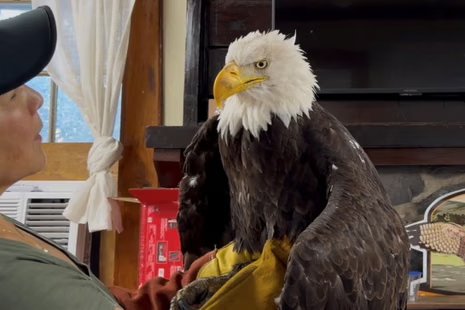

The jackie big bear eagle story has taken a heartbreaking turn, with new medical information providing a clearer picture of the serious health problems that led to the death of the famous bald eagle. Jackie, the longtime mate of Shadow and a star of the Big Bear Valley eagle livestream, died naturally in the early hours of August 10, 2026, after more than three weeks of intensive veterinary care. Although veterinarians conducted extensive testing and consulted specialists, they did not identify one definitive cause of her illness.
New information released after her death shows that Jackie was dealing with several significant medical abnormalities, including severe regenerative anemia, blood clots in her wing and one kidney, abnormalities affecting her liver and lungs, and an inadequate bone marrow response. The findings help explain why her condition repeatedly deteriorated despite aggressive treatment, while also making clear that the exact underlying disease remains unresolved.
Jackie’s Final Health Battle
Jackie’s health crisis began in July, when the adult bald eagle was found grounded and unable to fly near Big Bear Lake. Before her rescue, video showed an adult eagle involved in a confrontation with two younger eagles. The bird was able to defend herself but could not fly away normally. Wildlife rescuers subsequently determined that the eagle was Jackie, the well-known female from the Big Bear nest camera.
Jackie was taken to the San Dimas Raptor Rescue team before being transferred to the Ojai Raptor Center on July 18. Initial examinations showed that she was underweight and seriously ill. Veterinarians found severe anemia and inflammation involving her kidneys, while further examinations were needed to determine why her health had deteriorated so dramatically.
The medical situation became especially concerning because Jackie’s red blood cell levels remained dangerously low. She received a blood transfusion on July 22 using donor blood from Spirit, an ambassador bald eagle at the California Living Museum in Bakersfield. The transfusion initially produced an encouraging improvement, but her blood values later declined again.
For a period, there were signs that Jackie might stabilize. Her packed cell volume, or PCV, improved after the transfusion, and veterinary staff reported that she was eating, becoming more alert and showing more energy. However, those gains proved temporary. By early August, her blood values had fallen again, and she remained critically ill.
New Findings Explain More About Jackie’s Deterioration
The latest information from the Ojai Raptor Center provides important details that were not available during Jackie’s treatment.
Veterinarians found that Jackie had severe regenerative anemia, meaning she had an extremely low red blood cell count while her body was attempting to respond by producing new blood cells. Her condition also involved thrombosis, or blood-clot formation, in both her wing and near one kidney. Additional abnormalities were identified in her liver and lungs. Veterinary testing also showed that her bone marrow was not responding adequately.
These findings are significant because they demonstrate that Jackie was experiencing a complicated, multisystem medical crisis rather than simply recovering from the confrontation with other eagles.
The earlier fight may have been associated with the circumstances surrounding her discovery, but veterinary examinations did not establish that the confrontation itself was the definitive cause of her overall illness. In fact, initial examinations found no major wounds or broken bones, while subsequent testing revealed much deeper health problems.
Veterinarians also investigated possible causes during her treatment. Earlier testing ruled out lead toxicity and swallowed objects as explanations for her condition, while additional specialized testing continued as her health worsened. A contrast CT scan and bone marrow biopsy conducted shortly before her death provided additional information, but the veterinary team still did not have one definitive diagnosis.
That distinction is important. The newly released findings show what was medically wrong with Jackie, but they do not yet establish why those problems developed in the first place.
Jackie’s Condition Became Critical Again in August
Jackie’s medical course was marked by repeated setbacks. After her initial response to the blood transfusion, her PCV began falling again. By August 7, the Ojai Raptor Center reported that her PCV had dropped below 10 percent and that she remained in intensive care with oxygen therapy, supportive treatment and round-the-clock monitoring.
Two days later, her PCV fell below 6 percent before rising slightly to 9 percent. Even with that temporary improvement, veterinarians described her overall condition as extremely serious. A collaborative team involving multiple veterinarians, the California Department of Fish and Wildlife and the U.S. Fish and Wildlife Service continued evaluating her condition.
In the days immediately before her death, Jackie experienced additional health challenges, including the blood clots identified in her wing and kidney and another decline in her blood values. After 23 days of treatment, she became unable to keep food down and suffered a significant further decline in her PCV. She died naturally in the early morning of August 10.
The Ojai Raptor Center has emphasized that decisions throughout Jackie’s treatment were guided by available medical evidence, her welfare and what was considered to be in her best interest.
Where Jackie’s Remains Will Be Sent
Jackie’s remains have now entered a process governed by federal wildlife protections.
After her death, her remains were transferred to the California Department of Fish and Wildlife. A necropsy was subsequently performed by veterinary pathologists with the San Diego Zoo Wildlife Alliance. The examination is important because it may provide additional information about the disease processes that affected Jackie and could help resolve some of the questions left unanswered during her treatment.
Following the necropsy, Jackie’s remains are expected to be transported to the National Eagle Repository, a facility operated by the U.S. Fish and Wildlife Service’s Office of Law Enforcement.
The Repository has a specialized role in the handling of bald and golden eagle remains. According to the information released about Jackie’s case, federal requirements call for deceased bald and golden eagles to be transferred through the appropriate process. The Repository evaluates, stores and prepares eagle remains, parts and feathers for distribution to enrolled members of federally recognized Native American Tribes for spiritual and religious purposes.
This means Jackie will not simply be buried or disposed of as an ordinary animal remains case. Her status as a bald eagle places her remains within a federally regulated system that recognizes the cultural and religious importance of eagle feathers and other eagle materials.
Why Jackie Became So Famous
Long before her final illness, Jackie had become one of the world’s best-known wild bald eagles.
The Friends of Big Bear Valley livestream allowed viewers to observe Jackie and her longtime mate, Shadow, at their nest in real time. The camera attracted viewers from around the world and offered an unusually close look at the daily lives of wild bald eagles, from incubation and feeding to territorial behavior and the raising of eaglets.
Jackie was also regarded as a particularly important bird in the history of bald eagles in Big Bear Valley. She was documented as the first confirmed bald eagle to hatch in the valley and later returned to the area, eventually becoming part of the breeding pair watched by the online community.
Her partnership with Shadow became one of the central stories of the livestream. Together, they raised multiple eaglets, giving viewers an extraordinary opportunity to watch wild eagle behavior over many years.
The 2026 nesting season was especially meaningful because Jackie and Shadow successfully raised eaglets Sandy and Luna, who eventually fledged. Their development was followed closely by the livestream community before Jackie’s health crisis unfolded later in the summer.
Jackie’s Importance to Bald Eagle Conservation
Jackie’s popularity extended well beyond entertainment. Her life became a way for people who might never have studied wildlife to learn about bald eagles, nesting behavior, habitat protection and the challenges faced by wild birds.
Her story also reflects the broader recovery of the bald eagle in the United States. The species was once severely threatened by habitat loss, hunting and the effects of the pesticide DDT. Its recovery has become one of the country’s most prominent wildlife conservation successes.
Biologists and conservation advocates have pointed to Jackie’s public following as an example of how technology can connect people with wildlife. Watching a wild eagle care for its young, survive harsh weather and interact with its mate can create an emotional connection that traditional wildlife education does not always achieve in the same way.
That connection was particularly visible after news of Jackie’s death spread. Thousands of viewers who had followed her for years shared tributes, while wildlife organizations recognized the importance of the public interest generated by the Big Bear eagle cam.
What Remains Unknown About Jackie
The latest medical findings answer some questions but leave others unresolved.
There is currently no official confirmation of one specific underlying disease or condition that caused all of Jackie’s medical problems. Severe anemia, thrombosis, liver and lung abnormalities and an inadequate bone marrow response were documented, but the veterinary team did not identify a single definitive explanation for the overall decline before her death.
The necropsy and additional laboratory work may provide more answers. However, until the responsible veterinary and wildlife authorities release further confirmed results, claims that Jackie died from a particular disease, toxin, cancer or other specific condition should be treated as unconfirmed.
It is also important not to assume that the July confrontation with younger eagles was the sole cause of her death. The medical evidence released after her death points to a much more complicated health crisis.
Jackie’s Legacy in Big Bear Valley
For years, Jackie was more than one half of a famous eagle pair. She became a recognizable symbol of the Big Bear Valley ecosystem and an ambassador for bald eagle conservation.
Her life was followed through changing seasons, nesting attempts, storms, territorial encounters and the growth of her eaglets. The livestream allowed people around the world to witness behaviors that would normally remain hidden high in a tree.
Her death also changes the story of the Big Bear nest. Shadow remains, and the future of the nesting territory will continue to be watched by the Friends of Big Bear Valley community. What happens next should be allowed to unfold naturally rather than being predicted before there is official information.
Jackie’s legacy will also continue through the eaglets she helped raise and through the conservation awareness created by her life. Her remains will receive a regulated final disposition through the National Eagle Repository, while the continuing examination of her medical history may help wildlife professionals better understand the illness that ultimately claimed her life.
Latest Jackie Big Bear Eagle Update
As of August 12, 2026, the most important confirmed developments are:
- Jackie died naturally in the early hours of August 10, 2026, after more than three weeks of intensive veterinary care.
- Veterinarians identified severe regenerative anemia, blood clots in her wing and one kidney, liver and lung abnormalities, and an inadequate bone marrow response.
- Despite extensive testing and consultation with specialists, no single definitive cause of her illness has been confirmed.
- Her remains were transferred to the California Department of Fish and Wildlife following her death.
- A necropsy was performed by San Diego Zoo Wildlife Alliance veterinary pathologists.
- Following the necropsy process, her remains are expected to go to the National Eagle Repository, where eagle remains, parts and feathers are handled under federal requirements and may be distributed for authorized Native American cultural and religious purposes.
- Further medical information may be released as testing and examination are completed.
Final Thoughts
The latest Jackie Big Bear eagle update provides a more detailed understanding of just how seriously ill the beloved bald eagle had become. Her condition involved multiple abnormalities, and the combination of severe anemia, blood clots, organ abnormalities and inadequate bone marrow response made her recovery increasingly difficult despite intensive veterinary care.
At the same time, the available evidence does not establish one definitive cause of death. The ongoing examination of her remains may eventually answer additional questions, but until those findings are officially released, it is important to separate confirmed medical evidence from speculation.
Jackie’s influence will likely extend far beyond her final days. Through the Big Bear eagle cam, she introduced millions of people to the realities of wild eagle life and helped turn an individual bird into a powerful symbol of wildlife appreciation and conservation.
Share your thoughts about Jackie’s remarkable legacy in the comments and stay updated as verified findings from her medical examination become available.