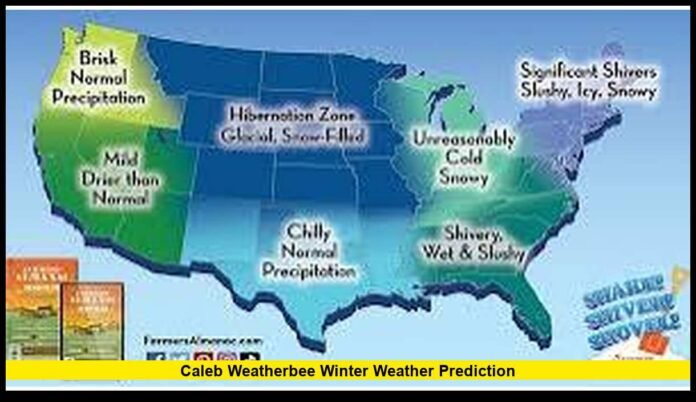

The latest caleb weatherbee winter weather predictions are drawing attention as meteorologists, weather enthusiasts and households across the United States prepare for the 2026–2027 cold season. The outlook is especially interesting this year because a strengthening El Niño is expected to influence weather patterns, while the Farmers’ Almanac has returned under new ownership and released a new winter outlook covering the season ahead.
Winter 2026–2027 could feature major swings between snow, rain, cold and milder conditions depending on where people live. Rather than one uniform winter across the country, the emerging picture points toward a season of contrasts, with an active southern storm track potentially playing a major role.
Key Points at a Glance
╔════════════════════════════════════════════════════════════════════╗
║ – Caleb Weatherbee remains the name associated with the Farmers’ Almanac’s long-range weather forecasts. ║
║ – The Farmers’ Almanac has continued under new ownership after previously announcing plans to end publication. ║
║ – A 2027 print edition has now been announced, extending the publication’s long-running tradition. ║
║ – The 2026–2027 winter outlook calls for sharp contrasts, active storms and changing conditions across the United States. ║
║ – NOAA says El Niño is strengthening and is expected to persist through the Northern Hemisphere winter. ║
║ – A very strong El Niño is increasingly likely during the late-fall and early-winter period. ║
║ – Snow lovers in some regions could see opportunities for significant winter storms, while other areas may lean warmer or wetter. ║
╚════════════════════════════════════════════════════════════════════╝
Who Is Caleb Weatherbee?
Caleb Weatherbee is the traditional forecasting name associated with the Farmers’ Almanac. The name has become familiar to readers who follow long-range weather outlooks because the publication has used Weatherbee as the identity of its principal weather forecaster.
Unlike television meteorologists or government forecasters who routinely appear publicly, Weatherbee has historically remained a largely private figure. The pseudonym has become part of the Farmers’ Almanac’s identity and its distinctive approach to seasonal forecasting.
For generations, readers have turned to the publication for predictions covering upcoming winters, summers and regional weather trends. Its forecasts are intended to provide a broad look at what could happen rather than replace short-range forecasts issued by professional meteorological agencies.
That distinction is especially important for the 2026–2027 winter. Seasonal predictions can identify broad tendencies, but individual snowstorms, ice events and cold outbreaks cannot be forecast accurately months ahead.
Farmers’ Almanac Returns With a New Chapter
The story surrounding the Farmers’ Almanac changed considerably during 2026.
The publication had previously faced uncertainty about its future, but new ownership ultimately kept the historic brand alive. The Farmers’ Almanac has now announced plans for a 2027 print edition, marking another chapter in a publishing tradition that dates back more than two centuries.
That development is significant for weather readers because it means the familiar almanac forecasting tradition has not disappeared.
The publication continues to promote long-range forecasts, seasonal weather information and regional outlooks, allowing readers to compare the almanac’s predictions with official meteorological forecasts.
For anyone searching for winter predictions, it is also important not to confuse the Farmers’ Almanac with the Old Farmer’s Almanac. They are separate publications with different histories, forecasting approaches and editorial operations.
What Is Expected During Winter 2026–2027?
The emerging outlook suggests that winter 2026–2027 may not be a quiet or predictable season.
The Farmers’ Almanac has described the upcoming winter as one featuring sharp contrasts, with an active storm track capable of producing quick changes in conditions.
Instead of expecting months of uninterrupted cold or warmth, readers should prepare for a season in which weather patterns can change rapidly.
One week could bring relatively mild temperatures, while another could feature snow, ice or bitter cold. The exact experience will depend heavily on location.
Southern states may be particularly important this winter because a more active storm track could increase precipitation opportunities. Farther north, the interaction between storms and available cold air will determine whether precipitation falls as rain, snow or a mixture.
El Niño Becomes the Major Climate Signal
One of the biggest scientific factors influencing the winter forecast is El Niño.
El Niño occurs when unusually warm ocean temperatures develop across parts of the tropical Pacific. Those warmer waters can alter atmospheric circulation and influence the jet stream, storm tracks and precipitation patterns across North America.
The latest NOAA outlook indicates that El Niño is already present and strengthening.
Forecasters expect it to continue through the Northern Hemisphere winter and into early spring 2027. NOAA’s projections also indicate a high probability of very strong El Niño conditions during the October–December period.
That makes El Niño one of the most important background signals for winter 2026–2027.
However, El Niño should not be interpreted as a guarantee of a particular temperature or snowfall outcome for every location.
Weather patterns are influenced by multiple interacting factors, and regional conditions can vary considerably even during strong El Niño events.
What Could Happen in the Northeast?
The Northeast could experience a highly variable winter.
An active storm track raises the possibility of several notable weather systems moving through the region. Depending on the position of each storm and the temperature of the air mass in place, precipitation could range from rain to heavy snow or mixed winter precipitation.
The biggest question for snow lovers will be whether storms can develop at the right time and location while cold air remains entrenched across the region.
A strong coastal storm could produce significant snowfall in some areas, while a slightly different storm track could result in rain closer to the coast.
This means residents should avoid relying on a single seasonal prediction when making travel or preparedness decisions.
Mid-Atlantic Could See a Mixture of Weather
The Mid-Atlantic sits in one of the most complicated winter-weather zones in the country.
The region can shift rapidly between rain, freezing rain, sleet and snow. Small temperature differences can completely change the type of precipitation a storm produces.
The 2026–2027 outlook suggests that residents could need more than one type of winter-weather preparation.
Snow shovels, ice melt, winter tires and rain gear may all prove useful depending on how individual storm systems develop.
For Washington, D.C., Baltimore, Philadelphia and surrounding communities, the most important details will become clearer only when individual storms move into the short- and medium-range forecast period.
Great Lakes and Midwest Outlook
The Great Lakes and Midwest could experience a classic mixture of winter conditions.
Lake-effect snow remains an important factor for communities near the Great Lakes, while larger storm systems can produce widespread snow and strong winds.
Cold-air outbreaks will also matter.
Even if seasonal averages trend differently from normal, short periods of severe cold can still occur. Winter weather does not need to remain cold for months to create hazardous conditions.
Travelers and residents should therefore pay attention to individual cold-air outbreaks rather than assuming that a seasonal temperature average tells the entire story.
Southern States Could Become a Winter Weather Hotspot
The South may be one of the more interesting regions during winter 2026–2027.
El Niño often favors a more active storm pattern across portions of the southern United States. Increased storm activity can bring substantial rainfall, but colder air interacting with those systems could also create opportunities for snow and ice in parts of the interior South.
The difference between a disruptive winter storm and an ordinary rain event may come down to the timing of cold air.
States farther north in the Southern Plains and Tennessee Valley could occasionally experience wintry precipitation when sufficiently cold air becomes established.
Meanwhile, Gulf Coast communities are more likely to see heavy rain from many systems because temperatures are generally too high for snow.
Southwest and California Could See Important Storm Activity
El Niño can also influence the southern tier of the western United States.
Parts of California and the Southwest may experience increased precipitation opportunities during an El Niño winter. However, seasonal precipitation does not mean that every storm will be equally strong.
A handful of major systems can account for a substantial share of seasonal rainfall or snowfall totals.
For California, mountain snowpack will be an especially important factor to watch as winter progresses. Snow in higher elevations is critical for water resources, recreation and spring runoff.
What About the Pacific Northwest?
The Pacific Northwest could experience a different winter pattern from parts of the southern United States.
El Niño can shift storm activity and temperature patterns across the Pacific Northwest, potentially producing periods that are warmer or drier than average.
That does not eliminate the possibility of snow.
Cold-air outbreaks can still occur, and mountain communities can experience significant snowfall even during a broader seasonal pattern that is not especially cold.
For residents in Washington and Oregon, the timing and strength of individual atmospheric systems will therefore remain more important than a single seasonal temperature prediction.
Why Long-Range Forecasts Should Be Used Carefully
Long-range forecasts are useful because they provide a broad sense of what may happen, but they cannot provide the precision of a seven-day forecast.
A seasonal outlook may indicate that a region has an increased chance of above- or below-average temperatures. It cannot reliably tell a homeowner whether snow will fall on a particular weekend several months in advance.
This is especially important when preparing for travel.
Someone planning a December road trip should not cancel plans solely because a seasonal forecast indicates an active winter. Instead, the traveler should monitor updated forecasts as the departure date approaches.
The same principle applies to heating, snow removal and emergency preparation.
Farmers’ Almanac Predictions vs. NOAA Forecasts
The Farmers’ Almanac and NOAA approach long-range forecasting differently.
The almanac uses its proprietary forecasting system and presents regional weather expectations in an accessible format for the public.
NOAA, meanwhile, relies on modern atmospheric and ocean observations, numerical weather prediction models, climate data and statistical forecasting techniques.
Their outlooks may sometimes point toward similar general conditions, but they are not interchangeable.
For public safety, official government weather warnings and forecasts should always take priority when severe weather threatens.
The almanac can still be useful as a seasonal guide and a source of historical perspective.
What Should Homeowners Do Before Winter?
Regardless of which seasonal forecast proves most accurate, basic winter preparation is worthwhile.
Homeowners should consider checking heating systems before the coldest part of the season, insulating exposed pipes, cleaning gutters and inspecting roofs for potential problems.
Drivers can prepare by checking tires, batteries, windshield wipers and emergency supplies.
People living in regions prone to winter storms should also keep basic supplies available in case power outages or travel disruptions occur.
Preparation becomes particularly important when a season is expected to contain rapid swings between different weather patterns.
The Latest Caleb Weatherbee Forecasting Outlook
Interest in caleb weatherbee winter weather predictions is likely to remain strong throughout the fall because the 2026–2027 season combines a renewed Farmers’ Almanac forecasting tradition with a potentially powerful El Niño.
The biggest takeaway is that the upcoming winter could be highly regional. Some parts of the country may experience repeated storms, while others could see more rain or milder temperatures.
A strong El Niño creates an important atmospheric backdrop, but it does not determine every storm.
As winter approaches, forecast confidence will improve as meteorologists gain better information about the jet stream, Arctic air, ocean temperatures and individual storm systems.
For readers following the latest outlook, the most useful strategy is to combine seasonal predictions with updated official forecasts throughout the winter.
Final Outlook for Winter 2026–2027
Winter 2026–2027 is shaping up to be one of the more interesting seasons in recent years.
A strengthening El Niño, an active southern storm track and the renewed Farmers’ Almanac publishing operation have all increased attention on the months ahead.
Some regions could experience periods of significant snow, while others may deal with heavy rain, ice or unusually mild stretches. The possibility of sharp temperature changes means residents should be prepared for more than one type of winter weather.
The most important detail is that seasonal forecasting provides probabilities, not guarantees. A prediction made in August cannot determine exactly what a community will experience in January or February.
As the season gets closer, short-range weather models and official warnings will provide increasingly useful information. Until then, the broad outlook points toward a winter capable of delivering plenty of surprises across the United States.
What are you expecting from the 2026–2027 winter? Share your local forecast thoughts below and keep checking back as new weather developments emerge.