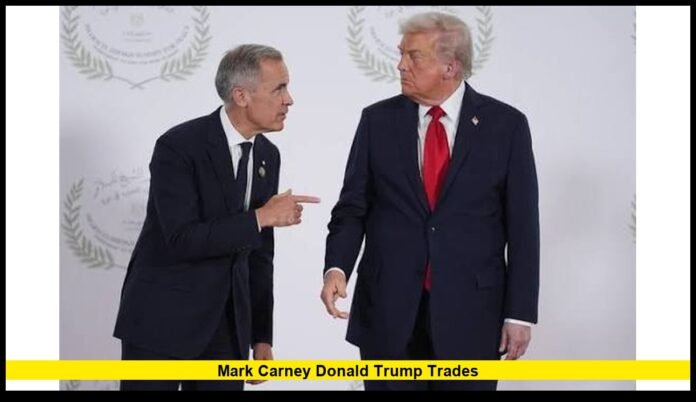

The Mark Carney Donald Trump trade relationship has entered another critical phase as Canada and the United States intensify negotiations amid President Donald Trump’s latest tariff measures and threats. Canadian Prime Minister Mark Carney is trying to preserve access to Canada’s largest export market while preparing potential countermeasures if Washington proceeds with new 50% tariffs on a significant range of Canadian goods.
The latest escalation comes at a particularly sensitive moment for North American trade. The future of the United States-Mexico-Canada Agreement, known as USMCA in the United States and CUSMA in Canada, is under scrutiny, while tariffs involving automobiles, dairy, alcohol, steel and other products have added new uncertainty for businesses on both sides of the border.
As of July 29, 2026, negotiations remain active, but there is no comprehensive settlement ending the broader Canada-U.S. trade dispute.
Key Points Summary
╔════════════════════════════════════════════════════════════════════╗
║ – Mark Carney and Donald Trump have agreed to intensify Canada-U.S. trade negotiations. ║
║ – Trump announced additional 50% tariffs covering a range of Canadian imports. ║
║ – The latest tariffs are scheduled to take effect on August 19, 2026. ║
║ – Carney says Canada is prepared to respond if the measures take effect. ║
║ – The future of USMCA/CUSMA has become a central issue in the wider trade relationship. ║
║ – Canadian negotiators are continuing high-level discussions with Washington. ║
╚════════════════════════════════════════════════════════════════════╝
What Is Happening With Mark Carney and Donald Trump on Trade?
On July 20, Trump announced additional 50% duties on categories of Canadian goods. The White House said the action was being taken under Section 338 of the Tariff Act of 1930 in response to what the administration describes as discriminatory Canadian treatment of American products.
The White House specifically highlighted disputes involving automobiles, alcohol and dairy products. The measures cover various Canadian exports but include exemptions for categories including energy, potash, certain critical minerals and some other products.
Canada strongly disputes Washington’s characterization of the situation.
Carney said Canada had been responding to previous U.S. trade measures and argued that earlier American tariffs violated CUSMA. His government says it remains committed to negotiating while protecting Canadian workers, farmers and businesses.
Carney and Trump Agree to Intensify Negotiations
Despite the escalating tariff confrontation, communication between the two leaders has continued.
On July 21, Carney said he had spoken with Trump and that the two leaders agreed to accelerate negotiations during the following weeks.
That development was significant because it suggested Ottawa and Washington were still searching for a negotiated solution rather than immediately allowing the dispute to spiral into another round of retaliation.
Carney has emphasized that Canada wants an agreement capable of providing longer-term stability rather than simply resolving one tariff dispute.
At the same time, Ottawa has made clear that negotiation does not mean Canada has ruled out countermeasures.
Trump’s 50% Canadian Tariffs Raise the Pressure
The Trump administration’s July 20 announcement dramatically increased the stakes.
According to the White House, additional 50% tariffs will apply to covered Canadian imports, including products across several industries. The administration says Canada has treated certain American products unfairly and that the tariffs are intended to offset those disadvantages.
The new measures are expected to become effective on August 19, 2026, making the coming weeks especially important for negotiators.
The tariffs do not apply uniformly to everything Canada sells to the United States. Key exemptions significantly limit their reach compared with a blanket 50% tariff on all Canadian exports.
Nevertheless, the affected trade remains substantial enough to create uncertainty for manufacturers, exporters and companies with integrated North American supply chains.
Carney Says Canada Is Ready to Respond
Carney has avoided immediately announcing another broad retaliation package.
Instead, his government is continuing negotiations while keeping possible responses available.
Following discussions with Canada’s provincial and territorial leaders, Carney said the country has a range of options if the new American tariffs ultimately take effect.
That approach allows Ottawa to maintain negotiating flexibility before the August 19 implementation date.
It also reflects the difficult balance facing the Canadian government: responding forcefully enough to defend Canadian industries without unnecessarily increasing costs for businesses and consumers.
Why Trump Says the Tariffs Are Necessary
Trump has consistently argued that tariffs can pressure trading partners to offer better terms to American producers while encouraging companies to manufacture more products inside the United States.
The administration says Canada’s policies disadvantage American businesses in areas including automobiles, dairy and alcohol.
The White House therefore describes the latest tariffs as measures designed to create a more balanced trading relationship.
Canada rejects that interpretation.
Carney’s government argues that Canada has been responding to American tariffs and that an escalating cycle of duties ultimately raises costs in both countries.
That fundamental disagreement explains why reaching a durable settlement has proved difficult.
USMCA Becomes a Major Part of the Dispute
The future of USMCA/CUSMA is increasingly important to the Mark Carney-Donald Trump trade relationship.
The agreement was negotiated during Trump’s first presidency and took effect in 2020, replacing the North American Free Trade Agreement.
Under its review mechanism, the three countries faced an important 2026 decision about extending the agreement’s long-term framework.
The July 1 deadline passed without the United States agreeing to a straightforward 16-year extension, increasing uncertainty about the pact’s future.
On July 28, Trump went further, saying he was not particularly concerned about preserving USMCA in its existing form and arguing that the agreement benefits Canada and Mexico more than the United States.
Those comments suggest upcoming negotiations could involve far more than the newest tariffs.
Canadian Trade Officials Heading Into High-Level Talks
Canada is continuing its diplomatic push in Washington.
Trade Minister Dominic LeBlanc and Canada’s negotiating team have been involved in discussions with U.S. officials as Ottawa attempts to resolve outstanding disputes.
The issues extend across several economically important sectors.
Automobiles are particularly sensitive because manufacturing operations in Canada and the United States are deeply integrated. Components can cross the border multiple times during the production process.
Steel and aluminum also remain central concerns, while agriculture and Canada’s supply-management system continue to be recurring points of disagreement.
The negotiations therefore involve not simply tariff percentages but the broader structure of North American commerce.
Automobiles at the Center of Canada-U.S. Tensions
The automotive sector illustrates why the trade dispute can quickly become complicated.
American and Canadian factories are interconnected through cross-border supply chains developed over decades. Parts manufactured in one country can be shipped to another factory and incorporated into a vehicle before additional components cross the border again.
Trump argues that U.S. policy should encourage more manufacturing and investment within America.
Canada, meanwhile, wants to protect its automotive manufacturing base and ensure Canadian plants remain competitive within the North American industry.
The White House has accused Canada of discriminating against U.S. automobile exports through its tariff policies, an allegation Ottawa disputes.
Dairy Remains Another Major Flashpoint
Agricultural trade—particularly dairy—has long been a source of friction between Washington and Ottawa.
Canada operates a supply-management system covering dairy and certain other agricultural products. The system uses production controls and import restrictions designed to manage domestic supply and support Canadian producers.
American administrations have repeatedly pushed for greater access to Canada’s dairy market.
Trump has again placed the issue near the center of the trade confrontation.
For Canada, however, major concessions on dairy can carry considerable domestic political consequences, making the issue especially difficult to resolve.
Could Canada Retaliate Against Trump Tariffs?
Canada has not ruled it out.
Carney has said his government has multiple options available if the latest U.S. measures come into force.
Potential responses could involve tariffs or other trade measures, although the precise scale and targets would depend on Ottawa’s final strategy.
Canada has previously responded to American tariffs with countermeasures aimed at U.S. products.
However, retaliation carries risks.
Tariffs imposed on imported American products can increase prices for Canadian companies and consumers, while U.S. tariffs can increase costs for American businesses that depend on Canadian materials and components.
For that reason, both sides have economic incentives to negotiate even while preparing tougher measures.
Canada Is Also Trying to Diversify Trade
One of Carney’s broader economic objectives is reducing Canada’s vulnerability to sudden changes in U.S. trade policy.
The United States remains Canada’s overwhelmingly important trading partner, meaning the relationship cannot realistically be replaced.
But Ottawa has increasingly emphasized developing stronger economic relationships with other countries and regions.
Carney said in his July 20 statement that his government had signed more than 20 economic and security partnerships as Canada seeks to strengthen its international relationships.
Greater diversification could eventually give Canadian companies more export opportunities outside the American market.
It is nevertheless a long-term project rather than an immediate substitute for U.S. trade.
Why the Canada-U.S. Trade Relationship Matters
Canada and the United States maintain one of the world’s largest bilateral economic relationships.
Their economies are connected through energy, manufacturing, agriculture, minerals, transportation and investment.
Disruptions therefore have consequences beyond government negotiations.
Manufacturers can face higher input costs. Farmers may lose export opportunities. Retailers can pay more for imported products, and companies may delay investment when they cannot predict future tariff rates.
Border states and Canadian provinces with deeply integrated industries can be particularly exposed.
That is why the outcome of the current Carney-Trump negotiations could influence economic decisions well beyond Ottawa and Washington.
What Trump Said About USMCA
Trump’s July 28 remarks added another layer of uncertainty.
The president said he did not care much about maintaining USMCA and suggested Canada and Mexico benefited more from the arrangement.
His comments came as Canadian officials prepared for further high-level negotiations in Washington.
The remarks matter because USMCA has provided the legal framework governing much of North American trade since 2020.
Businesses have made investments and developed supply chains based on expectations that trade rules under the agreement would remain relatively predictable.
A prolonged period of uncertainty could make companies more cautious about where they build factories and source materials.
What Carney Wants From the United States
Carney’s government appears focused on securing a comprehensive arrangement rather than negotiating indefinitely from one tariff announcement to another.
Canada wants predictable access to the American market, protection for important industries and a stable framework for future North American trade.
Ottawa has also indicated a willingness to discuss modernization of CUSMA.
Carney said Canada has submitted detailed proposals intended both to resolve the immediate dispute and address the future of the continental trade agreement.
The challenge is finding terms acceptable to Trump while avoiding concessions that Canada considers economically or politically unacceptable.
What Trump Wants From Canada
The Trump administration’s stated priorities include greater access for American products and changes to Canadian policies it considers discriminatory.
Autos, dairy and alcohol have received particular attention in the latest White House actions.
Trump’s broader trade philosophy also emphasizes using tariffs as leverage to encourage domestic manufacturing and investment.
That creates a fundamental negotiating difference.
Canada generally wants predictable tariff-free continental commerce, while Trump has demonstrated a willingness to use substantial tariffs as an active negotiating and industrial-policy tool.
August 19 Is Now a Critical Date
Unless the policy changes beforehand, the latest 50% tariffs are scheduled to take effect on August 19, 2026.
That gives negotiators a limited window to find compromises capable of preventing or reducing another escalation.
A complete Canada-U.S. economic settlement before then is possible but far from guaranteed.
The talks involve complex disagreements that have developed over months and, in some cases, years.
Another possibility is an interim arrangement that addresses the immediate tariff threat while broader USMCA negotiations continue.
What Happens Next in Mark Carney Donald Trump Trade Talks?
The next stage will depend heavily on negotiations between senior Canadian and American officials.
Several developments are worth watching: whether Washington modifies or delays the August 19 tariffs, whether Canada announces retaliatory measures, whether Carney and Trump hold additional direct discussions, and whether negotiations produce a pathway toward a renewed or substantially revised North American trade framework.
For businesses, predictability may ultimately be nearly as important as the final tariff rates.
Companies operating across Canada and the United States need to know what rules will apply before committing billions of dollars to factories, supply contracts and long-term investment.
Final Outlook
The Mark Carney Donald Trump trade negotiations have become one of the most important economic issues facing Canada and the United States in 2026.
Carney is pursuing a two-track strategy: intensifying negotiations with Washington while making clear that Canada can respond if the Trump administration follows through with additional tariffs.
Trump, meanwhile, continues to treat tariffs as a central tool for reshaping America’s trade relationships and has shown little enthusiasm for simply extending USMCA without significant changes.
The immediate focus is now August 19 and whether negotiations can produce enough progress to prevent the latest 50% tariffs from taking effect as planned.
Even if the immediate dispute is resolved, larger questions about automobiles, agriculture, industrial policy and the future of USMCA are likely to keep the Mark Carney Donald Trump trade relationship at the center of North American economic policy.
What do you think Canada and the United States should prioritize in the next trade deal? Share your thoughts and stay updated as the Carney-Trump negotiations develop.