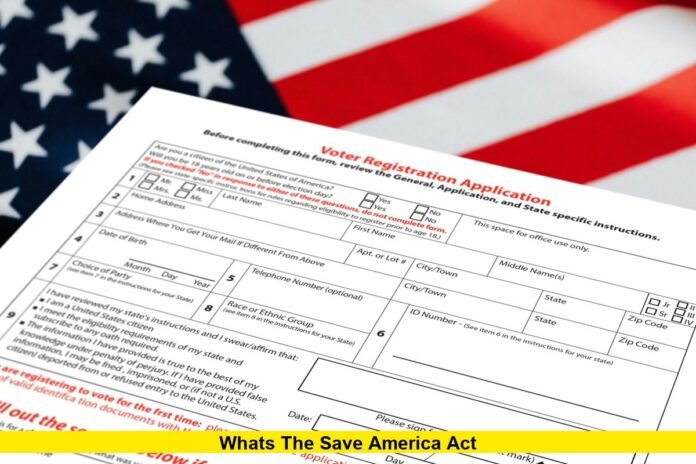

The question whats the Save America Act has become increasingly common as the proposed federal election bill continues to generate debate in the United States. Officially known as the Safeguard American Voter Eligibility (SAVE) America Act, the legislation seeks to make significant changes to voter registration and voting requirements for federal elections. Supporters describe it as an effort to strengthen election integrity, while opponents argue it could make voting more difficult for some eligible citizens.
As of today, the bill has not become federal law. It remains part of ongoing legislative discussions, and its future depends on congressional action.
What Is the SAVE America Act?
The SAVE America Act is proposed federal legislation that would amend existing election laws governing federal elections in the United States. Introduced in the U.S. House of Representatives during the 119th Congress, the bill focuses primarily on voter eligibility verification and identification requirements.
Its stated goal is to ensure that only U.S. citizens vote in federal elections by requiring additional documentation during the voter registration process and by establishing nationwide identification standards for federal voting.
Although non-U.S. citizens are already prohibited under federal law from voting in federal elections, supporters of the legislation argue that stronger verification measures are necessary to improve election security.
Main Provisions of the Bill
If enacted in its current form, the SAVE America Act would introduce several notable changes.
These include:
- Requiring documentary proof of U.S. citizenship when registering to vote in federal elections.
- Requiring eligible photo identification to vote in federal elections.
- Directing states to establish procedures for verifying citizenship.
- Requiring states to maintain voter registration lists by identifying and removing individuals who are determined to be non-citizens under applicable legal standards.
- Creating civil enforcement mechanisms and criminal penalties for certain violations related to voter registration and election procedures.
The legislation also outlines what documents may qualify as proof of citizenship, including certain passports, birth certificates, and specific forms of identification that meet federal requirements.
Why Was the SAVE America Act Introduced?
Supporters say the legislation is intended to strengthen confidence in U.S. elections by standardizing citizenship verification nationwide.
According to supporters, the proposal aims to:
- Prevent non-citizens from registering to vote in federal elections.
- Create uniform national standards.
- Improve voter roll accuracy.
- Increase public confidence in election administration.
Many Republican lawmakers have argued that additional safeguards are appropriate even though federal law already prohibits non-citizens from voting.
The proposal has also received support from President Donald Trump, who has repeatedly called for stricter federal election laws and stronger voter identification requirements during his second term.
Why Critics Oppose the Legislation
The SAVE America Act has also drawn significant criticism from Democratic lawmakers, voting rights organizations, and some election experts.
Critics argue that requiring documentary proof of citizenship could create practical barriers for eligible voters who may not have immediate access to required documents.
Groups opposing the bill have raised concerns that:
- Some citizens do not possess passports.
- Obtaining certified birth certificates may involve time and expense.
- Name changes after marriage could complicate documentation.
- Additional administrative requirements may slow voter registration.
Opponents also note that documented cases of non-citizens illegally voting in federal elections have historically been relatively rare compared with the total number of ballots cast.
Supporters respond that even rare instances justify stronger safeguards to preserve election integrity.
The differing viewpoints have made the legislation one of the more closely watched election policy proposals in Congress.
Current Legislative Status
As of today, the SAVE America Act has not become law.
The bill was introduced in the House of Representatives and referred to the House Committee on House Administration. Separate legislative efforts have also attempted to include similar election provisions within broader congressional legislation, reflecting continued political interest in the proposal.
Because Congress may amend legislation at any stage, the bill’s final language could change if it advances further.
Until both chambers of Congress approve identical versions and the President signs the legislation—or Congress overrides a veto—the proposal does not have the force of federal law.
Political Debate Surrounding the Bill
The SAVE America Act has become part of a broader national discussion over election administration.
Supporters generally emphasize:
- Election integrity.
- Citizenship verification.
- Uniform federal standards.
- Increased public confidence.
Opponents generally focus on:
- Potential voter access issues.
- Administrative burdens.
- Costs for states.
- Effects on eligible voters who may lack required documentation.
Because election laws often involve both federal and state authority, the legislation also raises broader constitutional and policy questions about the appropriate balance between national standards and state administration of elections.
How the Bill Could Affect Voters
If the SAVE America Act were enacted substantially as proposed, voter registration procedures for federal elections would change.
Prospective voters may need to provide documentary proof of citizenship when registering. Existing state election offices would also have additional responsibilities for verifying eligibility and maintaining voter registration databases.
Depending on how the law would ultimately be implemented, some states might need to update registration systems, modify election procedures, and train election officials on new federal requirements.
However, because the bill has not become law, current federal voting rules remain in effect.
Broader Impact on Election Administration
Election officials across the country would likely face significant implementation responsibilities if the legislation were enacted.
Potential changes could include:
- Updating voter registration forms.
- Revising verification procedures.
- Training election workers.
- Coordinating with federal and state agencies.
- Expanding public education efforts regarding documentation requirements.
The exact administrative impact would depend on any final version approved by Congress.
Recent Developments
The SAVE America Act continues to receive attention in Congress during 2026. Republican lawmakers have explored multiple legislative paths for advancing election-related provisions, including discussions about incorporating elements of the proposal into broader legislation. At the same time, Senate leaders have indicated that procedural and political hurdles remain before the bill could advance further.
Because congressional negotiations continue, additional amendments or procedural changes may occur before any final vote.
Why Public Interest Remains High
Searches for whats the Save America Act continue because election laws directly affect millions of American voters.
The proposal touches on several issues that regularly receive national attention, including:
- Federal election security.
- Voter registration.
- Proof of citizenship.
- Voter identification.
- Congressional election reform.
Whether the legislation ultimately advances or not, it has already become an important part of the ongoing national conversation surrounding election policy.
Final Thoughts
The SAVE America Act represents one of the most significant recent proposals to modify federal voter registration and identification requirements. Supporters believe it would strengthen election security and reinforce confidence in the voting system, while critics argue it could create unnecessary barriers for eligible voters.
At present, the bill has not become federal law, and its future depends on congressional action. Until additional legislative steps occur, existing federal election laws remain in place.
Stay informed as Congress considers future election legislation, and share your thoughts on how proposed voting reforms may shape future federal elections.