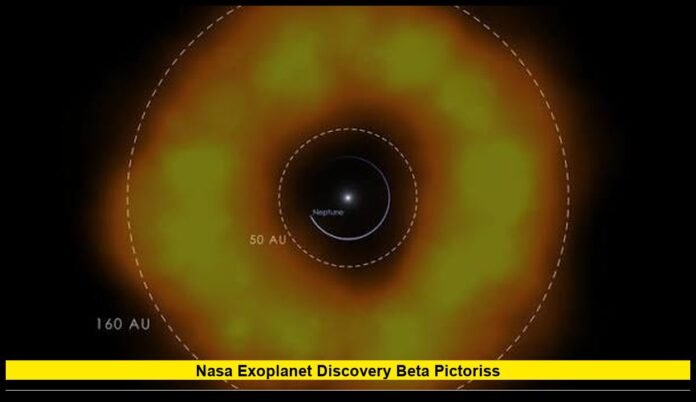

The nasa exoplanet discovery beta pictoris has captivated astronomers after NASA’s James Webb Space Telescope helped identify a previously hidden giant planet orbiting one of the most closely studied young stars in our cosmic neighborhood. The finding marks another milestone in exoplanet research, showcasing how modern infrared observations and advanced spectroscopy can uncover planets that have remained concealed despite decades of astronomical study. The newly confirmed world, named Beta Pictoris d, adds another important chapter to humanity’s growing understanding of how planetary systems form and evolve.
A Star System That Has Fascinated Scientists for Decades
Beta Pictoris has long been regarded as one of the most valuable laboratories for studying planetary formation. Located approximately 63 light-years from Earth in the southern constellation Pictor, the bright young star is estimated to be only around 20 million years old. While that may sound ancient by human standards, it is incredibly young in stellar terms.
Because of its youth, Beta Pictoris still possesses a massive disk of dust, gas, and rocky debris surrounding the star. Scientists believe this disk closely resembles the environment that once surrounded our own Sun during the early stages of the solar system’s formation more than 4.5 billion years ago.
For years, astronomers have closely monitored this system, watching how dust structures shift and evolve while searching for clues about hidden planets shaping the surrounding material.
Meet Beta Pictoris d
Unlike many previously discovered exoplanets that reveal themselves by dimming their parent star during transit or pulling the star slightly through gravity, this newly confirmed planet was found using a far more sophisticated technique.
Researchers analyzed faint atmospheric signatures captured by the James Webb Space Telescope’s powerful infrared instruments. Instead of identifying the planet through visible light alone, scientists detected molecular fingerprints within its atmosphere, allowing them to separate the planet’s signal from the overwhelming brightness of the nearby star.
This innovative approach demonstrates the growing power of modern astronomy, where planets can be discovered not simply by seeing them directly but by identifying the unique chemical signatures they leave behind.
Why Beta Pictoris Continues to Stand Out
Astronomers have studied thousands of planetary systems beyond our own, yet Beta Pictoris remains one of the most scientifically valuable.
Several factors make the system unique.
Its young age allows scientists to witness planetary evolution relatively early in its history. Massive planets still retain heat generated during their formation, making them easier to observe in infrared wavelengths. The surrounding debris disk continues to evolve, providing important evidence of gravitational interactions between planets and leftover material.
Until now, two confirmed giant planets—Beta Pictoris b and Beta Pictoris c—were known to orbit the star.
The addition of Beta Pictoris d transforms the system into one of only a handful where multiple giant planets have been directly observed, making it an exceptional target for future investigations.
The James Webb Space Telescope Makes the Difference
Operating primarily in infrared light, Webb allows astronomers to see through thick clouds of dust that often obscure objects from traditional optical telescopes.
Young planets emit considerable heat as they slowly cool following their formation. This thermal radiation appears strongly in infrared wavelengths, making Webb particularly effective at locating newly formed gas giants.
For Beta Pictoris d, Webb’s Near-Infrared Spectrograph enabled researchers to identify atmospheric molecules with remarkable precision.
Rather than searching for reflected starlight, scientists examined tiny variations in infrared spectra that indicated the presence of a massive planetary atmosphere.
The successful detection opens an entirely new pathway for discovering worlds that might otherwise remain invisible.
A Discovery Hidden Inside Existing Data
One of the most fascinating aspects of the finding is that evidence of Beta Pictoris d had existed for years without attracting attention.
Following Webb’s observations, astronomers revisited archived images and measurements collected by earlier observatories.
Subtle signals that previously appeared insignificant suddenly made sense when interpreted alongside Webb’s new data.
The ability to combine historical observations with cutting-edge technology highlights an important aspect of modern astronomy. Scientific breakthroughs often emerge not only from new observations but also from reexamining older data using improved techniques and better theoretical understanding.
What Scientists Know About the Planet
Although additional observations will refine its characteristics, astronomers have already developed an initial picture of Beta Pictoris d.
Current estimates suggest the planet is several times more massive than Jupiter, placing it firmly among giant gas planets.
Its atmosphere appears rich in molecules commonly associated with young gas giants, including carbon monoxide and water vapor. Scientists also continue investigating whether methane is present in measurable quantities.
Because the planet remains relatively young, it continues radiating heat produced during its formation, making it brighter in infrared wavelengths than older planets of similar size.
Its large orbit around the host star means a complete revolution takes many decades, allowing researchers to observe gradual orbital movement over extended periods.
Understanding Planet Formation
Every newly discovered exoplanet provides another opportunity to test competing theories about planetary formation.
Scientists generally believe giant planets develop through one of two primary mechanisms.
The first involves a gradual buildup of solid material into a massive core that eventually attracts enormous quantities of hydrogen and helium gas.
The second proposes that parts of the surrounding gas disk collapse directly under gravity, forming giant planets much more rapidly.
Studying the Beta Pictoris system may help determine which process dominates in young planetary systems.
Since the planets formed relatively recently, researchers can compare observations with computer simulations that model the earliest stages of planetary evolution.
The Importance of the Debris Disk
One of Beta Pictoris’ defining characteristics is its spectacular debris disk.
This enormous ring contains dust, ice, rocky fragments, and countless smaller bodies left over from planetary formation.
Astronomers have observed unusual gaps, bends, and warped structures throughout the disk for many years.
Many of these distortions are believed to result from the gravitational influence of orbiting planets.
With the discovery of Beta Pictoris d, researchers now have another massive object capable of shaping the surrounding material.
Future simulations may reveal how all three giant planets work together to sculpt the complex architecture visible throughout the disk.
Why Direct Imaging Is So Challenging
Capturing images of exoplanets represents one of astronomy’s greatest technical achievements.
Stars outshine their planets by enormous margins, making nearby worlds almost impossible to detect using ordinary telescopes.
Advanced imaging systems employ coronagraphs and sophisticated data-processing techniques that block much of the star’s light while preserving faint signals coming from orbiting planets.
Even with these methods, many planets remain hidden because dust, distance, and brightness differences complicate observations.
Webb’s ability to analyze infrared spectra provides astronomers with another valuable tool that complements direct imaging rather than replacing it.
A Rare Planetary Family
Planetary systems containing multiple directly observed giant planets remain extremely uncommon.
Every additional member discovered within Beta Pictoris dramatically increases its scientific value.
Having several massive planets orbiting the same young star allows astronomers to compare atmospheric properties, orbital evolution, temperatures, and chemical composition under nearly identical formation conditions.
These comparisons provide insights that isolated planets cannot offer.
Researchers now hope to understand whether all three planets formed simultaneously or whether their formation occurred over an extended period.
Atmospheric Chemistry Offers New Clues
Modern astronomy extends far beyond locating planets.
Scientists increasingly focus on understanding what those worlds are made of.
By examining light passing through or emitted by planetary atmospheres, researchers can estimate temperatures, identify molecules, and investigate cloud layers.
Beta Pictoris d appears to possess an atmosphere dominated by hydrogen and helium while containing trace amounts of heavier molecules.
Each atmospheric component tells scientists something about the planet’s origin and subsequent evolution.
Future Webb observations may provide increasingly detailed chemical inventories capable of revealing even more about the planet’s history.
What Happens Next
Although Beta Pictoris d has now been confirmed, researchers consider the discovery only the beginning.
Astronomers plan continued monitoring using the James Webb Space Telescope alongside major ground-based observatories.
These observations will improve orbital calculations, refine estimates of planetary mass, and reveal additional atmospheric details.
Scientists also hope to determine whether smaller rocky planets may exist closer to the star.
While such worlds remain difficult to detect within the bright stellar environment, improving observational techniques continue increasing the chances of future discoveries.
The Future of Exoplanet Exploration
The nasa exoplanet discovery beta pictoris demonstrates how rapidly planetary science continues advancing.
Only a few decades ago, planets outside the solar system remained purely theoretical. Today, thousands have been identified, with increasingly sophisticated instruments revealing not only their existence but also their atmospheres, temperatures, weather patterns, and orbital dynamics.
The James Webb Space Telescope is expected to remain at the forefront of these efforts for years to come, helping astronomers uncover hidden worlds that escaped previous generations of telescopes.
As more powerful observatories begin operating during the coming decade, researchers anticipate an even greater wave of discoveries that will reshape our understanding of planetary systems across the Milky Way.
Each newly identified world contributes another piece to the puzzle of how stars and planets form together. Beta Pictoris d serves as another reminder that even well-studied regions of space can still hold remarkable surprises waiting to be uncovered.
What are your thoughts on this remarkable planetary discovery? Share your views in the comments and stay connected for more updates on the latest breakthroughs in space exploration and astronomy.