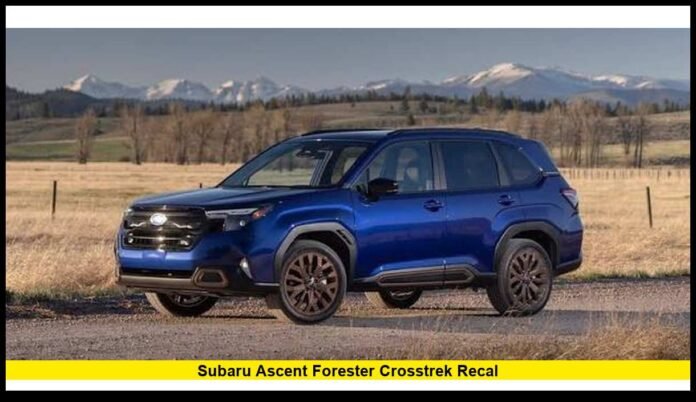

Subaru owners across the United States are paying close attention to the latest subaru ascent forester crosstrek recall, which affects more than 541,000 vehicles across several popular SUV models. The recall centers on an incorrect certification label that displays the wrong rear Gross Axle Weight Rating (GAWR), a key safety specification that helps drivers understand how much weight their vehicle can safely carry. While the issue does not involve a mechanical defect, Subaru is taking action to correct the labels to ensure owners have accurate information and remain compliant with federal vehicle safety standards.
The campaign covers multiple model years of the Subaru Ascent, Forester, Forester Hybrid, and Crosstrek Hybrid. Owners are encouraged to verify whether their vehicle is included and follow Subaru’s instructions once replacement labels become available.
Key Points Summary
╔════════════════════════════════════════════════════════════════════╗
║ – More than 541,000 Subaru SUVs have been included in a nationwide recall. ║
║ – The issue involves incorrect rear Gross Axle Weight Rating labels. ║
║ – No mechanical or performance defects have been identified. ║
║ – Subaru will provide corrected certification labels free of charge. ║
║ – Owners should check their VIN and watch for official recall notices. ║
╚════════════════════════════════════════════════════════════════════╝
Understanding the Recall
Vehicle recalls are commonly associated with defective parts such as airbags, brakes, or steering systems. This recall is different because it focuses on information printed on the vehicle’s federal certification label.
Every vehicle sold in the United States includes a certification label that provides important specifications, including the Vehicle Identification Number (VIN), tire information, manufacturing details, and Gross Axle Weight Ratings. These ratings indicate the maximum weight each axle is designed to safely support.
In this case, Subaru discovered that certain vehicles were equipped with certification labels displaying an incorrect rear axle weight rating. Although the vehicles themselves were manufactured properly, the inaccurate label could cause owners to unintentionally exceed the axle’s intended load capacity.
Federal regulations require manufacturers to provide accurate certification information, making the correction necessary even though the underlying vehicle components remain unaffected.
Which Subaru Models Are Included?
The recall covers several of Subaru’s most popular SUV models.
Affected vehicles include:
- 2019 through 2026 Subaru Ascent
- 2025 Subaru Forester
- 2026 Subaru Forester
- 2025 Subaru Forester Hybrid
- 2026 Subaru Forester Hybrid
- 2026 Subaru Crosstrek Hybrid
Combined, these vehicles total more than 541,000 units across the United States.
Owners should remember that inclusion depends on the individual VIN rather than simply the model year. Not every vehicle built during these production years may necessarily require the updated certification label.
Why the Gross Axle Weight Rating Matters
Many drivers rarely notice the certification label located inside the driver’s door jamb. However, the information it contains serves an important purpose.
The Gross Axle Weight Rating establishes the maximum amount of weight that can safely rest on each axle while maintaining proper vehicle handling and braking performance.
Vehicle weight includes:
- Passengers
- Cargo
- Roof-mounted equipment
- Trailer tongue weight
- Accessories
- Aftermarket modifications
When the rear axle carries more weight than designed, several issues may develop, including:
- Reduced braking effectiveness
- Poorer steering response
- Suspension stress
- Increased tire wear
- Reduced vehicle stability
- Higher likelihood of tire overheating
Although most everyday driving situations never approach these limits, families carrying luggage, outdoor equipment, camping gear, bicycles, or towing trailers could unknowingly rely on the incorrect label when determining safe loading.
Providing accurate information helps drivers make informed decisions before loading their vehicles.
Is the Vehicle Safe to Drive?
One of the first questions owners ask whenever a recall is announced is whether they should stop driving immediately.
Fortunately, this recall does not indicate a defect involving vehicle operation.
There are no reported problems involving:
- Engine performance
- Transmission operation
- Steering
- Suspension components
- Brake systems
- Electrical systems
- Fuel delivery
- Airbags
Instead, Subaru has identified an administrative compliance issue involving vehicle labeling.
Drivers may continue using their vehicles while awaiting the remedy, provided they avoid overloading the vehicle and follow the weight recommendations outlined in the owner’s manual.
Subaru’s Solution
Because the issue involves only the certification label, the repair process is expected to be relatively simple.
Subaru will produce corrected certification labels containing the proper Gross Axle Weight Rating.
Owners will receive instructions explaining how the replacement will be completed. Depending on Subaru’s final repair process, owners may receive the corrected label directly or have it professionally installed by an authorized Subaru retailer at no cost.
Unlike recalls requiring replacement parts or extensive repairs, this campaign should require minimal time to complete.
Notification Timeline
Recall campaigns generally occur in several stages.
First, Subaru identifies the affected production range and works with federal regulators to finalize the recall details.
Next, owners receive official notification explaining:
- Why the recall has been issued
- Which vehicles are affected
- Whether driving restrictions apply
- What remedy will be provided
- How to complete the repair
If replacement materials are still being manufactured, Subaru may initially send an interim notice informing owners that a remedy is being prepared.
Once corrected labels become available, a second notification provides instructions for completing the recall.
How to Check Whether Your Vehicle Is Included
Owners do not need to wait for a letter before checking recall status.
The easiest method is to locate the vehicle’s 17-character VIN, which can be found:
- On the dashboard near the windshield
- Inside the driver’s door
- On vehicle registration documents
- On insurance paperwork
Entering the VIN into Subaru’s recall lookup system or the federal recall database will confirm whether the vehicle is included in the campaign.
Owners purchasing used vehicles should also perform a recall search, since unresolved recalls remain attached to the vehicle rather than the owner.
What Happens If the Label Is Not Corrected?
Although many owners may never approach the vehicle’s maximum load capacity, correcting the certification label remains important.
Federal safety regulations require manufacturers to provide accurate information regarding vehicle specifications.
Leaving the incorrect label in place could result in:
- Confusion about maximum cargo limits
- Improper weight distribution
- Increased axle loading under heavy cargo conditions
- Noncompliance with federal vehicle certification requirements
Correcting the label eliminates uncertainty and ensures drivers have accurate information when transporting passengers and cargo.
Subaru’s Commitment to Vehicle Safety
Subaru has built a reputation for emphasizing long-term reliability and occupant safety.
Its lineup consistently performs well in crash testing while incorporating advanced driver assistance technologies such as:
- EyeSight Driver Assist Technology
- Adaptive Cruise Control
- Lane Centering
- Automatic Emergency Steering
- Blind Spot Detection
- Rear Cross Traffic Alert
- DriverFocus Distraction Mitigation System
Like every major automaker, Subaru occasionally issues recalls whenever manufacturing errors, supplier issues, or regulatory concerns are identified.
Voluntary recalls allow manufacturers to address potential issues before they develop into larger safety concerns.
Other Subaru Safety Campaigns During 2026
The certification label recall is only one of several safety campaigns involving Subaru vehicles this year.
Earlier recalls included concerns involving certain Forester and Forester Hybrid models equipped with panoramic moonroofs. In those cases, improperly bonded glass could potentially separate from the vehicle under certain conditions.
Additional campaigns addressed limited numbers of hybrid models for fuel system-related issues requiring inspection and repairs.
Each recall addresses an entirely separate component and should not be confused with the current certification label campaign.
Owners should verify all outstanding recalls affecting their specific VIN rather than assuming only one campaign applies.
Tips for Safely Loading Your Subaru
Regardless of whether your vehicle is included in the recall, following proper loading practices improves both safety and vehicle performance.
Helpful recommendations include:
- Place heavier cargo as low as possible.
- Position heavy items close to the center of the vehicle.
- Avoid placing excessive weight behind the rear axle.
- Secure loose cargo before driving.
- Check tire pressure before carrying heavy loads.
- Review towing limits before attaching trailers.
- Avoid exceeding maximum roof rack capacity.
Balanced loading reduces suspension stress while maintaining predictable handling during emergency maneuvers.
Why Certification Labels Are Regulated
Vehicle certification labels serve more than an administrative purpose.
Government safety standards require manufacturers to display accurate technical information so owners, mechanics, dealerships, inspectors, and regulators all reference identical specifications.
These labels typically include:
- VIN
- Date of manufacture
- Gross Vehicle Weight Rating
- Front Gross Axle Weight Rating
- Rear Gross Axle Weight Rating
- Tire size recommendations
- Cold tire inflation pressures
Even relatively small errors require correction because inaccurate specifications could affect vehicle operation under heavy loading conditions.
What Owners Should Do Now
Current owners should take several simple steps following the recall announcement.
First, determine whether the vehicle is included by checking its VIN.
Second, continue driving responsibly while remaining within recommended loading limits.
Third, monitor official communications from Subaru regarding availability of corrected certification labels.
Finally, complete the recall promptly once the replacement label becomes available.
Although the repair itself is straightforward, ensuring the vehicle displays accurate federal certification information helps maintain compliance and supports safe vehicle operation.
Looking Ahead
The subaru ascent forester crosstrek recall highlights that recalls are not always the result of defective mechanical components. Sometimes the issue involves ensuring that owners receive accurate information needed to operate their vehicles safely.
For Subaru, correcting the certification labels demonstrates a proactive approach to regulatory compliance and customer safety. While drivers can continue using their SUVs under normal conditions, completing the recall remains an important step once notifications arrive.
As manufacturers continue introducing new hybrid technologies, advanced safety systems, and updated vehicle platforms, maintaining accurate documentation becomes just as important as ensuring the reliability of the mechanical systems themselves. By responding promptly to recall notices and staying informed, owners can help keep their vehicles safe, compliant, and ready for years of dependable service.
Have you checked whether your Subaru is affected? Share your experience in the comments and stay connected for the latest automotive recall news and ownership updates.