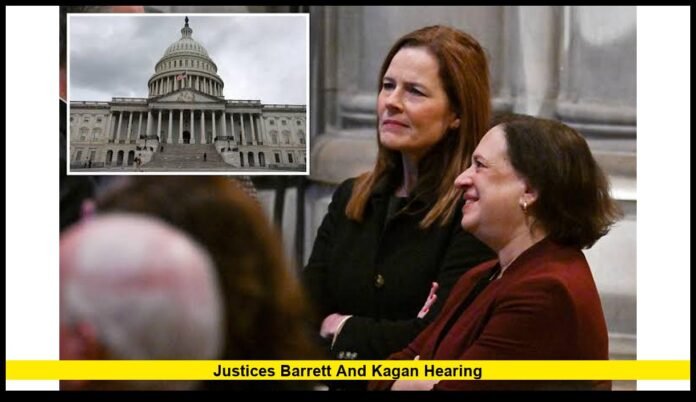

The justices barrett and kagan hearings have become one of the most closely watched events involving the U.S. Supreme Court this summer. On July 14, 2026, Associate Justices Amy Coney Barrett and Elena Kagan are scheduled to appear before congressional appropriators to discuss the Supreme Court’s fiscal year 2027 budget request, court operations, and the growing need for judicial security. Although the hearing is centered on funding rather than legal decisions, it arrives after another consequential Supreme Court term and is expected to attract significant public and political attention.
Unlike cabinet officials or agency leaders, Supreme Court justices seldom testify before Congress. Their appearance offers lawmakers and the public a rare opportunity to hear directly from members of the nation’s highest court about the challenges involved in managing the federal judiciary while maintaining judicial independence.
A Rare Congressional Appearance by Sitting Supreme Court Justices
The Supreme Court operates as an independent branch of government, making direct appearances by its members before Congress uncommon. While the legislative branch controls federal spending, the judiciary is responsible for explaining its financial needs without compromising its constitutional role.
Justice Amy Coney Barrett and Justice Elena Kagan were selected to represent the Court during discussions over the upcoming budget. Their testimony is expected to focus on practical issues such as funding requests, courthouse operations, technology investments, employee resources, and security improvements.
The hearing is not intended to examine recent Supreme Court rulings. Instead, it serves as part of the annual appropriations process that allows Congress to review funding requests from every branch of the federal government.
Even so, because the Supreme Court has remained at the center of numerous national debates, the hearing is expected to receive considerably more public attention than a typical budget session.
Why Congress Holds These Hearings
Congress must determine how much funding the judiciary requires to continue operating efficiently while meeting growing administrative responsibilities.
Budget hearings generally examine topics including:
- Court administration
- Employee compensation
- Information technology modernization
- Building maintenance
- Security improvements
- Public access initiatives
- Long-term operational planning
For the Supreme Court, maintaining secure facilities and reliable technology has become increasingly important as workloads evolve and security concerns continue to rise.
Judicial Independence Remains a Central Principle
One reason these hearings are relatively rare is the importance of maintaining judicial independence.
The United States Constitution establishes three separate branches of government. Although Congress controls appropriations, it traditionally avoids interfering with judicial decision-making.
Similarly, Supreme Court justices generally avoid discussing pending cases, recently decided litigation, or internal deliberations.
During the hearing, Barrett and Kagan are expected to reinforce this long-standing tradition by limiting their remarks to institutional matters rather than legal controversies.
This balance allows Congress to evaluate funding needs while respecting the judiciary’s constitutional independence.
The Supreme Court’s Budget Priorities
The proposed fiscal year 2027 budget includes funding for several key priorities.
Judicial Security
Security remains the Court’s highest operational concern.
Threats directed toward federal judges have increased significantly over the past several years, prompting greater investment in protective measures.
Funding requests are expected to support:
- Enhanced courthouse security
- Residential protection for justices
- Emergency response capabilities
- Cybersecurity improvements
- Coordination with federal law enforcement agencies
Protecting judges allows courts to function independently without intimidation or outside influence.
Technology Modernization
Modern courts rely heavily on secure digital infrastructure.
Budget requests include continued investment in:
- Secure communication systems
- Electronic filing platforms
- Data protection
- Network modernization
- Digital records management
Technology improvements also help courts provide more efficient public access while protecting sensitive judicial information.
Court Administration
Like every federal institution, the Supreme Court requires ongoing funding for daily operations.
Administrative expenses include:
- Personnel
- Legal research support
- Building maintenance
- Facility operations
- Library resources
- Administrative technology
Although these responsibilities often receive little public attention, they remain essential to keeping the judicial system functioning smoothly.
Amy Coney Barrett’s Role on the Court
Since joining the Supreme Court in 2020, Justice Amy Coney Barrett has become one of its most influential conservative members.
Throughout the Court’s recent terms, Barrett has participated in numerous landmark constitutional decisions involving:
- Administrative law
- Federal authority
- Religious liberty
- Immigration
- Environmental regulation
- Election law
Although frequently associated with the Court’s conservative majority, Barrett has occasionally joined opinions that differed from expectations, demonstrating the independent decision-making expected of Supreme Court justices.
Her analytical writing and careful questioning during oral arguments have made her an increasingly prominent voice within the Court.
Elena Kagan’s Continuing Influence
Justice Elena Kagan remains one of the Court’s most respected legal scholars.
Appointed in 2010, she has authored numerous influential majority opinions, concurring opinions, and dissents.
Kagan is widely recognized for:
- Detailed constitutional analysis
- Strong courtroom questioning
- Clear legal writing
- Institutional leadership
- Practical judicial reasoning
During congressional testimony, Kagan is expected to focus primarily on administrative matters while emphasizing the judiciary’s commitment to impartiality and constitutional independence.
Why Security Has Become Such an Important Issue
Security concerns affecting judges have changed dramatically over the past decade.
Federal judges increasingly face threats, harassment, and intimidation connected to high-profile legal decisions.
These challenges have prompted courts nationwide to strengthen protections for:
- Judges
- Court employees
- Families
- Courthouse visitors
- Sensitive judicial facilities
The Supreme Court’s budget request reflects these evolving realities.
Additional funding would help improve physical security, expand protective infrastructure, strengthen emergency planning, and enhance cybersecurity protections against increasingly sophisticated digital threats.
Ensuring judicial safety helps preserve public confidence in an independent legal system.
Public Interest in the Hearing
Although budget hearings usually attract limited national attention, this year’s event has generated widespread interest.
Several factors contribute to that attention.
A Highly Visible Supreme Court
The Supreme Court has issued several nationally significant decisions during recent terms, increasing public awareness of the institution.
Americans across the political spectrum continue following the Court more closely than in previous decades.
Ongoing Discussion About Court Administration
Questions surrounding ethics, transparency, and institutional governance remain part of broader public conversations.
While those issues are not the primary purpose of the hearing, lawmakers may seek clarification about administrative policies and procedures.
Growing Focus on Judicial Resources
As federal courts face increasing workloads and security responsibilities, Congress must determine whether current funding levels remain adequate.
The hearing provides an opportunity to explain how additional resources would support efficient court operations.
Will Recent Supreme Court Decisions Be Discussed?
The hearing is expected to remain focused on budgetary matters.
However, members of Congress often use these opportunities to ask broader institutional questions.
Possible areas of discussion include:
- Court administration
- Ethics policies
- Security planning
- Budget priorities
- Public confidence
- Operational transparency
Barrett and Kagan are unlikely to comment directly on specific legal rulings or pending litigation.
That longstanding practice protects judicial neutrality while preserving the integrity of future cases.
Why Bipartisan Representation Matters
The selection of both Justice Barrett and Justice Kagan provides balanced representation from different judicial perspectives.
Although the two justices frequently disagree on constitutional interpretation, they share responsibility for overseeing the institution’s administrative functions.
Their joint appearance demonstrates that managing the Supreme Court extends beyond ideological differences.
Budget planning, employee support, courthouse operations, technology modernization, and judicial security affect every member of the Court regardless of judicial philosophy.
How the Hearing Could Shape Future Funding
Congress will review testimony before determining the final level of appropriations for the judiciary.
Funding decisions may influence:
- Future security projects
- Technology upgrades
- Infrastructure improvements
- Staffing resources
- Administrative modernization
While budget hearings rarely produce immediate policy changes, they help lawmakers better understand the operational needs of the federal judiciary.
Why Judicial Security Continues to Receive Bipartisan Support
Regardless of political affiliation, lawmakers generally agree that judges must be able to perform their constitutional duties without fear of violence or intimidation.
Security investments are viewed as protecting the judicial process itself rather than individual judges.
Maintaining safe courthouses, secure residences, and modern protective systems helps preserve the rule of law and public confidence in the courts.
That shared understanding has made judicial security one of the least controversial aspects of the Supreme Court’s annual budget request.
Broader Significance for the Judiciary
Although the hearing focuses on finances, it also highlights the administrative complexity of operating the nation’s highest court.
Beyond deciding constitutional questions, the Supreme Court oversees numerous operational responsibilities requiring careful financial planning and coordination.
Those responsibilities include managing facilities, supporting employees, protecting sensitive information, maintaining historical records, and ensuring that court operations continue uninterrupted.
The hearing gives the public a clearer understanding of these often-overlooked responsibilities.
Looking Ahead
The justices barrett and kagan hearings are expected to provide important insight into how the Supreme Court plans for the future while responding to changing operational demands.
Lawmakers will evaluate requests related to security, technology, staffing, and infrastructure as part of the fiscal year 2027 appropriations process. Although the hearing is administrative rather than judicial, it offers a rare opportunity to hear directly from two sitting Supreme Court justices about the challenges of managing one of the nation’s most important constitutional institutions.
As the federal judiciary continues adapting to evolving security risks, technological change, and increasing public attention, the decisions made during this budget process will help shape how the Supreme Court operates in the years ahead.
What do you think about Congress’ oversight of the Supreme Court’s budget and operations? Share your thoughts in the comments and stay tuned for more updates on the U.S. judiciary.