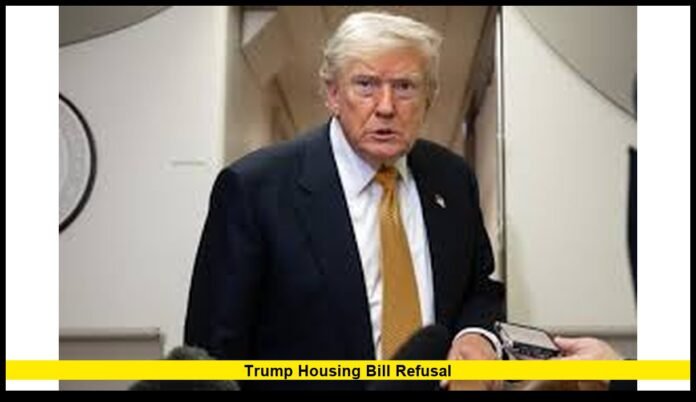

The trump housing bill refusal has become one of the most talked-about political stories in Washington after President Donald Trump declined to sign a bipartisan housing measure that had already cleared both chambers of Congress with strong support. While the president chose not to put his signature on the legislation, he also did not issue a veto, creating widespread discussion about what the decision means for the future of housing policy, affordability, and the relationship between the White House and Congress. The episode also drew attention because it occurred at a time when housing costs remain one of the biggest financial concerns for millions of Americans.
Housing Affordability Remains a National Concern
Housing affordability continues to rank among the most important economic issues in the United States. Families looking to buy their first home face elevated mortgage rates, higher property prices, and limited inventory in many regions. Renters are also dealing with increased monthly housing costs, making it more difficult to save for homeownership or manage everyday expenses.
Over the past several years, economists have repeatedly pointed to one central problem: the nation does not have enough homes to meet demand. Population growth, years of underbuilding, rising construction costs, labor shortages, and restrictive zoning policies have all contributed to the shortage.
Federal lawmakers from both political parties have acknowledged that increasing the nation’s housing supply is one of the most effective long-term approaches to improving affordability. That shared understanding helped produce one of the rare bipartisan housing bills seen in recent years.
Understanding the Housing Legislation
The legislation at the center of the debate, known as the 21st Century ROAD to Housing Act, was designed to encourage the construction of more homes while reducing some of the regulatory hurdles that often slow development.
Rather than creating a large new federal housing program, lawmakers focused on reforms intended to make it easier and faster for communities and private developers to build additional housing.
Key objectives of the legislation include:
- Encouraging faster residential construction
- Simplifying permitting procedures
- Reducing unnecessary project delays
- Supporting affordable housing development
- Improving planning for communities experiencing rapid population growth
- Expanding opportunities for mixed-use housing
- Addressing concerns about large institutional ownership of single-family homes
Supporters argued that increasing housing supply over time could help stabilize prices and provide more options for both buyers and renters.
Why President Trump Declined to Sign the Bill
The most important point surrounding the trump housing bill refusal is that President Trump did not reject the legislation because of widespread objections to its housing provisions.
Instead, he tied his decision to another issue that he considers a legislative priority.
The president stated that Congress had not acted on election-related legislation that he strongly supports, specifically measures involving proof of citizenship for voter registration and broader election security reforms.
According to Trump’s public statements, he chose not to sign the housing legislation as a form of protest against Congress’s decision not to advance that election bill.
His position shifted public attention away from housing policy itself and toward the broader political disagreement between the White House and Congress.
Why the Legislation Can Still Become Law
Many Americans assume every bill must receive the president’s signature before becoming law.
The U.S. Constitution provides several different paths after Congress passes legislation.
The president may:
- Sign the bill into law.
- Veto the legislation.
- Take no action while Congress remains in session, allowing the bill to become law automatically after the constitutional review period.
- Exercise a pocket veto only under limited constitutional circumstances when Congress adjourns before the review period expires.
Because President Trump indicated that he would neither sign nor veto the housing bill while Congress remained available to receive a veto, the legislation was positioned to become law without his signature once the constitutional deadline passed.
This constitutional process has existed since the nation’s founding and has been used by presidents from both political parties.
Rare Bipartisan Cooperation
The housing legislation attracted attention not only because of the president’s decision but also because of the unusually broad coalition that supported it.
Congress has often struggled to pass major legislation with significant bipartisan backing. Housing, however, has increasingly become an issue affecting urban, suburban, and rural communities alike.
Lawmakers from both parties agreed that the country faces a substantial housing shortage.
Although Republicans and Democrats continue to disagree about many economic policies, they found common ground on several housing reforms designed to increase supply rather than impose broad federal controls on pricing.
The strong bipartisan vote demonstrated that housing affordability remains an area where lawmakers can occasionally work together despite broader political divisions.
The Housing Supply Challenge
One reason the legislation received wide support is the growing recognition that the United States has built fewer homes than needed over many years.
Several factors have contributed to the shortage.
Rising Construction Costs
Builders continue to face higher prices for materials, transportation, insurance, and financing.
These costs often make projects more expensive before construction even begins.
Labor Shortages
The construction industry continues to experience shortages of skilled workers, including electricians, plumbers, carpenters, and other trades.
Labor shortages increase project timelines and overall costs.
Local Regulations
Many communities require lengthy approval processes before residential construction can begin.
Environmental reviews, zoning restrictions, permitting requirements, and local planning procedures can delay projects for months or even years.
Supporters of the legislation believe reducing unnecessary delays could encourage additional private investment in housing.
What the Bill Could Mean for Homebuyers
Although many Americans hope for immediate relief, housing experts generally agree that no single law can rapidly reduce home prices.
Building homes takes time.
Developers must acquire land, secure financing, obtain permits, complete construction, and bring properties to market.
Even after regulatory reforms are implemented, the effects typically unfold gradually.
If additional homes enter the market over the coming years, buyers could benefit from:
- Greater housing inventory
- Increased competition among sellers
- More choices in growing communities
- Better opportunities for first-time buyers
- Slower long-term price growth
While market conditions such as mortgage interest rates will continue to influence affordability, increasing supply remains an important component of any long-term housing strategy.
Potential Benefits for Renters
Renters may also see long-term advantages if more housing becomes available.
When supply expands, landlords often face greater competition for tenants, which can help moderate rent increases in some markets.
The legislation also encourages development across different housing categories rather than focusing exclusively on single-family homes.
Communities experiencing rapid population growth may gain additional apartments, townhomes, duplexes, and mixed-use developments that provide more housing options for working families.
However, the timing of those benefits will vary depending on local construction activity and economic conditions.
Institutional Investors and Housing Ownership
Another notable feature of the legislation addresses concerns about institutional investors purchasing large numbers of single-family homes.
Over the past decade, investment firms have become increasingly active in certain housing markets.
Some lawmakers argue that concentrated ownership reduces opportunities for families trying to purchase homes.
Supporters of the legislation believe new limits and oversight can help maintain a healthier balance between individual buyers and institutional ownership.
Others note that investor activity represents only one factor affecting affordability, alongside interest rates, supply shortages, construction costs, and population growth.
Congressional Reaction
Members of Congress from both parties praised the bipartisan effort that produced the legislation.
Many lawmakers viewed it as an opportunity to address one of the country’s most pressing economic challenges through practical reforms rather than sweeping federal mandates.
After President Trump announced that he would not sign the bill, several lawmakers expressed disappointment that a broadly supported housing package had become connected to a separate political dispute.
Others defended the president’s broader legislative priorities while continuing to support many of the housing provisions included in the bill.
The differing reactions reflected ongoing debates over presidential strategy rather than widespread disagreement about the need to improve housing affordability.
Why the Story Drew National Attention
The trump housing bill refusal quickly became a national headline because it combined several issues that affect millions of Americans.
Housing costs influence nearly every household, whether someone rents an apartment, owns a home, or hopes to purchase property in the future.
The decision also highlighted the constitutional process through which legislation can become law without a presidential signature, something that many Americans rarely encounter.
In addition, the episode underscored the political reality that major policy debates often extend beyond the substance of a single bill.
What Happens After the Bill Becomes Law
Once the constitutional process is complete, federal agencies responsible for implementing the legislation begin carrying out its provisions.
Some regulatory changes may take effect relatively quickly.
Other sections will require agencies to develop implementation rules, coordinate with state and local governments, and establish administrative procedures.
Communities seeking to benefit from the legislation may also need to adjust local planning practices, permitting systems, and housing policies.
Because housing development occurs over several years, measurable effects on supply and affordability are expected to emerge gradually rather than immediately.
Long-Term Outlook for the Housing Market
The legislation alone cannot solve every challenge facing the U.S. housing market.
Mortgage rates, inflation, construction financing, land availability, labor markets, and local regulations will all continue to shape housing affordability.
Still, many policymakers believe that increasing the number of available homes represents one of the most sustainable approaches to improving affordability over time.
Whether the legislation achieves its intended goals will depend on implementation, cooperation among federal, state, and local governments, and continued private-sector investment in residential construction.
Final Thoughts
The trump housing bill refusal represents an unusual chapter in modern American policymaking. President Donald Trump chose not to sign a bipartisan housing measure, not because he broadly opposed its housing reforms, but because he sought to emphasize separate election legislation that he viewed as a higher priority. Even without his signature, the constitutional process allows qualifying legislation to become law when the required conditions are met.
For Americans concerned about rising home prices and rental costs, the legislation reflects a continued effort by lawmakers to address the nation’s housing shortage through regulatory reforms and increased construction opportunities. While the impact will not be immediate, the measure could influence housing development and affordability over the coming years as its provisions are implemented across the country.
What do you think about the future of U.S. housing policy? Share your thoughts in the comments and stay tuned for the latest developments.