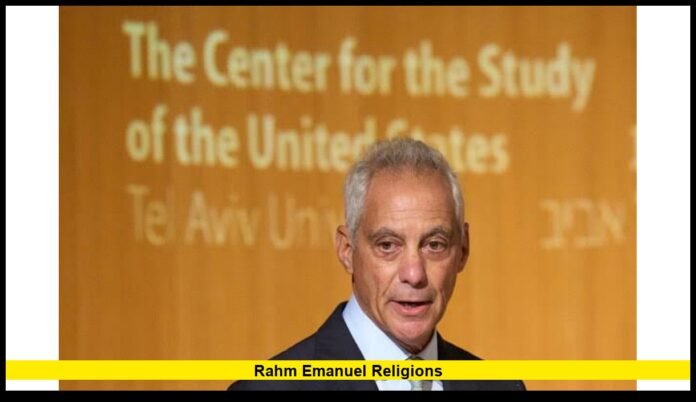

Interest in rahm emanuel religion continues to grow as the longtime American politician remains one of the most recognizable figures in U.S. public life. Whether serving as a congressman, White House chief of staff, mayor of Chicago, or U.S. ambassador to Japan, Rahm Emanuel has maintained a prominent presence in national and international politics. Alongside questions about his career, many people are curious about his personal background, particularly his religious identity and the role it has played throughout his life.
Rahm Emanuel has consistently identified as Jewish. His family history, upbringing, and connection to Jewish traditions have been well documented over the years. While religion has never been the defining feature of his political career, his Jewish heritage has shaped parts of his personal identity and has often been discussed whenever he speaks on issues involving Israel, antisemitism, or international diplomacy.
Who Is Rahm Emanuel?
Rahm Israel Emanuel was born on November 29, 1959, in Chicago, Illinois. Over the past several decades, he has become one of the most influential Democratic political leaders in the United States. Known for his direct communication style and strategic political skills, Emanuel has held several high-profile government positions and has earned a reputation as an experienced policymaker.
His career has included service in Congress, leadership roles in the White House, and executive positions at both the local and international levels. Beyond politics, Emanuel has remained active in public discussions about foreign policy, education, economic development, and national security.
Despite his many professional achievements, questions about his family background and faith continue to attract public attention.
Rahm Emanuel’s Religious Identity
Rahm Emanuel is Jewish and has openly acknowledged his faith throughout his adult life. Unlike some public figures who rarely discuss religion, Emanuel has never hidden his Jewish heritage. At the same time, he has generally preferred to keep the details of his private religious practices out of the public spotlight.
His religion is often mentioned in biographies because it forms an important part of his family’s history. Rather than serving as a central theme in his political campaigns, Judaism has been part of the broader story of his upbringing and personal values.
Many observers note that Emanuel’s public life reflects a strong emphasis on education, civic responsibility, public service, and community involvement—principles that were encouraged within his family from an early age.
A Family with Deep Jewish Roots
Rahm Emanuel comes from a family whose Jewish heritage spans generations.
His father, Benjamin Emanuel, was born in Jerusalem during the period when the region was under British administration before the establishment of the modern State of Israel. He later immigrated to the United States, where he became a respected pediatrician.
His mother, Marsha Smulevitz Emanuel, worked as a social worker and was involved in community and civil rights activities. Together, Emanuel’s parents created a household that valued education, discipline, and public engagement while maintaining Jewish traditions.
Growing up in such an environment gave Rahm Emanuel a strong appreciation for both his family’s heritage and the importance of serving others.
Childhood and Religious Upbringing
His childhood combined academic achievement, athletic participation, and involvement in Jewish community life. Friends and classmates have often described him as energetic, competitive, and highly motivated.
The values taught at home emphasized responsibility, respect for learning, and participation in civic life. These lessons would later become visible throughout his political career.
Although Emanuel has never presented himself as a religious leader, his upbringing helped shape the principles that guided many of his decisions in public office.
Education and Early Development
Rahm Emanuel attended Sarah Lawrence College, where he earned his undergraduate degree before later completing graduate studies at Northwestern University.
His education helped prepare him for a career that combined public policy, political strategy, and government administration.
Even before entering national politics, Emanuel gained valuable experience working on Democratic political campaigns. His ability to organize, negotiate, and build coalitions quickly attracted attention among party leaders.
These early experiences established the foundation for what would become one of the most influential political careers of his generation.
Entering National Politics
Rahm Emanuel’s rise through American politics was remarkably fast.
After working in political consulting and campaign management, he became involved in the administration of President Bill Clinton. During this period, he developed a reputation for handling difficult negotiations and managing complex legislative priorities.
His work inside the White House demonstrated his ability to navigate challenging political situations while maintaining strong relationships with lawmakers across different areas of government.
Those experiences prepared him for elected office and eventually led to his successful campaign for Congress.
Service in Congress
Emanuel represented Illinois in the U.S. House of Representatives, where he quickly became known as an effective legislator and party strategist.
During his years in Congress, he focused on economic issues, healthcare, transportation, and national security.
He also played an important role in Democratic Party fundraising and candidate recruitment, helping shape election strategies during multiple campaign cycles.
Although religion rarely became part of legislative debates involving Emanuel, his Jewish background occasionally drew attention whenever Congress discussed matters relating to Israel or religious freedom.
White House Chief of Staff
One of the defining chapters of Emanuel’s career began in 2009 when President Barack Obama selected him as White House Chief of Staff.
The position placed Emanuel at the center of the administration during a period marked by economic recovery efforts following the financial crisis.
As chief of staff, he coordinated policy discussions, managed communications between government agencies, and helped oversee major legislative initiatives.
His leadership style was often described as energetic, demanding, and highly organized.
Political observers frequently noted his ability to make quick decisions while balancing competing priorities inside one of the world’s most challenging executive offices.
Mayor of Chicago
In 2011, Emanuel was elected mayor of Chicago.
During his two terms, he pursued projects aimed at strengthening the city’s economy, improving transportation infrastructure, expanding technology investment, and supporting neighborhood development.
His administration also focused on attracting businesses and encouraging innovation throughout Chicago.
However, his time as mayor was not without controversy. Public concerns over policing, education reforms, and budget decisions generated intense political debate.
Despite criticism from opponents, Emanuel remained committed to a long-term vision for Chicago that emphasized economic competitiveness and modernization.
His tenure demonstrated both the opportunities and challenges of leading one of America’s largest cities.
Diplomatic Service in Japan
Following his years as mayor, Emanuel accepted a new challenge by serving as the United States Ambassador to Japan.
This diplomatic assignment allowed him to strengthen one of America’s most important international alliances.
During his tenure, he promoted cooperation in areas including defense, technology, trade, cybersecurity, and regional security across the Indo-Pacific.
His active public engagement made him one of the most visible American ambassadors in recent years.
He frequently met with government officials, business leaders, military representatives, and local communities while promoting closer relations between the United States and Japan.
The experience added another significant chapter to his already extensive public service career.
The Relationship Between Faith and Public Service
Although Rahm Emanuel is Jewish, religion has generally remained separate from his political decision-making.
Instead of emphasizing religious beliefs during campaigns, he has typically focused on practical governance, economic growth, education, healthcare, and national security.
Nevertheless, his faith has influenced aspects of his public identity.
He has spoken against antisemitism and has supported efforts to strengthen relationships between Jewish communities and government institutions.
His Jewish heritage has also contributed to public interest whenever discussions involve Israel or broader Middle East policy.
Why People Continue Searching About His Religion
Public curiosity about Emanuel’s religion remains strong for several reasons.
First, his father’s birthplace in Jerusalem naturally attracts attention.
Second, Emanuel has maintained visible relationships with Jewish organizations throughout his life.
Third, his diplomatic experience and involvement in discussions concerning Israel often lead people to explore his personal background.
Finally, as speculation occasionally emerges regarding future political opportunities, many voters seek a fuller understanding of the leaders who may shape national policy.
These factors help explain why searches relating to his religious identity continue to appear online.
His Family’s Accomplishments
The Emanuel family has achieved remarkable success across several professional fields.
Rahm Emanuel’s brother Ari Emanuel is widely recognized as one of the entertainment industry’s most influential executives, representing major actors, filmmakers, athletes, and media personalities.
Another brother, Dr. Ezekiel Emanuel, has become internationally respected for his work in medicine, healthcare policy, and bioethics.
Together, the Emanuel brothers have built distinguished careers in politics, entertainment, and medicine while sharing the same family heritage.
Their achievements have contributed to public fascination with the Emanuel family as a whole.
Public Image in 2026
As of 2026, Rahm Emanuel continues to be an influential voice in American political discussions.
He regularly appears at policy forums, university events, television interviews, and public speaking engagements addressing foreign affairs, economic competitiveness, democratic institutions, and international alliances.
Political analysts occasionally mention him as a potential candidate for future national leadership roles, although no official campaign has been announced.
His experience across legislative, executive, municipal, and diplomatic positions gives him one of the broadest public service résumés among contemporary American political figures.
Throughout these discussions, rahm emanuel religion remains a topic of interest because voters often seek to understand the personal background of influential public leaders alongside their professional accomplishments.
Common Misconceptions
Several misconceptions continue to circulate online regarding Emanuel’s faith.
One common misunderstanding is that he converted to Judaism later in life. This is incorrect. He was born into a Jewish family and has consistently identified as Jewish throughout his public career.
Another misconception suggests that religion has dominated his political agenda. In reality, Emanuel’s policies have generally focused on governance, public administration, economic development, education, infrastructure, diplomacy, and national security rather than religious issues.
Understanding these distinctions helps provide a more accurate picture of both his personal identity and professional record.
Legacy and Continuing Influence
Rahm Emanuel’s career reflects decades of service at multiple levels of government. Few American politicians have held influential positions in Congress, the White House, city government, and international diplomacy.
His Jewish faith forms an important part of his personal identity, but it represents only one aspect of a career defined by political leadership, policy development, and public administration.
Whether remembered for his work in Washington, his leadership in Chicago, or his diplomatic service abroad, Emanuel remains a significant figure in modern American politics. His combination of political experience, administrative expertise, and international perspective continues to shape conversations about leadership, governance, and the future direction of the Democratic Party.
For readers seeking accurate information about his background, the answer is clear: Rahm Emanuel is Jewish, and his family heritage has remained a consistent element of his life while his public career has been driven primarily by policy, public service, and government leadership.