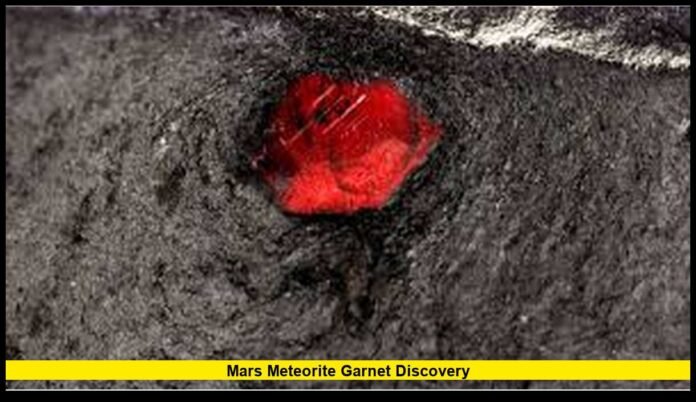

The mars meteorite garnet discovery is drawing significant attention across the scientific community after researchers confirmed the first known occurrence of garnet in a meteorite originating from Mars. Announced in June 2026, the finding provides valuable evidence about geological processes that shaped the Red Planet billions of years ago and may help scientists better understand the evolution of Mars during its earliest history.
For decades, researchers have examined Martian meteorites to uncover clues about the planet’s formation, volcanic activity, crustal development, and environmental changes. While scientists have identified many minerals in Martian rocks over the years, garnet had remained notably absent from confirmed samples. That changed when a team of researchers identified garnet within a Martian meteorite known as NWA 8171.
The discovery represents much more than the identification of a new mineral. Scientists believe it could transform current understanding of the complexity of Mars’ geological history and reveal processes that have not been recognized before in Martian rocks.
Why This Discovery Is Important
Every mineral found in a planetary sample acts as a record of conditions that existed when the rock formed. Certain minerals are especially useful because they preserve information about temperature, pressure, chemistry, and environmental conditions over long periods.
Garnet belongs to this category.
Geologists often describe garnet as one of nature’s most effective record keepers. The mineral can survive for billions of years while preserving details about the environment in which it formed. Because of these characteristics, garnet plays an important role in studies of Earth’s geological evolution.
Finding garnet on Mars opens new opportunities for planetary scientists.
The mineral could help researchers reconstruct ancient events that occurred during critical periods of Martian history. It may also reveal details about the conditions that existed deep within the planet’s crust.
Unlike many discoveries that add only a small piece of information, this one has the potential to influence several areas of Mars research simultaneously.
Understanding Garnet and Its Geological Significance
Many people know garnet as a gemstone commonly used in jewelry. However, geologists view the mineral very differently.
Garnet refers to a family of silicate minerals that form under specific geological conditions. Different varieties develop depending on factors such as temperature, pressure, and chemical composition.
On Earth, garnet is frequently found in:
- Metamorphic rocks
- Igneous rocks
- Deep crustal environments
- Mountain-building regions
- Areas affected by intense heat and pressure
Scientists study garnet because its internal chemistry often preserves evidence of geological events.
A single garnet crystal can contain valuable information about how rocks changed through time. Researchers can analyze its composition to determine temperatures, pressures, and chemical conditions that existed during formation.
This makes garnet one of the most useful minerals for reconstructing ancient planetary environments.
The Meteorite Behind the Discovery
The garnet was identified in a meteorite known as NWA 8171.
This meteorite belongs to a group of rocks that originated on Mars before being ejected into space by a powerful impact. After traveling through the solar system, the rock eventually landed on Earth, where scientists recovered and studied it.
Martian meteorites are extremely valuable because they provide direct physical samples from another planet.
Spacecraft and rovers can perform many scientific measurements, but laboratory studies on Earth allow researchers to examine rocks with much greater precision. Modern instruments can detect microscopic features that would otherwise remain invisible.
NWA 8171 has been studied for several years, yet the garnet remained hidden until researchers performed highly detailed mineralogical analyses.
The discovery highlights how advances in scientific technology continue to reveal new information from samples that have already been collected.
How Researchers Identified the Mineral
The garnet-bearing fragment inside the meteorite is remarkably small.
Scientists examined a tiny grain measuring less than a millimeter across. At first glance, the material appeared similar to minerals commonly found in Martian meteorites.
Closer examination told a different story.
Researchers used advanced laboratory techniques capable of analyzing minerals at microscopic scales. These methods included high-resolution imaging and detailed chemical analysis.
The results showed that the grain possessed the chemical characteristics of garnet rather than other minerals initially suspected.
Further investigation identified the mineral as andradite, a member of the garnet family.
This confirmation marked the first verified discovery of garnet in a Martian meteorite.
For planetary scientists, the result represented a major milestone because it introduced a mineral that had never before been documented in confirmed Martian samples.
A Previously Unknown Martian Rock Type
The significance of the discovery extends beyond the garnet itself.
Researchers reported that the fragment containing the garnet appears to belong to a previously unrecognized rock type from Mars.
This finding suggests that the geological diversity of Mars may be greater than scientists once believed.
Many existing models of Martian geology rely on meteorites collected over several decades. Those samples have provided tremendous insights into volcanic activity, crust formation, and planetary evolution.
However, the newly identified rock fragment indicates that Mars may contain geological environments not fully represented in the meteorite record.
The discovery raises the possibility that additional unknown rock types remain hidden within existing collections.
Scientists are now examining whether similar materials may have been overlooked in other Martian meteorites.
Read More – Mars Organic Molecules Discovery Signals New Chapter in Red Planet Research
What the Discovery Reveals About Ancient Mars
Mars today appears cold, dry, and relatively inactive.
Billions of years ago, conditions were dramatically different.
Evidence gathered from orbiters, landers, rovers, and meteorites shows that ancient Mars experienced extensive volcanic activity, frequent asteroid impacts, and widespread geological change.
The garnet discovery adds another layer to this story.
Because garnet generally forms under specific conditions, its presence suggests that parts of Mars once experienced environments capable of producing this mineral.
Researchers believe several geological processes may have contributed.
These include:
- High-temperature volcanic activity
- Deep crustal heating
- Intense impact events
- Chemical alteration of rocks
- Interactions involving fluids and minerals
The exact mechanism remains under investigation, but the discovery confirms that Mars experienced more complex geological processes than previously recognized.
The Role of Impact Events
Large asteroid impacts have shaped Mars throughout its history.
The Martian surface contains enormous impact basins that formed during periods of intense bombardment in the early solar system.
When a massive impact occurs, temperatures and pressures rise dramatically within surrounding rocks.
These extreme conditions can transform existing minerals and create entirely new geological structures.
Scientists believe some garnets on Earth formed through similar processes.
As a result, researchers are exploring whether ancient Martian impacts played a role in creating the garnet-bearing material found in NWA 8171.
If confirmed, the finding would provide another example of how impact events influenced the evolution of the Martian crust.
Connections to Ancient Volcanism
Volcanic activity represents another possible explanation.
Mars contains some of the largest volcanoes in the solar system, including Olympus Mons and several giant shield volcanoes located in the Tharsis region.
Ancient volcanic systems generated tremendous heat.
As magma moved through the crust, surrounding rocks would have experienced changing temperatures and chemical conditions. Such environments can produce minerals that preserve records of geological activity.
The newly discovered garnet may represent evidence of these ancient processes.
Scientists continue to investigate whether the mineral formed directly through volcanic activity or through later events that altered volcanic rocks.
Either scenario points to a dynamic geological history.
What Makes Martian Meteorites Unique
Only a small number of meteorites have been confirmed as originating from Mars.
Scientists identify these rocks by comparing their chemical and isotopic signatures with measurements collected by Mars missions.
Each Martian meteorite provides a unique glimpse into a different part of the planet’s history.
Some samples record volcanic eruptions.
Others preserve evidence of crustal formation.
A few reveal signs of water-related processes.
The garnet-bearing meteorite now joins this collection as one of the most scientifically intriguing Martian samples ever studied.
Its unusual composition offers a rare opportunity to investigate geological conditions not previously recognized in Martian rocks.
Modern Technology and New Discoveries
One reason discoveries like this continue to occur is the rapid advancement of analytical technology.
Laboratory instruments today can detect minerals at scales unimaginable a few decades ago.
Researchers can analyze microscopic structures, determine chemical compositions with exceptional accuracy, and map mineral distributions within tiny fragments of rock.
As these technologies improve, scientists often revisit previously studied samples.
New techniques frequently reveal details that earlier investigations could not detect.
The garnet discovery demonstrates the value of reexamining meteorite collections using modern tools.
Even small fragments can contain important scientific surprises.
Implications for Future Mars Research
The discovery is expected to influence future studies of Martian geology.
Researchers will likely focus on several important questions:
How Common Is Garnet on Mars?
Scientists do not yet know whether garnet is rare or widespread.
Additional studies may identify similar minerals in other meteorites or future Martian samples.
What Geological Environment Produced It?
Determining the conditions that formed the garnet remains a major objective.
Researchers hope to reconstruct the temperature, pressure, and chemistry involved in its creation.
Could Similar Rocks Exist Elsewhere on Mars?
The newly recognized rock type raises the possibility that other unexplored geological regions contain related materials.
Future missions may target areas capable of preserving comparable rocks.
What Does It Reveal About Mars’ Interior?
Minerals often provide clues about processes occurring deep within a planet.
The garnet could offer insights into crustal evolution and internal geological activity during Mars’ early history.
Growing Interest in Martian Sample Studies
The timing of this discovery is notable.
Planetary science has entered a period of renewed focus on Mars.
Researchers continue studying meteorites while also preparing for future sample-return efforts and advanced exploration missions.
Every new finding contributes to a broader understanding of how Mars evolved from a more active world into the planet observed today.
The identification of garnet demonstrates that important discoveries remain possible even from samples already available on Earth.
Many scientists believe existing collections still contain valuable information waiting to be uncovered.
A New Piece of the Martian Puzzle
Understanding Mars requires assembling evidence from many different sources.
Orbiters reveal large-scale surface features.
Rovers analyze rocks directly on the planet.
Meteorites provide laboratory-accessible samples.
The garnet discovery adds a significant new piece to this puzzle.
It confirms the presence of a mineral previously unknown in Martian samples and introduces a rock type not previously recognized in the Martian meteorite record.
These findings suggest that Mars experienced geological processes more diverse than many researchers had assumed.
As scientists continue investigating the meteorite, additional details may emerge about the events that shaped the Red Planet billions of years ago.
The discovery serves as a reminder that even tiny mineral grains can unlock major insights into planetary history. By studying these microscopic records, researchers move closer to understanding the complex geological story of Mars and the forces that transformed it over time.
What are your thoughts on this remarkable discovery? Share your perspective and keep following the latest developments in Mars exploration and planetary science.