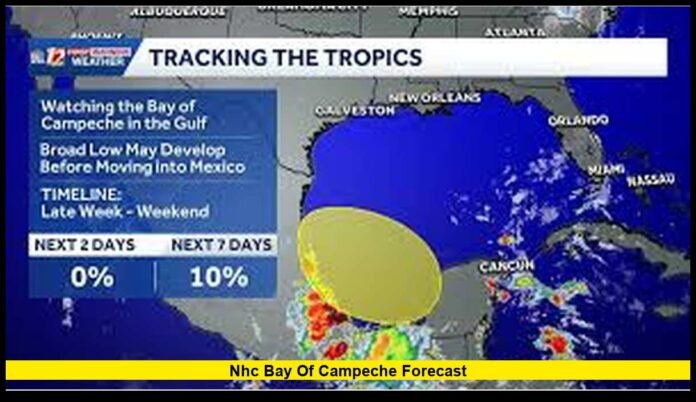

The nhc bay of campeche forecast remains a major focus for meteorologists and Gulf Coast residents as the 2026 Atlantic hurricane season continues through June. Current official outlooks indicate that no tropical cyclone development is expected in the Bay of Campeche during the coming days. While the region contains very warm waters that often support tropical activity, atmospheric conditions are currently limiting the organization of any significant system.
The Bay of Campeche is one of the most closely monitored areas in the Atlantic hurricane basin because storms can develop there quickly and move toward land with little warning. As of June 10, 2026, forecasters continue to watch the region carefully, but no organized tropical disturbance is showing signs of becoming a tropical depression, tropical storm, or hurricane.
Current Conditions Across the Bay of Campeche
The Bay of Campeche forms the southwestern corner of the Gulf of Mexico along Mexico’s eastern coastline. This area frequently attracts attention during hurricane season because of its warm sea-surface temperatures and favorable geographic location.
At the moment, weather conditions across the region remain relatively stable. Thunderstorms continue to develop over portions of the southern Gulf, but these storms lack the organization required for tropical cyclone formation.
Several atmospheric factors are preventing development:
- Strong upper-level winds
- Unfavorable wind shear
- Lack of a well-defined low-pressure center
- Disorganized thunderstorm clusters
- Environmental conditions that do not support sustained circulation
Because these factors remain in place, tropical development chances remain very low.
Why the Bay of Campeche Receives So Much Attention
Every hurricane season, forecasters dedicate significant attention to the Bay of Campeche. The region has a long history of producing tropical systems, especially during the early and middle parts of the Atlantic season.
Several characteristics make the area important:
Warm Water Temperatures
The Gulf of Mexico typically heats up quickly during late spring and early summer. The Bay of Campeche often contains some of the warmest water in the entire basin.
Warm water provides energy for tropical cyclones. When atmospheric conditions become favorable, storms can strengthen rapidly.
Short Distance to Land
Unlike storms that form far out in the Atlantic Ocean, systems that develop in the Bay of Campeche often have limited travel distance before reaching land.
This can reduce preparation time for coastal communities.
Frequent Tropical Activity
Many tropical depressions and tropical storms have formed in this region over the decades. Some have later intensified into hurricanes before making landfall.
Because of this history, forecasters rarely ignore activity in the area.
2026 Atlantic Hurricane Season Overview
The Atlantic hurricane season officially began on June 1 and will continue through November 30.
June generally represents the beginning of increased monitoring across the Gulf of Mexico, Caribbean Sea, and Atlantic Ocean. Historically, early-season activity often develops closer to North America rather than in the deep tropical Atlantic.
Areas that frequently attract attention include:
- Bay of Campeche
- Western Caribbean Sea
- Central Gulf of Mexico
- Eastern Gulf Coast waters
- Northwestern Caribbean
The current pattern remains relatively quiet across these regions.
Meteorologists continue routine surveillance of all tropical basins, but no immediate threats have emerged in the Gulf.
Atmospheric Conditions Limiting Tropical Development
One of the most important factors in tropical forecasting involves evaluating the atmosphere above the ocean.
Warm water alone cannot create a tropical cyclone. Several additional ingredients must work together before a storm can form.
Wind Shear Remains Elevated
Wind shear occurs when wind speed or direction changes significantly with height.
Tropical cyclones need a vertically aligned structure. Strong wind shear disrupts that structure by pushing thunderstorms away from the storm’s center.
Current wind patterns across portions of the Gulf continue to interfere with tropical organization.
Lack of Persistent Rotation
Developing tropical systems require a concentrated area of low pressure and rotating thunderstorms.
Recent weather patterns have produced scattered showers and thunderstorms, but these storms have not organized around a central circulation.
Without sustained rotation, tropical development remains unlikely.
Dry Air Intrusions
Dry air often weakens thunderstorm activity.
When dry air mixes into developing systems, it can reduce rainfall intensity and limit the storm’s ability to strengthen.
Some portions of the Gulf atmosphere continue to contain dry air, creating another obstacle for tropical formation.
Sea Surface Temperatures Remain Favorable
Although atmospheric conditions remain unfavorable, ocean temperatures continue to attract attention.
The Bay of Campeche contains very warm waters for this time of year.
Warm sea-surface temperatures support:
- Increased evaporation
- Enhanced thunderstorm development
- Greater atmospheric moisture
- Potential energy for tropical systems
These temperatures alone do not guarantee development. However, they explain why forecasters continue monitoring the area despite the current low-risk outlook.
If atmospheric conditions change later in the season, these warm waters could become a more important factor.
Rainfall and Thunderstorm Activity
Even without tropical cyclone formation, weather impacts can still occur around the Bay of Campeche.
Scattered thunderstorms continue to affect portions of the southern Gulf and nearby coastal regions.
Periods of heavy rain may develop in localized areas, particularly where thunderstorms repeatedly move across the same locations.
Potential weather impacts include:
- Localized flooding
- Ponding on roads
- Reduced visibility
- Gusty winds near thunderstorms
- Temporary disruptions to marine operations
These impacts differ significantly from those associated with tropical storms or hurricanes.
Read More – Tropical Storm Hurricane Imelda: NOAA Tracking Intensifies as U.S. Southeast Monitors Threat
Marine Conditions in the Gulf Region
Marine interests frequently monitor Bay of Campeche forecasts.
Commercial shipping, fishing fleets, energy operations, and recreational boaters rely on accurate weather information throughout hurricane season.
Current marine conditions remain generally manageable, although thunderstorms can still create hazards.
Boaters should remain aware of:
- Lightning activity
- Sudden wind gusts
- Reduced visibility
- Rough seas near thunderstorms
- Rapid weather changes
Even in the absence of tropical systems, Gulf weather can change quickly.
Historical Importance of the Bay of Campeche
The Bay of Campeche has played an important role in Atlantic hurricane history.
Numerous tropical systems have formed in the region due to its combination of warm waters and favorable geographic location.
Several factors contribute to its historical significance:
Rapid Development Potential
Storms sometimes organize quickly in the Bay of Campeche because environmental conditions can change rapidly.
A disturbance that appears weak one day can become much stronger within a short period if conditions improve.
Gulf Coast Impacts
Systems forming in this region can affect:
- Eastern Mexico
- Texas
- Louisiana
- Mississippi
- Alabama
- Florida
Because of these potential impacts, forecasters closely monitor even minor disturbances.
Early-Season Activity
June and July storms often develop closer to land than storms that occur later in the season.
The Bay of Campeche remains one of the most common early-season development zones.
What Forecasters Are Watching Next
Meteorologists continue evaluating several factors that could influence future tropical activity.
Tropical Waves
Tropical waves moving westward across the Caribbean sometimes reach the Gulf of Mexico.
Most remain weak, but some can become development candidates under favorable conditions.
Changes in Wind Shear
A reduction in wind shear could increase the likelihood of tropical organization.
Current forecasts suggest that elevated shear remains one of the primary limiting factors.
Moisture Trends
Increasing atmospheric moisture often helps thunderstorms organize more effectively.
Forecasters routinely monitor moisture levels across the Gulf basin.
Pressure Patterns
Low-pressure systems serve as the foundation for tropical cyclone development.
At present, no significant low-pressure center is showing signs of becoming organized.
Implications for Gulf Coast Residents
The current outlook provides reassuring news for residents along the Gulf Coast.
No tropical storms or hurricanes threaten the region at this time.
States benefiting from the quiet pattern include:
- Texas
- Louisiana
- Mississippi
- Alabama
- Florida
Emergency managers often encourage residents to use quieter periods for hurricane preparedness.
Recommended actions include:
- Reviewing evacuation plans.
- Checking emergency supplies.
- Updating contact information.
- Testing weather alert systems.
- Reviewing insurance documents.
- Preparing emergency communication plans.
Preparation completed before a storm threat emerges often proves more effective than last-minute planning.
The Role of the National Hurricane Center
The National Hurricane Center serves as the primary agency responsible for monitoring tropical weather in the Atlantic basin.
Forecasters evaluate:
- Satellite imagery
- Ocean temperatures
- Wind patterns
- Atmospheric conditions
- Computer forecast models
These tools help meteorologists identify areas that may become favorable for tropical cyclone development.
The center issues routine outlooks throughout hurricane season, allowing residents and emergency officials to remain informed.
How Forecast Confidence Is Determined
Forecast confidence depends on the agreement among meteorological observations and forecast guidance.
Current confidence remains relatively high because several indicators point toward limited tropical activity.
These indicators include:
- Persistent wind shear
- Lack of organized circulation
- Weak thunderstorm structure
- Absence of significant low pressure
- Consistent forecast guidance
When multiple factors align, forecasters gain greater confidence in their outlooks.
Looking Ahead Through June
Although the current outlook remains quiet, hurricane season is still in its early stages.
The Bay of Campeche will likely remain an area of interest throughout the coming months because environmental conditions can evolve quickly.
Warm ocean temperatures continue to provide energy for future development opportunities if atmospheric conditions become more favorable.
For now, however, no tropical cyclone formation appears likely in the region.
Bottom Line
The latest nhc bay of campeche forecast indicates a quiet tropical pattern across the southwestern Gulf of Mexico. No tropical cyclone development is expected in the near term, and atmospheric conditions continue to suppress storm organization despite very warm ocean waters.
Forecasters will maintain close monitoring of the region throughout the 2026 Atlantic hurricane season, but current conditions support a low-risk outlook for the Bay of Campeche. Gulf Coast residents can use this calm period to review preparedness plans while staying aware of future weather updates.
What are your thoughts on this season’s early Gulf weather pattern? Share your views in the comments and stay updated on the latest tropical developments.