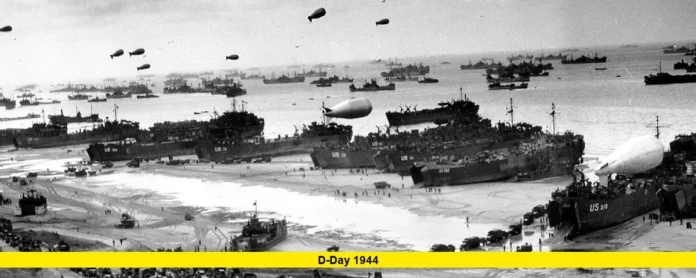

On June 6, 1944, the world witnessed one of the most consequential military operations in human history. Known as D-Day, this massive Allied invasion of Nazi-occupied France not only altered the outcome of World War II but also reshaped the modern world. Eighty-two years later, the world continues to honor the courage, sacrifice, and extraordinary planning that made that single day a turning point for freedom and democracy.
What Is D-Day? The Meaning Behind the Name
The term “D-Day” is a standard military designation used to mark the start date of any large-scale operation — “D” simply stands for “day.” However, the June 6, 1944, invasion of Normandy became so significant that “D-Day” has come to mean that event and that event alone in popular consciousness.
Officially codenamed Operation Overlord, the mission was the largest combined naval, air, and land assault ever launched in the history of warfare. Its goal was to establish a beachhead in Nazi-occupied France, opening a decisive western front to crush Hitler’s Germany between Allied forces advancing from both east and west.
The Road to D-Day: Planning Operation Overlord
The planning for a cross-Channel assault on Europe began almost immediately after France fell to Nazi Germany in 1940. For years, British and American military strategists debated the timing, scale, and precise location of the invasion.
By December 1943, General Dwight D. Eisenhower was appointed Supreme Commander of the Allied Expeditionary Force, and preparations for Operation Overlord intensified dramatically. According to the National WWII Museum, by May 1944, a staggering 2,876,000 Allied troops had been amassed in southern England, along with the largest armada in history and more than 1,200 aircraft standing ready.
A key component of Overlord’s success was Operation Fortitude, an elaborate Allied deception campaign that successfully convinced German High Command that the primary invasion would strike at Pas-de-Calais — not Normandy. This strategic misdirection kept critical German Panzer divisions away from the beaches on the crucial first day.
As per the U.S. Army, in a message to his troops on the eve of the invasion, General Eisenhower declared: “Your task will not be an easy one… We will accept nothing less than full victory.”
June 6, 1944: What Happened on D-Day
The D-Day invasion began in the pre-dawn hours of June 6, 1944. Shortly after midnight, more than 18,000 Allied paratroopers from the American 82nd and 101st Airborne Divisions and British units were dropped into Normandy to seize key bridges, disrupt German communications, and protect the flanks of the coming beach landings.
At dawn, the naval and air bombardment of German coastal defenses began in earnest. Then came the landings.
The Five D-Day Beaches: Utah, Omaha, Gold, Juno, and Sword
Allied forces targeted a 50-mile stretch of Normandy coastline, divided into five assault beaches, each with a distinct code name and assigned force.
Utah Beach (American)
Utah Beach, the westernmost landing zone, was assaulted by the U.S. 4th Infantry Division. Strong currents swept the first wave of troops about two miles south of their intended target — accidentally into a more lightly defended sector. According to the Imperial War Museum, Utah was taken with relatively few casualties compared to the other beaches.
Omaha Beach (American)
Omaha was the most heavily fortified of all five beaches and remains the most iconic D-Day battleground. The beach was defended by deeply entrenched German positions, and the preliminary naval and air bombardment largely missed its targets. According to the National WWII Museum, over 34,000 Americans came ashore at Omaha on June 6, with approximately 2,400 casualties on that beach alone — by far the highest of any single landing zone.
Gold Beach (British)
Gold Beach was stormed by British forces, with landings scheduled for 7:25 a.m. — nearly an hour after the American beaches, due to tidal differences. Allied casualties at Gold numbered approximately 1,000 soldiers, with roughly 350 killed. By the end of the day, British troops had pushed several miles inland and linked up with Canadian forces from Juno.
Juno Beach (Canadian)
Juno Beach was assigned to the 3rd Canadian Infantry Division. Initial resistance was fierce — according to historical accounts, roughly one-third of landing craft struck mines, and nearly half of all Canadian casualties occurred in the first hour. Despite this, the Canadians achieved the deepest Allied penetration inland on D-Day, pushing close to the airfield at Carpiquet west of Caen. By midnight, approximately 21,400 Canadian troops had landed on Juno.
Sword Beach (British)
Sword Beach, the easternmost of the five, was assaulted by the British 3rd Division supported by French and British commandos. Rising tides and congestion on the narrow beach created significant difficulties, but 28,500 men landed on Sword that day, suffering approximately 630 casualties. The division successfully repelled a German counter-attack but fell short of capturing the strategically vital city of Caen — a goal that would take several more weeks to achieve.
The Scale of the D-Day Invasion: By the Numbers
The sheer size of Operation Overlord is difficult to fully comprehend. According to the National WWII Museum and the Imperial War Museum, the invasion involved:
- Nearly 160,000 Allied troops landed on D-Day across all five beaches
- Over 7,000 naval vessels, including 4,000 landing craft and 1,200 warships
- More than 11,000 Allied aircraft providing air cover and support
- 23,400 airborne troops deployed from 822 aircraft and gliders
- Over 10,300 total Allied casualties (killed, wounded, or missing) on D-Day alone
- 4,414 confirmed Allied deaths on June 6, 1944, including 2,501 Americans
- German casualties estimated between 4,000 and 9,000 killed, wounded, or missing
Within just a few days of the initial landing, approximately 326,000 troops, more than 50,000 vehicles, and around 100,000 tons of equipment had landed in Normandy.
The Battle of Normandy: What Followed D-Day
D-Day was not a single battle — it was the beginning of a long and brutal campaign. The Battle of Normandy raged from June 6 through late August 1944. According to historical records, that broader campaign cost 73,000 Allied lives with a further 153,000 wounded.
By August 1944, all of northern France had been liberated. By the spring of 1945, the Allies had driven deep into Germany, and on May 7, 1945, Nazi Germany surrendered unconditionally.
Historians commonly refer to D-Day as the beginning of the end of World War II, and the psychological impact of a successful Allied landing in France was enormous — it called into question Germany’s ability to hold western Europe and dramatically increased resistance activity across occupied territories.
Why D-Day 1944 Still Matters Today
The legacy of June 6, 1944, extends far beyond military history. D-Day stands as a testament to what democratic nations can achieve through unity, sacrifice, and shared purpose. More than 2 million soldiers, sailors, airmen, and support personnel from over a dozen countries participated in Operation Overlord. Their sacrifice liberated hundreds of millions of people from tyranny and bondage.
As the Deseret News observed just hours ago, the 2026 remembrance carries special significance — not only as part of America’s 250th birthday year but also because the remaining veterans who actually fought on those beaches are now in their late nineties and early hundreds, making every anniversary potentially one of the last with firsthand witnesses present.
D-Day 82nd Anniversary 2026: Today’s Commemorations in Normandy
June 6, 2026 marks the 82nd anniversary of D-Day, and the world has gathered once again in Normandy to honor the fallen.
According to reports published today, commemorations began at dawn with French schoolchildren walking across Juno Beach to mark H-Hour — the precise time at which British servicemen were first deployed. Serving military personnel, the grandson of British Commander Field Marshal Montgomery, and pipers from the Jedburgh Pipe Band marched alongside the schoolchildren.
The central international ceremony was held at Langrune-sur-Mer on Sword Beach, with French Prime Minister Sébastien Lecornu, UK Defence Secretary John Healey, and US Defence Secretary Pete Hegseth among the approximately 400 high-profile guests in attendance. The American Battle Monuments Commission hosted a separate official ceremony at Normandy American Cemetery in Colleville-sur-Mer at 11 a.m. CET.
In one of the most moving moments of the day, 100-year-old veteran Ken Hay stood before the crowd at the British Normandy Memorial in Ver-sur-Mer and recited the remembrance poem, tissue in hand, before a minute of silence was observed. Wreaths were laid at the foot of the memorial wall, on which more than 22,000 names are engraved.
Notably, members of UNESCO were also in attendance, as part of an active bid to have the Normandy beaches designated a UNESCO World Heritage Site — a recognition that would permanently enshrine their historical significance in international law.
A new statue of U.S. Army General James M. Gavin was also unveiled in Saint-Mère-Église on June 5, honoring one of the legendary commanders of the airborne operations that preceded the beach landings.
For the fifth consecutive year, Delta Air Lines’ Normandy Legacy Flight program flew World War II veterans and students to Normandy, continuing a powerful tradition of education and remembrance.
Key Figures of D-Day 1944
General Dwight D. Eisenhower — Supreme Commander of the Allied Expeditionary Force, Eisenhower made the final, high-stakes call to proceed with the invasion on June 6 despite uncertain weather. His leadership was essential to Overlord’s success.
Field Marshal Bernard Montgomery — British Commander of Allied ground forces during the initial phase of the invasion. His grandson Henry Montgomery walked across Sword, Juno, and Gold beaches on June 6, 2026, retracing his grandfather’s footsteps.
General Omar N. Bradley — Commander of the U.S. First Army during the D-Day landings, overseeing the American assault on Utah and Omaha beaches.
Prime Minister Winston Churchill — Churchill was instrumental in planning the invasion and personally involved in even minor details — including insisting that the beach code name “Jellyfish” be changed, finding it disrespectful toward those who would die there. It was renamed Juno.
Frequently Asked Questions About D-Day 1944
What does D-Day stand for? The “D” in D-Day simply stands for “day.” It was a standard military term used to designate the start date of a major operation. June 6, 1944, became so historically significant that the term is now synonymous with the Normandy landings.
Why was Normandy chosen for the D-Day landings? The Allies deliberately chose Normandy over the more obvious Pas-de-Calais to surprise the Germans. The longer sea crossing was offset by the element of strategic deception through Operation Fortitude, which successfully misled German High Command about the true invasion target.
How many soldiers died on D-Day? A total of 4,414 Allied troops were killed on D-Day itself, including 2,501 Americans. Over 10,300 Allied soldiers were killed, wounded, or reported missing across all five beaches.
What was Omaha Beach? Omaha Beach was the most heavily defended of the five D-Day landing zones, assigned to American forces. It saw the highest Allied casualties of any beach on June 6, 1944, with approximately 2,400 U.S. casualties.
When did World War II end after D-Day? Following D-Day, all of northern France was liberated by August 1944. Germany surrendered unconditionally on May 7, 1945, less than a year after the Normandy landings.
When is the next D-Day anniversary? The 83rd anniversary of D-Day will be observed on June 6, 2027. Given the advanced age of the remaining veterans, each year’s commemoration carries increasing historical and emotional weight.
The beaches of Normandy speak for themselves — drop your thoughts in the comments below and let us know how you’re honoring the legacy of D-Day 1944 this year.