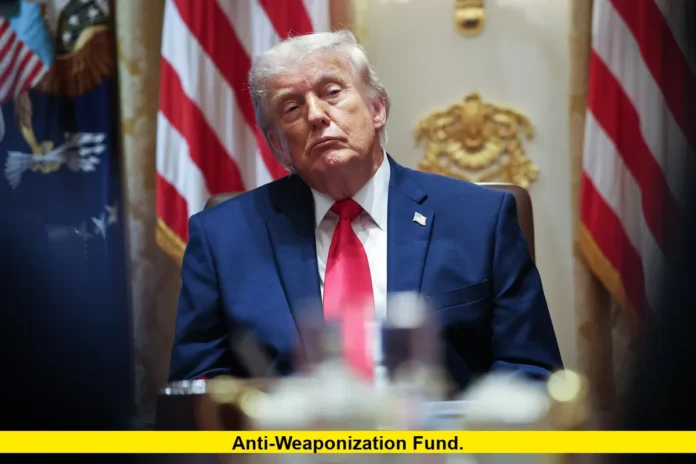

The Trump administration has officially put its position in writing — the controversial $1.8 billion “anti-weaponization fund” is not moving forward. In a landmark filing on June 5, 2026, the Justice Department told two federal judges that lawsuits challenging the program are now moot because the fund was never set up and will no longer be pursued. Here is everything you need to know about how this politically explosive fund rose, sparked rare bipartisan backlash, and ultimately collapsed in a matter of weeks.
What Was the Anti-Weaponization Fund?
Origins of the $1.776 Billion Program
The anti-weaponization fund was born out of a settlement between the Internal Revenue Service and President Donald Trump, two of his sons — Donald Trump Jr. and Eric Trump — and the Trump Organization. As per the Justice Department’s original announcement, the fund was to receive $1.776 billion drawn from the Treasury’s Judgment Fund — a standing appropriation that allows the DOJ to settle and pay cases without needing annual congressional approval.
The settlement resolved a $10 billion lawsuit filed by Trump alleging that the IRS had failed to protect him from an unauthorized leak of his tax returns during his first term in office. As part of the deal, Trump would not personally receive any payments but was promised a formal apology from the IRS. The fund itself was intended to compensate individuals who claimed they were wrongly targeted or persecuted — what the administration called “victims of lawfare and weaponization.”
How the Fund Was Supposed to Work
According to the Justice Department’s original filing, the fund was to be governed by a five-member panel appointed by the Attorney General, with one member chosen in consultation with congressional leadership. Claims were to be processed no later than December 1, 2028, and any remaining money would revert to the federal government. The DOJ also noted legal precedent in the Obama-era “Keepseagle” settlement, which created a $760 million fund to address discrimination claims.
Bipartisan Backlash: Why the Fund Imploded
Republicans Break With Trump
The anti-weaponization fund became one of the most politically damaging self-inflicted wounds of the Trump administration’s second term. In a rare display of intra-party defiance, roughly half of the Republican Senate conference expressed serious reservations about the fund. According to reports, Sen. Ted Cruz of Texas said about half the Republican conference appeared ready to vote with Democrats to restrict or kill it.
The central concerns among GOP senators included the lack of oversight in how money would be distributed, the possibility that Jan. 6 rioters convicted of violently assaulting police could receive payouts, and the perception that taxpayer dollars were being funneled to political allies. Senate Judiciary Committee Chair Sen. Chuck Grassley of Iowa was among the most outspoken, stating that the only way to get immigration enforcement funded was for the president to abandon the weaponization fund entirely.
The controversy was so severe that Senate Majority Leader John Thune was forced to cancel planned votes on a broader $72 billion immigration enforcement reconciliation package — a bill Trump had personally championed — because Republicans couldn’t reach consensus while the fund remained on the table.
Democrats Condemn It as a ‘Slush Fund’
Democrats on both sides of Congress were united in their opposition. Sens. Cory Booker of New Jersey and Bill Cassidy of Louisiana submitted a brief to the federal court describing the fund as “an immediate and dire threat” to Congress and the constitutional order. Several House Democrats alleged that the administration had improperly used the Judgment Fund in other contexts as well, adding to concerns about executive overreach.
Legal Challenges and Court Battles
Federal Judges Step In
Even before the administration reversed course, the anti-weaponization fund faced serious legal obstacles. Two federal lawsuits were filed challenging its legality — one in the Eastern District of Virginia before Judge Leonie M. Brinkema and another in Washington, D.C. A federal judge in Virginia issued an order temporarily blocking the fund, which the DOJ said it would abide by while “strongly disagreeing” with the ruling.
Legal experts flagged multiple constitutional concerns, including the requirement that matters before courts represent genuine controversies between opposing parties — a problem when Trump was effectively suing his own administration and then settling with it. As per critics, the arrangement meant Trump was negotiating with himself, bypassing the judicial scrutiny that would normally apply.
No Money Was Ever Transferred
In court filings, DOJ attorneys acknowledged that the fund never got off the ground. According to the filings, no members were appointed to the five-person governing panel, no claims procedures were established, and no money had been transferred. “No claims were formally submitted, received, adjudicated, granted, or denied,” the DOJ wrote, making the legal challenges simultaneously moot and premature in the government’s view.
The Official End: DOJ’s June 5 Court Filings
Trump Administration Puts It in Writing
On Friday, June 5, 2026, the Justice Department filed court documents in both Alexandria, Virginia, and Washington, D.C., formally confirming in writing for the first time that the anti-weaponization fund will not proceed. The filings stated plainly: “This dispute concerns an Anti-Weaponization Fund that had not been set up and is now not going forward. As a result, Plaintiffs’ claims are not justiciable.”
The documents were signed by Associate Attorney General Stanley Woodward and senior counsel Andrew Block. The DOJ urged judges to dismiss the lawsuits on the grounds that there was no live controversy left to adjudicate. Attorneys argued that asking courts to intervene would allow judges to “unwind a preferable political resolution” and insert themselves into what the administration described as a feature of the democratic process.
Acting AG Blanche’s Congressional Testimony
The written court filings came after Acting Attorney General Todd Blanche had already told a House Appropriations subcommittee on June 2 that the DOJ was “not moving forward with the fund, period.” The administration argued in its court filings that Blanche’s congressional testimony should be considered binding and that the public interest no longer supported judicial intervention against something that had already been halted.
Trump’s Own Confusing Signals
Despite the administration’s formal position in court, President Trump himself injected uncertainty into the situation. When asked in the Oval Office on June 4 whether the fund was dead or just on hold, Trump responded: “I’d have to ask the lawyers. I don’t know.” He went on to say he still considered the fund “a beautiful thing” and expressed strong support for its intent, complicating the administration’s efforts to present a unified front.
Analysts at Lawfare noted that the administration’s abandonment was “characteristically shifty” and raised the possibility that the White House could pursue alternative means of compensating political allies outside the fund’s formal structure. Proud Boy Enrique Tarrio, pardoned by Trump in January 2025, went on record suggesting that even without the official fund, individual lawsuit settlements with no congressional oversight could deliver larger payouts.
Impact on the Senate Reconciliation Bill
Immigration Enforcement Bill Finally Passes
After a two-week delay caused almost entirely by the anti-weaponization fund controversy, the Senate voted 52-47 in the early hours of June 6, 2026, to pass a roughly $70 billion reconciliation package funding Immigration and Customs Enforcement and Customs and Border Protection through 2029. Sen. Lisa Murkowski of Alaska was the lone Republican to vote against the final measure.
Before the bill passed, senators endured a marathon voting session lasting more than 18 hours. Multiple attempts to formally codify the death of the anti-weaponization fund as part of the bill — including a proposal by Sen. Thom Tillis of North Carolina to redirect the funds toward fraud enforcement and a Democratic effort by Minority Leader Chuck Schumer to send the bill back to committee — were defeated on party-line votes. The Senate ultimately passed the bill without imposing any formal legislative restrictions on the fund.
What Happens Next?
With the fund officially abandoned in court filings, the immediate legal battles are likely to be dismissed as moot. However, congressional Democrats have signaled they intend to push for legislation that would permanently bar the administration from reviving the fund or creating a similar program through other legal mechanisms.
Broader questions also remain. The Trump administration’s use of the Judgment Fund — a mechanism with minimal congressional oversight — has come under scrutiny in multiple contexts. Whether the administration will attempt to use alternative legal tools to compensate allies outside this specific fund structure remains an open question that lawmakers on both sides of the aisle say they are watching closely.
FAQ: Anti-Weaponization Fund Explained
What was the anti-weaponization fund? It was a $1.776 billion fund announced by the Trump Justice Department in May 2026 to compensate individuals allegedly targeted by political “weaponization” under prior administrations. It was funded through the Treasury’s Judgment Fund and arose from a settlement of Trump’s lawsuit against the IRS.
Why was the fund controversial? The fund drew bipartisan criticism over concerns about lack of oversight, the possibility of payouts to Jan. 6 convicts, and constitutional questions about Trump effectively suing and settling with his own government. Critics called it a political slush fund.
Who killed the anti-weaponization fund? A combination of federal court rulings, bipartisan congressional pressure, and the Trump administration’s own reversal ended the fund. Acting AG Todd Blanche told Congress the program would not proceed, and the DOJ put that commitment in writing in federal court on June 5, 2026.
Can the fund be revived? Technically, no formal legislation has banned it. Democrats have pledged to pursue permanent legislation barring any revival. The administration has not ruled out using other legal settlement mechanisms to achieve similar ends.
Did anyone receive money from the fund? No. According to DOJ court filings, no money was ever transferred, no governing panel was appointed, and no claims were processed before the fund was scrapped.
What do you think — is the anti-weaponization fund truly dead for good, or could the Trump administration find another path? Drop your thoughts in the comments below and bookmark this page for the latest updates.