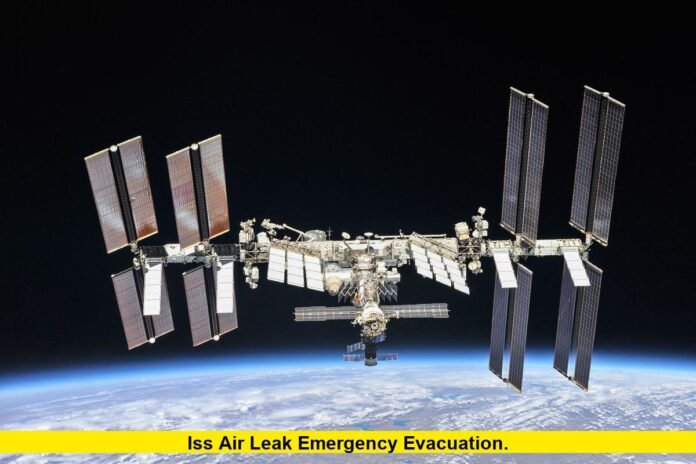

The iss air leak emergency evacuation situation drew global attention on June 5, 2026, after NASA temporarily directed several astronauts aboard the International Space Station (ISS) to shelter inside a docked spacecraft while engineers assessed a worsening air leak in the station’s Russian segment. Fortunately, the incident did not lead to a full evacuation, and the crew was later cleared to resume normal operations after repair efforts were paused for further analysis.
The event highlights the ongoing challenges of maintaining the aging International Space Station, which has remained continuously inhabited for more than 25 years and serves as one of the most important international scientific laboratories ever built.
What Happened During the ISS Air Leak Incident?
NASA ordered five astronauts to move into a docked SpaceX Crew Dragon spacecraft as a precautionary safety measure while Russian space agency Roscosmos attempted repairs on an air leak located in the Zvezda service module transfer tunnel.
The temporary shelter procedure was initiated after engineers detected new concerns during pressurization tests in the Russian section of the station. Safety protocols required astronauts to remain prepared for a potential evacuation if conditions worsened.
However, after approximately two hours of monitoring and assessment, NASA informed the crew that they could leave the spacecraft and return to their regular activities aboard the ISS. The repair work was paused while engineers gathered additional data and measurements to better understand the situation.
Why Was NASA Concerned?
Air leaks in space are taken extremely seriously because maintaining cabin pressure is essential for crew survival.
Although the leak did not pose an immediate threat, NASA and Roscosmos have been monitoring recurring pressure loss issues in the Russian segment for several years. The latest discovery raised concerns because engineers identified additional leak locations during testing.
Reports indicate that specialists quickly sealed one leak site while continuing investigations into another suspected leak area. The situation prompted mission controllers to activate precautionary procedures even though station systems remained stable.
Space agencies emphasize that such actions are part of standard safety protocols designed to protect astronauts while technical teams evaluate evolving situations.
Astronauts Return to Normal Operations
Following discussions between NASA and Roscosmos, repair efforts were temporarily halted to allow engineers to analyze new data.
Once the work was paused, NASA determined there was no immediate need for astronauts to remain in emergency shelter mode. The crew exited the Dragon spacecraft and returned to their normal scientific and maintenance activities aboard the station.
The quick resolution demonstrated the effectiveness of established emergency procedures developed over decades of human spaceflight experience.
While the shelter order lasted only a short period, it served as an important real-world test of ISS emergency readiness systems.
Which Astronauts Were Affected?
The precautionary shelter order involved members of the current ISS crew, including astronauts and cosmonauts representing multiple international partners.
The station currently hosts a multinational team that includes NASA astronauts, Roscosmos cosmonauts, and European Space Agency personnel.
International cooperation remains one of the defining features of the ISS program. During incidents such as air leaks, teams from multiple space agencies coordinate closely to ensure crew safety and mission continuity.
This collaborative approach has helped maintain the station’s successful operation despite numerous technical challenges throughout its history.
The Long-Running Air Leak Problem
The recent incident is part of a broader issue that has affected the ISS for several years.
Engineers have repeatedly identified small leaks and cracks within portions of the Russian segment, particularly around the Zvezda service module and associated transfer areas.
While many of these leaks have been repaired or stabilized over time, new pressure-loss concerns occasionally emerge during inspections and testing.
Space agencies continue to investigate the root causes behind the recurring leaks, which may involve structural aging, material fatigue, or other long-term factors associated with operating a spacecraft in the harsh environment of low Earth orbit.
The ISS first began operations in 1998 and has hosted continuous human presence since November 2000, making it one of the longest-running space habitats ever constructed.
How Emergency Procedures Work on the ISS
The International Space Station is equipped with detailed emergency response protocols for a variety of potential threats, including:
- Air leaks
- Fire incidents
- Toxic atmosphere events
- Space debris impacts
- System failures
When a possible pressure leak is detected, astronauts may be instructed to move into docked spacecraft that can serve as emergency escape vehicles.
These spacecraft remain attached to the station specifically to provide evacuation capability if a serious emergency develops.
In the latest incident, the SpaceX Crew Dragon spacecraft served as the designated safe-haven location while engineers assessed the situation.
Because the leak remained manageable and repairs were underway, evacuation ultimately proved unnecessary.
Why the ISS Remains Safe
Despite headlines suggesting an emergency evacuation, NASA and Roscosmos repeatedly emphasized that there was no immediate danger to crew members or station systems.
The decision to place astronauts in shelter mode was a precautionary measure intended to maximize safety while repairs were conducted.
Space agencies routinely use conservative safety standards when dealing with potential risks in orbit. Even relatively small changes in leak rates can trigger heightened monitoring and temporary operational changes.
This cautious approach helps ensure that potential problems are addressed before they become critical.
The successful return of astronauts to normal station activities underscores the effectiveness of these safety procedures.
Impact on Future Missions
The air leak issue comes at a time when multiple international missions are planned for the ISS.
Engineers will continue evaluating the affected areas before approving future docking operations and crew exchanges.
Recent leak concerns have already influenced mission scheduling decisions, prompting additional inspections and testing before some planned launches.
Nevertheless, officials have indicated that current station operations remain stable and that scientific research aboard the orbital laboratory continues uninterrupted.
The incident is unlikely to alter the long-term mission of the ISS, but it reinforces the importance of ongoing maintenance and monitoring as the station ages.
The Future of the International Space Station
The ISS remains one of humanity’s most ambitious engineering achievements.
For more than two decades, astronauts have conducted thousands of experiments in microgravity, advancing knowledge in medicine, physics, biology, materials science, and space exploration.
As the station approaches the later years of its operational life, maintenance challenges such as air leaks become increasingly significant.
NASA and its international partners continue working on plans for future commercial space stations that could eventually succeed the ISS.
Until then, engineers remain committed to safely operating and maintaining the orbital laboratory while supporting groundbreaking scientific research.
Final Thoughts
The latest iss air leak emergency evacuation scare ended without injury, evacuation, or major disruption to station operations. While astronauts briefly sheltered inside a docked spacecraft as a precaution, NASA and Roscosmos successfully managed the situation and allowed the crew to return to normal duties. The incident serves as a reminder of both the challenges and resilience involved in maintaining a permanently inhabited laboratory hundreds of miles above Earth.
What do you think about the latest ISS safety procedures? Share your thoughts in the comments and stay updated for more space exploration news and breaking developments.