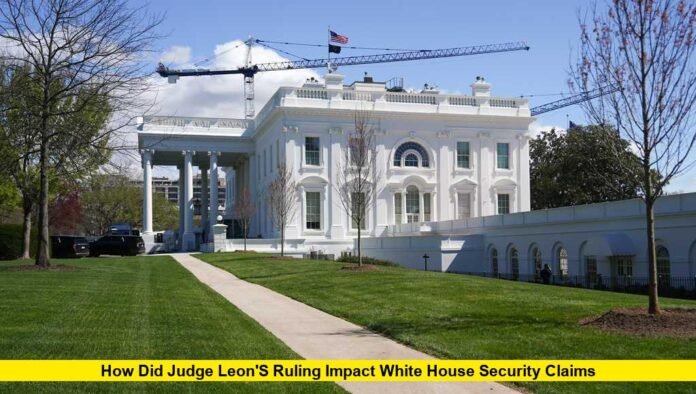

The legal battle over President Donald Trump’s $400 million White House ballroom has put a spotlight on a critical constitutional question: can the executive branch invoke national security to bypass federal law? At the center of it all is Senior U.S. District Judge Richard Leon, whose rulings have repeatedly challenged the Trump administration’s broad security claims — and reshaped the boundaries of presidential authority in the process.
Who Is Judge Richard Leon?
Judge Richard Leon is a senior U.S. District Judge for the District of Columbia, nominated to the bench by Republican President George W. Bush in 2002. Known for running a tight courtroom and delivering even-handed decisions regardless of the administration in power, Leon has earned bipartisan respect over decades of service.
His reputation for independence is well established. In 2008, he became the first federal judge to order the release of detainees at Guantanamo Bay, ruling against the very administration that appointed him. His portrait unveiling in 2018 drew three sitting Supreme Court justices — conservatives Clarence Thomas and Chief Justice John Roberts, and liberal Elena Kagan — a rare show of cross-ideological admiration.
It is this record that makes his rulings on the White House ballroom dispute especially significant.
Background: The White House Ballroom Controversy
The controversy began in late 2025 when the Trump administration demolished the East Wing of the White House to make way for a massive new ballroom — a nearly 90,000-square-foot structure intended to host up to 999 guests. Trump has described the project as a gift to America, funded largely by private donations, though public funds are being used for an underground bunker and security upgrades beneath the site.
In December 2025, the National Trust for Historic Preservation filed a lawsuit arguing that the project violated federal law because Congress had never authorized it.
Judge Leon’s March 31 Ruling: The First Major Blow
On March 31, 2026, Judge Leon issued a landmark preliminary injunction ordering construction to halt. His reasoning was unambiguous: no statute “comes close” to granting Trump the authority he claims he has to rebuild the ballroom, and he concluded the preservationist group suing to stop it is likely to succeed on the merits of its claims.
In a pointed line that would reverberate across legal circles, Leon wrote: “The President of the United States is the steward of the White House for future generations of First Families. He is not, however, the owner.”
Acknowledging the logistical realities of halting an ongoing project, the judge suspended enforcement of his order for 14 days to allow the White House time to appeal.
How Did the Administration Respond to the Ruling?
The Trump administration moved quickly. In an emergency motion filed in the U.S. Court of Appeals for the District of Columbia, National Park Service lawyers argued that Leon’s decision left the executive mansion “open and exposed” and was “threatening grave national-security harms to the White House, the President and his family, and the President’s staff.”
The filing cited dramatic specifics: materials that would be installed to make a “heavily fortified” facility, including bomb shelters, military installations, and a medical facility. The administration also pointed to features like bulletproof windows, missile-resistant columns, and drone-proof roofs as essential security upgrades.
The Appeals Court Sends the Case Back
On April 11, 2026, a three-judge panel from the D.C. Circuit Court of Appeals weighed in — but rather than ruling definitively, it returned the case to Judge Leon. The panel said it did not have enough information to decide how much of the project can be suspended without jeopardizing the safety of the president, his family, or the White House staff. The panel instructed Leon to clarify whether — and how — his injunction interferes with the administration’s plans for safety and security.
The appeals court extended its stay for three days, to April 17, to allow the Trump administration to seek Supreme Court review.
Judge Leon’s April 16 Clarification: Security Is Not a Blank Check
On April 16, 2026, Judge Leon issued his clarified ruling — and it was a decisive rejection of the administration’s sweeping security argument. Leon rejected the president’s “disingenuous” bid to circumvent an earlier ruling against the project by claiming that it needed to proceed for national security reasons.
The judge drew a clear and firm line. In his own words: “National security is not a blank check to proceed with otherwise unlawful activity.”
Leon’s latest ruling came in response to the appeals court’s instruction and addressed the 90,000-square-foot ballroom planned for the site where the East Wing of the White House once stood.
What Construction Was Allowed?
Leon did not block all work at the site. His revised order allowed for “below-ground construction of national security facilities, work necessary to provide for presidential security, and construction necessary to protect and secure the White House and the construction site itself.”
However, the above-ground ballroom remained firmly off-limits without congressional approval. The judge reiterated that crews could continue working on the bunker and could proceed with other work “necessary to ensure the safety, security, and structural integrity of the White House” and its grounds, but made clear that no above-ground construction could continue except work to cover and secure the facilities being built underground.
What Did Leon Say About the Administration’s Security Claims?
The judge was sharply critical of the administration’s attempt to use national security as a blanket justification. Leon said the court had “taken Defendants’ invocation of national security and presidential security seriously throughout this case,” noting that this was precisely why he had included a safety-and-security exception in his original order.
But he dismissed the administration’s expanded argument: “Defendants argue that the entire ballroom construction project, from tip to tail, falls within the safety-and-security exception and therefore may proceed unabated,” Leon wrote. He rejected that interpretation outright.
On the specific features the White House cited as security necessities, Leon noted that while features like bulletproof windows and missile-resistant columns “may well be beneficial,” the administration had not provided justification for why these must be installed immediately.
The Broader Legal Significance: Limits on Presidential Power
Judge Leon’s rulings carry implications well beyond the ballroom itself. By refusing to allow the national security label to override judicial oversight and congressional authority, Leon has reinforced a foundational constitutional principle: that the executive branch cannot use security claims as a free pass to conduct otherwise unlawful activity.
This matters because the administration’s argument was unusually expansive. It essentially claimed that because some below-ground elements of the project served security purposes, all above-ground construction — including the grand ballroom — was therefore a security necessity. Leon rejected this logic directly, calling the claims “belated” and characterizing the effort to reframe the entire project as a national security installation as disingenuous.
Leon has ruled against executive overreach no matter the president — a record that gives his decisions substantial legal weight and credibility across party lines.
What Happened After the April 16 Ruling?
The administration did not accept the ruling quietly. The Justice Department appealed Leon’s decision. Anticipating the appeal, Leon delayed implementation of his ruling for one week and warned the White House that any above-ground work that happens during that period may need to be reversed depending on how the case plays out.
The administration filed a notice that it will ask the U.S. Court of Appeals for the District of Columbia Circuit to review Leon’s latest decision as well.
President Trump responded with sharp public criticism. On social media, Trump called Leon — a George W. Bush nominee — a “Trump Hating” judge who “has gone out of his way to undermine National Security, and to make sure that this Great Gift to America gets delayed, or doesn’t get built.”
Meanwhile, the project’s opponents expressed satisfaction. The National Trust for Historic Preservation stated it was pleased with the court’s rulings, reinforcing that the legal challenge remains on solid footing.
Timeline of Key Events
- December 2025 — National Trust for Historic Preservation files lawsuit challenging the ballroom project
- March 31, 2026 — Judge Leon issues preliminary injunction halting above-ground construction; enforcement suspended for 14 days
- April 2, 2026 — National Capital Planning Commission gives final approval to the ballroom project
- April 4, 2026 — Trump administration files emergency motion in appeals court citing grave security risks
- April 11, 2026 — D.C. Circuit Court of Appeals returns case to Leon, asking him to clarify the security exception
- April 16, 2026 — Leon issues clarified ruling, rejecting the administration’s broad security argument; blocks above-ground construction
- April 17, 2026 — Administration files notice to appeal; Leon’s ruling stays in effect pending further appeals
What This Means Going Forward
The case is likely headed for further appellate scrutiny, and the Supreme Court remains a possible destination. The core legal question — whether a president can invoke national security to bypass the requirement for congressional authorization — is one the courts have not squarely addressed in this context before.
Judge Leon’s rulings have, at minimum, established that courts will not accept sweeping national security claims at face value. The government must provide specific, credible justification for why a particular security need cannot wait for lawful authorization — and calling an entire construction project a “security necessity” does not meet that bar.
For preservationists, constitutional scholars, and anyone watching the evolving limits of executive power, the White House ballroom case has become one of the most consequential legal battles of 2026.
Do you think Judge Leon drew the right line between national security and the rule of law? Share your thoughts in the comments below — and follow us for the latest updates as this case moves through the courts.