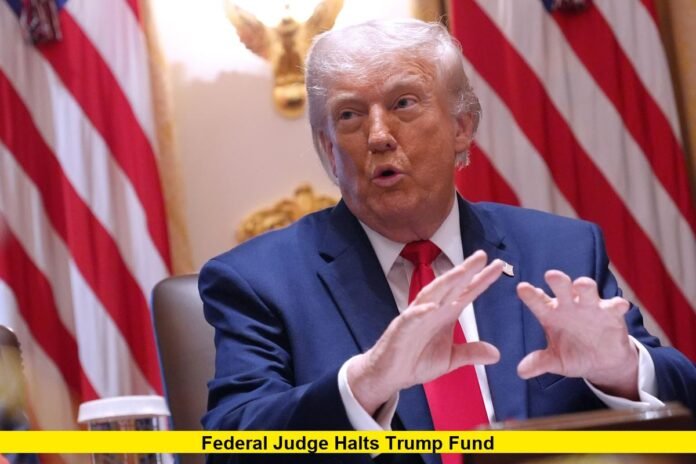

A federal judge has moved to halt one of the most controversial financial initiatives launched by the Trump administration — a nearly $1.8 billion “Anti-Weaponization Fund” that critics across the political spectrum quickly condemned as a taxpayer-funded slush fund for the president’s allies.
What Happened: The Court Order Explained
On the morning of Friday, May 29, 2026, U.S. District Judge Leonie M. Brinkema of the Eastern District of Virginia issued a two-page order temporarily blocking the Trump administration from moving forward with its plan to create and operate the fund. In clear and sweeping language, the judge ruled that the administration cannot take any action “pursuant to the creation or operation of the Anti-Weaponization Fund, which includes the transferring of money to the Fund; the consideration of any claims submitted to the Fund; and the disbursing of any funds from the Fund.”
Judge Brinkema, who was appointed to the federal bench by President Bill Clinton, also scheduled a hearing for June 12, 2026 to hear arguments on whether to extend the halt on a more lasting basis. A key factor in her decision to act immediately was the government’s failure to provide the court with assurances that it would hold off on disbursing any funds while litigation was pending — a detail the judge highlighted in a footnote of her order.
Background: What Is the Anti-Weaponization Fund?
The Anti-Weaponization Fund was announced earlier in May 2026 by the Justice Department as part of an unprecedented legal settlement between President Donald Trump, his sons Donald Trump Jr. and Eric Trump, and the Trump Organization — and the Internal Revenue Service. The lawsuit originally centered on the leak of Trump’s tax returns during his first term.
Under the settlement terms, the Trump family and the Trump Organization would receive a formal apology but no direct monetary payment or damages. However, the settlement established the $1.776 billion fund — a figure that notably echoes the country’s founding year — to compensate individuals who claim they were unfairly targeted by the federal government. Acting Attorney General Todd Blanche described the fund as providing “a systematic process to hear and redress claims of others who suffered weaponization and lawfare.”
The money for the fund was drawn from the Judgment Fund, a congressional appropriation traditionally used by the government to pay legal claims filed against it. Legal experts immediately raised red flags, with one law professor noting that the Judgment Fund “is for lawsuits — it’s not for an amorphous group of people who feel like they’ve been wronged generally by a prior administration.”
Trump himself defended the fund publicly, saying it was meant to reimburse people who were “horribly treated,” had their lives destroyed, or went bankrupt over legal fees stemming from what he described as political persecution.
Who Is Eligible — and Who Is Not?
The fund has drawn intense scrutiny over who might ultimately receive payouts. Acting AG Blanche told lawmakers on May 19 that he could not promise to bar compensation for January 6, 2021, Capitol rioters, Trump campaign donors, or Republican lawmakers whose phone records were seized during the Jack Smith investigation into efforts to overturn the 2020 election.
Both Democratic and Republican voices condemned the fund. Senator Ron Wyden called it a setup for “a $1.7 billion slush fund for right-wing political violence,” while Senator Elizabeth Warren described it as “an insane level of corruption.” Critics also pointed to the fact that Acting AG Blanche previously served as Trump’s personal defense attorney in federal cases involving election interference and classified documents.
Trump allies, pardoned January 6 defendants, and others connected to the administration have already come forward expressing interest in receiving compensation from the fund.
Who Sued — and Why
The lawsuit that led to Judge Brinkema’s order was filed in the Eastern District of Virginia and brought by a diverse coalition of plaintiffs who argue they were themselves targeted by the Trump administration — but are explicitly ineligible to receive anything from the fund because the government views them as ideological or political opponents.
One of the most prominent plaintiffs is Andrew Floyd, a former Assistant U.S. Attorney who led Capitol riot prosecutions before being fired, which he believes was direct retaliation for his January 6 work. In a court filing, Floyd stated: “The President’s targeting of me and others involved in January 6 prosecutions leaves our country in a very dark place, sending a message that insurrection and sedition will be protected (and even encouraged) as long as it is on behalf of this administration.”
Other plaintiffs include Jonathan Caravello, a California State University professor who was acquitted of an assault charge stemming from a 2025 protest against an immigration raid, and the city of New Haven, Connecticut, which the DOJ recently sued over its sanctuary city immigration policies.
Their lawsuit argues that the fund “rewards and incentivizes unlawful behavior and facilitates an astounding abuse of taxpayer funds,” and calls the legal foundation of the fund entirely without merit — noting the unusual nature of a sitting president suing the executive branch agencies he himself controls.
The suit also charges that the underlying IRS settlement was “meritless” because of the president’s unique dual role as both a plaintiff and head of the executive branch — a constitutional paradox that legal experts have called unprecedented in American history.
Other Legal Challenges Mounting
The Virginia case is not standing alone. At least two additional lawsuits have been filed separately in Washington, D.C., also challenging the fund’s creation. The advocacy group Citizens for Responsibility and Ethics in Washington (CREW) filed one of those suits, describing the fund as “a jaw-dropping act of presidential corruption.” Separately, two Capitol Police officers who helped defend the Capitol on January 6 also filed suit to block potential payouts to the rioters they confronted that day.
What Comes Next
With Judge Brinkema’s temporary block now in place, the fund is frozen — no money can be transferred to it, no claims can be considered, and no disbursements can be made. The June 12 hearing will be the next major legal milestone, where the court will consider whether to issue a more extended preliminary injunction keeping the fund on hold while the full legal challenge plays out.
The Department of Justice did not immediately respond to press requests for comment on the ruling.
Given the number of parallel legal challenges and the constitutional questions raised — including the misuse of the Judgment Fund, the president’s role as both plaintiff and executive, and potential violations of federal statutes — this legal battle is widely expected to reach the appellate level, and potentially the Supreme Court.
This story is still unfolding — drop your thoughts in the comments below, and make sure to bookmark this page for the latest updates as the June 12 hearing approaches.