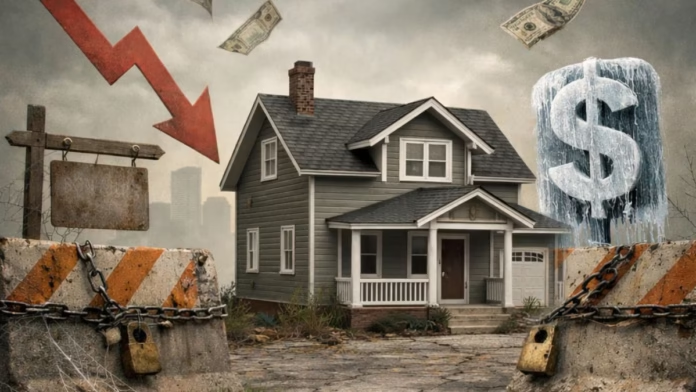

The US housing market has endured three grinding years of high mortgage rates, frozen inventory, and sidelined buyers — but the spring of 2026 is telling a different story. Fresh data, shifting seller behavior, and a reawakening across dozens of metro areas are signaling that the long-awaited thaw may finally be here. Whether you’re a first-time buyer, a seller on the fence, or an investor reassessing your strategy, understanding the 2026 US housing market trends is essential before your next move.
The Big Headline: New Listings and Contract Signings Hit a Four-Year High
The most important data point of spring 2026 comes straight from Realtor.com’s Spring 2026 Housing Market Progress Report: new listings and contract signings have each reached their highest levels since 2022. Contract signings climbed 4.5% year-over-year in April 2026 — the strongest annual gain in three years — while new listings rose 1.4% year-to-date and now sit 22% above their 2023 low.
“For the first time in three years, we’re seeing contract signing growth that genuinely outpaces the trend of the recent past,” said Jake Krimmel, senior economist at Realtor.com. “Buyers have been sidelined but they haven’t disappeared — they’ve simply been waiting for the right conditions.”
That patience is now paying off. For the first time since mortgage rates surged from pandemic-era lows of sub-3% to the current 6%–7% range, both supply and demand signals are improving at the same time. With homes that go under contract typically closing within four to six weeks, this demand signal is on track to appear in closed-sales data by June — the clearest evidence yet that the 2026 housing market is genuinely starting to move.
Why Sellers Are Finally Coming Off the Sidelines
One of the most persistent drags on the housing market over the past three years has been the “rate lock-in” effect: homeowners sitting on mortgage rates of 3% or lower had little financial incentive to sell and take on a new loan at double the cost. That dynamic is quietly beginning to loosen.
According to Coldwell Banker’s 2026 Home Shopping Season Report — based on a survey of more than 700 real estate agents nationwide — one in three home sellers is now giving up a mortgage rate below 5%. For many, the decision to list is driven less by market timing and more by life itself: 36% of agents say their clients are listing due to personal life circumstances such as job changes, family needs, or downsizing.
Nationally, 43% of real estate agents report a busier home shopping season than last year. The mood, however, is described as “measured.” Buyers are re-entering the market with renewed intent, but they are more cautious and discerning than in years past. Sellers who have adjusted to that reality — pricing their homes realistically from day one — are finding buyers. Those who haven’t are sitting with stale listings.
These 21 US Cities Suddenly Became Hot Housing Markets Again
Across the top 50 metro areas, contract signings are up in 34 markets compared with 2025. In 31 of those metros, new home listings are also rising. But the most encouraging signal is this: in 21 markets, new listings and contract signings are climbing together — the dual-engine dynamic that defines a truly functioning market.
That phenomenon is happening predominantly in the Midwest, where affordability is strongest and buyers have the most purchasing power:
- Kansas City, MO — leading the national rebound with gains on both sides of the ledger
- Louisville, KY — rising listings meeting rising demand
- Indianapolis, IN — one of the most active markets in the country
- Columbus, OH — consistent buyer activity and competitive pricing
- Cincinnati, OH — strong fundamentals driving both listings and signings
Meanwhile, some Southern markets are showing their own version of recovery. Austin and Jacksonville are recording higher contract signings despite fewer new listings — a rebound driven by notable price corrections after the pandemic-era overvaluation that made those cities unaffordable for many buyers.
Where Home Prices Stand in 2026
Home prices nationally are still elevated — but the pace of appreciation has slowed materially. The S&P Cotality Case-Shiller Index reported a 0.91% year-over-year increase in January 2026, which translates to a 1.44% decline in real terms when adjusted for inflation. In plain language: homes are still expensive, but they’re not getting more expensive as fast as inflation, which means real affordability is slowly improving.
A March 2026 Reuters survey of housing analysts projects US home prices will rise approximately 1.80% in 2026, followed by 2.50% in 2027. Redfin has dubbed this the “Great Housing Reset” — not a crash, not a boom, but a prolonged period of gradual normalization where income growth begins to outpace home-price growth for the first time since the Great Recession era.
The national median list price per square foot fell 2.4% year-over-year in April 2026, and the share of listings with price reductions has eased — a sign that sellers are pricing more accurately from the start rather than over-pricing and later cutting.
Regional variations are sharp:
- The Northeast (Connecticut, New Jersey, New York, Rhode Island) remains the most competitive region, with tight inventory and rapid turnover. Hartford, CT tops Zillow’s 2026 hottest markets list, with 66.4% of homes selling above asking price and inventory still 63% below pre-pandemic levels.
- The Midwest offers the best affordability and the most momentum right now.
- The Sun Belt (Austin, Jacksonville, parts of Florida) is correcting after pandemic-era over-building and price inflation.
- The West Coast is seeing home prices fall the most, particularly in areas where new construction boomed post-2020.
Mortgage Rates: Still High, But Strategies Exist
The 30-year fixed mortgage rate is hovering around 6.3%–7% in 2026 — far above the sub-3% lows of 2020–2021 but slightly below peak levels seen in late 2023. With inflation still present and the Federal Reserve moving cautiously, most analysts expect rates to remain in the 6%+ range through the end of 2026.
That doesn’t mean buyers are without options. Several strategies have become increasingly popular:
- Builder rate buydowns: Many homebuilders are paying upfront to lower buyers’ rates — sometimes to 4.9% instead of 6.25% — a significant monthly savings tool.
- Adjustable-rate mortgages (ARMs): ARMs have regained attention as buyers seek lower initial rates with plans to refinance if borrowing costs decline.
- Assumable mortgages: Savvy buyers are seeking out FHA and VA loans where they can inherit a seller’s historically lower interest rate.
- Down payment assistance: State housing finance agencies have significantly expanded DPA programs. California’s Dream For All program, for example, offers up to 20% down payment assistance for qualifying buyers.
Real-World Example: The Kansas City First-Time Buyer
Take the story playing out across Kansas City right now. A couple in their early 30s — both professionals, household income around $110,000 — had been watching the market for two years, priced out by overvalued listings and high rates. In early 2026, they found a 3-bedroom home listed at $285,000, down from a $310,000 peak price in 2022. Their lender offered a rate buydown program from the builder on a comparable new-build nearby, reducing their effective rate to 5.4% for the first two years.
After comparing both options, they went under contract on the existing home — the seller, motivated by a job relocation, had priced realistically from the start. The transaction closed in 34 days. This is exactly the type of realistic pricing + motivated seller + prepared buyer equation that is now repeating across the Midwest.
Practical Steps for Buyers in the 2026 Market
The 2026 housing market rewards preparation. Here’s what experts recommend:
1. Get pre-approved before you start shopping. Knowing your real buying power before you fall in love with a home prevents heartbreak and positions you as a serious buyer in competitive markets.
2. Explore all loan types — not just the standard 30-year fixed. FHA loans require as little as 3.5% down. Conventional loans can start at 3% for first-time buyers. ARMs may make sense if you plan to sell or refinance within 5–7 years.
3. Ask builders about rate buydowns and incentives. In inventory-heavy markets, builders are offering significant concessions. A 1%–2% rate buydown over the first few years can save thousands of dollars in the short term.
4. Research down payment assistance programs in your state. Many buyers qualify for DPA programs and don’t know it. A HUD-approved housing counselor can identify programs you may be eligible for.
5. Target metros with dual momentum (rising listings AND signings). The 21 metros where both metrics are rising simultaneously represent the healthiest markets. These are places where you’ll find more inventory and less bidding war pressure than in the ultra-tight Northeast.
6. Price your home realistically if you’re selling. The data is unambiguous in 2026: sellers who price competitively from day one are finding buyers. Those who cling to 2022 peak valuations are not.
7. Budget beyond the mortgage payment. Property taxes, insurance, HOA fees, and maintenance costs can add 25%–40% to your monthly housing cost. Build those into your budget before you commit.
Key Points Summary
╔════════════════════════════════════════════════════════════════════╗
║  – New listings and contract signings hit their highest levels     ║
║    since 2022, per Realtor.com's Spring 2026 Progress Report.      ║
║                                                                    ║
║  – Contract signings rose 4.5% year-over-year in April 2026,      ║
║    the strongest annual gain in three years.                       ║
║                                                                    ║
║  – 21 US cities now have both listings and signings rising         ║
║    simultaneously — largely in the Midwest.                        ║
║                                                                    ║
║  – Home price growth has slowed to ~1.8% forecast for 2026,        ║
║    with real (inflation-adjusted) prices declining slightly.       ║
║                                                                    ║
║  – One in three sellers is now giving up a sub-5% mortgage rate,  ║
║    unlocking inventory that has been frozen since 2022.            ║
║                                                                    ║
║  – Mortgage rates remain in the 6%–7% range; builder buydowns,    ║
║    ARMs, and DPA programs are key affordability tools in 2026.     ║
║                                                                    ║
║  – Hartford, CT tops Zillow's 2026 hottest market list; Buffalo,  ║
║    Boston, and Philadelphia round out the competitive Northeast.   ║
╚════════════════════════════════════════════════════════════════════╝
The Bottom Line
The 2026 US housing market is not a boom. It is not a crash. It is, as Redfin economists have described it, a “Great Housing Reset” — a slow but real recalibration where sellers are accepting today’s reality, buyers are cautiously re-emerging, and the cities that benefit most are those where realistic pricing has replaced wishful thinking. The data from spring 2026 is the most encouraging in four years. Whether it holds through the summer and into 2027 depends on mortgage rates, inventory growth, and whether the supply-demand realignment that’s beginning in the Midwest can spread to the rest of the country.
For buyers and sellers alike, the window of opportunity is real — but it rewards those who come prepared.
Are you navigating the 2026 housing market as a buyer, seller, or investor? Drop your questions and experiences in the comments below — we’d love to hear what’s happening in your market, and we’ll keep this page updated as new data rolls in.