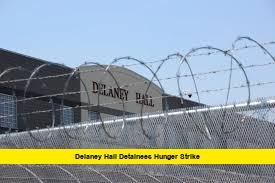

Immigration detention in America has rarely looked quite so tense as it does right now at Delaney Hall in Newark, New Jersey. Since Friday, May 22, 2026, roughly 300 detainees have been on a hunger and labor strike, refusing meals and work assignments to demand their freedom and draw attention to what they describe as inhumane conditions inside the facility. The protest has triggered protests outside the jail, visits by high-ranking elected officials, clashes between ICE agents and demonstrators, and a wave of national media attention that shows no sign of dying down.
What Is Delaney Hall?
Delaney Hall is a privately operated immigration detention facility located at 451 Doremus Avenue in Newark, New Jersey. Managed by the GEO Group under a contract with U.S. Immigration and Customs Enforcement (ICE), the facility has an authorized capacity of roughly 1,196 detainees. It holds the distinction of being the first federal immigration detention center to open under President Donald Trump’s second term, after a 15-year, $1 billion contract was awarded to GEO Group in early 2025.
The facility’s re-opening was itself contentious. Newark Mayor Ras Baraka publicly argued that GEO Group had not complied with standard municipal building and safety regulations, and the city filed a lawsuit in New Jersey Superior Court alleging the detention center lacked a valid certificate of occupancy. Despite that legal dispute, Delaney Hall began housing detainees and has remained a flashpoint for the broader national debate over immigration enforcement.
How the Hunger Strike Began
The current hunger and labor strike did not emerge without warning. In the weeks before it launched, nearly 300 detainees signed and circulated a letter describing what they called deteriorating conditions inside the jail — insufficient food, inadequate medical care, and systematic mistreatment by guards. That letter caught the attention of advocacy groups and elected officials alike.
On May 18, 2026, Representatives LaMonica McIver, Rob Menendez, and Analilia Mejia conducted an unannounced oversight visit to Delaney Hall to investigate the claims firsthand. What they found confirmed the detainees’ accounts. Representative McIver stated afterward that conditions inside included not enough food, no adequate medical care, and treatment that detainees themselves described as torture.
On Friday, May 22, 2026, detainees made their move. During a rally held outside the facility, those inside called out to family members and supporters through phone calls broadcast over a bullhorn. They announced the start of both a hunger strike and a labor strike — refusing meals and stopping participation in the facility’s internal work program, where detainees can earn roughly one dollar per day performing jobs inside the jail. Their statement was unambiguous: “We are not striking to demand better treatment and conditions. We are doing this to demand freedom.”
The Conditions at the Heart of the Strike
Advocates, attorneys, and lawmakers who have entered Delaney Hall paint a troubling picture of life inside. Among the most consistent allegations are overcrowding, poor food quality, and a lack of basic medical attention.
This is not the first time food has been at the center of unrest at Delaney Hall. In June 2025, a riot broke out after detainees protested the lack of meals and drinking water. Prior to that uprising, detainees had reported receiving frozen or incomplete meals, with some individuals getting only a hot dog while others received only the bun. The June 2025 riot was suppressed with the use of tear gas and riot gear, and four detainees escaped by breaking through a partition made of chicken wire and plaster — an episode that advocates said underscored both the desperation of those held inside and the facility’s disregard for proper construction and inspection standards.
Then, in December 2025, a detainee named Jean Wilson Brutus was pronounced dead less than 24 hours after arriving at Delaney Hall. His death prompted calls for an independent investigation and autopsy, and it cast a long shadow over the facility’s reputation heading into 2026.
Beyond physical conditions, detainees and their families have raised serious due process concerns. Senator Andy Kim, who visited the facility on Saturday, May 23, described speaking with numerous people who had been detained while following the formal legal process — showing up for scheduled green card interviews — and who were then arrested on the spot. Kim also reviewed a court docket showing 74 immigration cases scheduled before a single judge in a single day, allowing an average of approximately five minutes per case.
Political and Community Response
The hunger strike has drawn an extraordinary level of political attention for a detention facility, with elected officials visiting on multiple occasions over just a few days.
Senator Andy Kim and Representative Rob Menendez visited Delaney Hall on Saturday evening, May 23, for a congressional oversight visit. Menendez expressed concern that ICE might use transfers as leverage against strikers, noting that when detainees go on hunger strikes, it carries real power — and that federal authorities knew it.
On Sunday, May 24, the situation escalated. Menendez returned to the facility and attempted entry again to check on striking detainees, but was not allowed inside. That same afternoon, word spread that guards were attempting to move a detainee who was among those leading the strike. Gabriela Soto, a 28-year-old U.S. citizen who is several months pregnant and whose husband Martin Soto has been held at Delaney Hall since February, was standing in the visitor line when she saw her husband being forced into a van. She ran toward the vehicle and pounded on its doors. Protesters who had gathered outside formed a human blockade at the gates of the facility, chanting “Free Martin,” and held their position for hours into Sunday night.
Attorneys for Martin Soto had already filed a habeas corpus petition in New Jersey court seeking his release — a legal claim that a transfer to another jurisdiction could effectively derail.
On Memorial Day, Monday, May 25, 2026, Governor Mikie Sherrill joined Senator Kim and several other members of the congressional delegation — including Representatives McIver, Pou, Menendez, and Mejia, as well as Newark Mayor Ras Baraka — outside Delaney Hall. Sherrill’s request for formal access to the facility was denied by federal officials, who described her visit as politically motivated. Unlike members of Congress, the governor does not carry federal oversight authority to enter ICE facilities. She remained outside, speaking with detainee families near the gates.
Senator Kim, however, was eventually allowed inside after directly contacting DHS Secretary Markwayne Mullin. Later that afternoon, ICE threatened to transfer more than 100 detainees involved in the strike to facilities in Louisiana and Texas. As Kim attempted to negotiate against those transfers, ICE agents fired rubber bullets at protesters gathered outside and used pepper spray on the crowd. Senator Kim and local assembly candidate Mussab Ali were reportedly among those affected by the agents’ response.
Representative Frank Pallone, who had visited Delaney Hall earlier in 2026, returned on Monday and issued a statement saying he was shocked by what he witnessed during that earlier visit and was disgusted that conditions had continued to worsen in the months since.
ICE and Federal Government’s Position
Federal officials have largely pushed back against the characterization of conditions at Delaney Hall as inhumane, framing the political visits as theater rather than legitimate oversight. The Department of Homeland Security released a statement through a spokesperson describing Governor Sherrill’s visit as a political performance. ICE has its own internal threshold for what qualifies as a formal hunger strike — requiring that a detainee forgo nine consecutive meals or go 72 hours without food and water. Advocacy organizations have pointed out that this standard is nearly impossible for individuals who are already malnourished and medically neglected.
Visits to Delaney Hall by the public were suspended during the peak of the unrest, with ICE citing the need to maintain facility security.
Adding another layer of concern to the oversight picture: David Venturella, a former principal of GEO Group — the private company that owns and operates Delaney Hall — was named as acting ICE Director, a development that immigrant rights organizations have described as emblematic of the profit-to-politics pipeline that has characterized the current administration’s immigration enforcement approach.
A Timeline of Key Events
- February 2025 — Delaney Hall reopens under GEO Group management with a $1 billion, 15-year ICE contract.
- March 2025 — Newark files suit against GEO Group over lack of certificate of occupancy.
- May 9, 2025 — Newark Mayor Ras Baraka is arrested outside Delaney Hall on trespassing charges; charges are later dropped. Rep. LaMonica McIver faces assault charges from the incident; she pleads not guilty.
- June 2025 — A riot breaks out inside the facility over lack of food and water. Tear gas and riot gear are deployed. Four detainees escape through a makeshift wall.
- December 2025 — Detainee Jean Wilson Brutus dies within 24 hours of arrival at the facility.
- January 2026 — Senator Cory Booker visits Delaney Hall and introduces legislation to prohibit the federal government from using private detention facilities.
- May 18, 2026 — Representatives McIver, Menendez, and Mejia conduct an unannounced oversight visit; confirm allegations of abuse and inhumane conditions.
- May 22, 2026 — Roughly 300 detainees formally launch a hunger and labor strike.
- May 23, 2026 — Senator Kim and Representative Menendez visit for congressional oversight.
- May 24, 2026 — ICE attempts to transfer strike leader Martin Soto; protesters block facility gates.
- May 25, 2026 — Governor Sherrill is denied entry. ICE threatens mass transfers and fires rubber bullets at protesters. Senator Kim gains entry after contacting the DHS Secretary.
- May 26, 2026 — Strike enters its fifth day with no resolution announced.
What Detainees and Families Are Demanding
The detainees’ demands, as relayed through family members, advocates, and the NJAIJ (New Jersey Alliance for Immigrant Justice), center on several points: an immediate investigation into conditions at Delaney Hall; the release of elderly, young, and medically vulnerable individuals; a formal meeting with Governor Sherrill; and broader accountability for GEO Group’s operations. Some detainee voices have been explicit that they are not simply asking for better food or more humane conditions — they are demanding freedom itself.
Gabriela Soto, who has become a central figure in the public protests, represents the human stakes clearly. A U.S. citizen, pregnant, and mother of two, she has been advocating publicly for her husband Martin since February. “He’s not a criminal,” she told reporters. “He came to every appointment. He did everything they asked.”
Broader Context: Immigration Detention Under the Second Trump Administration
Delaney Hall exists within a much larger system. Trump’s second term has seen an aggressive expansion of immigration enforcement, with the administration framing its crackdown as a response to what it describes as a large-scale invasion. Detention capacity has increased sharply, and private prison companies like GEO Group have benefited enormously from expanded federal contracts.
Civil liberties organizations, Democratic lawmakers, and immigrant rights advocates argue that the speed and scale of this expansion have outpaced any meaningful oversight infrastructure. The situation at Delaney Hall — where a sitting governor is denied entry, where a U.S. senator requires the personal intervention of the DHS Secretary to gain access, and where detainees describe conditions as torture — is, for many observers, a symptom of that larger failure.
Senator Booker’s legislation to ban the use of private immigration detention facilities has not advanced in the Republican-controlled Senate. In the meantime, advocates say, the hunger strike at Delaney Hall is one of the only tools left to people who have no other way to be heard.
What Comes Next
As of Tuesday, May 26, 2026, the strike at Delaney Hall has entered its fifth day with no clear resolution. ICE has not publicly withdrawn its threat to transfer striking detainees to out-of-state facilities. Legal advocates are continuing to pursue habeas corpus petitions for individual detainees. State and federal legislators have pledged continued oversight visits. And protesters remain active outside the facility’s gates.
Whether the hunger strike succeeds in changing conditions inside Delaney Hall — or accelerates action at the state or federal level — remains to be seen. What is clear is that it has already forced one of the country’s most contested immigration detention facilities back into the national spotlight, at a moment when the debate over how America treats people in immigration custody is as charged as it has ever been.
If you’ve been following the situation at Delaney Hall, share your thoughts in the comments below — and subscribe or bookmark this page to stay updated as this story continues to develop.