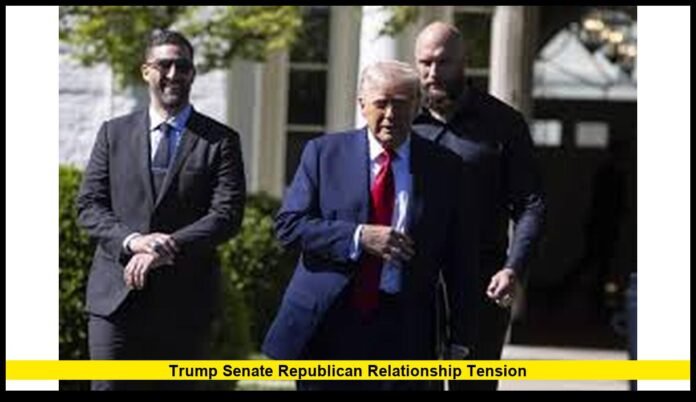

Trump Senate Republican relationship tension has intensified in Washington as several GOP senators openly challenge parts of President Donald Trump’s legislative and political agenda in May 2026. Internal disagreements over immigration funding, tariff policies, Senate primary endorsements, and a controversial Justice Department compensation fund have created one of the most visible Republican divides since Trump returned to the White House.
The friction became especially clear this week after Senate Republicans delayed action on a major immigration funding package tied to Trump’s priorities. Several Republican senators raised objections to a proposed $1.776 billion “anti-weaponization” fund designed to compensate people who claimed they were unfairly targeted by the federal government during previous investigations. Concerns over oversight, eligibility, and political fallout triggered sharp disagreements behind closed doors and stalled Senate action before the Memorial Day recess.
The dispute reflects a broader shift inside the Republican Party. While Trump still commands strong loyalty from much of the GOP base, some Senate Republicans are becoming more willing to publicly oppose him on spending, tariffs, and campaign strategy. The latest developments have sparked new debate about Trump’s influence over Senate Republicans heading into the 2026 midterm elections.
Why Senate Republicans Delayed Trump’s Immigration Funding Plan
Republican leaders entered May hoping to quickly pass a multibillion-dollar immigration enforcement package that would provide additional funding for ICE and Border Patrol operations through the remainder of Trump’s term. The legislation represented one of the administration’s highest domestic priorities.
However, negotiations collapsed after Senate Republicans questioned the administration about the proposed “anti-weaponization” fund. Senators reportedly demanded detailed answers regarding who could receive payments and whether individuals connected to the January 6 Capitol riot could qualify. Several GOP lawmakers said the plan lacked proper safeguards and transparency.
The concerns became serious enough that Senate Republicans postponed scheduled votes and left Washington without advancing the bill. That setback prevented Trump from securing a legislative victory before his publicly stated June 1 target date.
Some Republicans privately described the proposal as politically risky. Others feared the fund could damage GOP messaging during an election year when Republicans are trying to maintain Senate control and expand their House majority.
The White House defended the proposal, arguing that Americans harmed by politically motivated investigations deserved compensation. Trump himself responded angrily to critics and insisted his administration would continue fighting for what he called victims of government abuse.
Trump’s Texas Senate Endorsement Deepens GOP Divide
Another major source of tension emerged in Texas, where Trump endorsed Attorney General Ken Paxton over longtime Republican Senator John Cornyn in a closely watched Senate primary runoff.
The endorsement stunned many Senate Republicans because Cornyn has served as a central figure within GOP leadership for years. Senate Majority Leader John Thune and several establishment Republicans reportedly hoped Trump would back Cornyn to avoid a divisive and expensive primary fight. Instead, Trump endorsed Paxton and praised him as a loyal MAGA ally.
The move angered some Senate Republicans who worry the GOP could lose the seat in the general election if internal divisions weaken the eventual nominee. Others interpreted the endorsement as another example of Trump targeting Republicans he views as insufficiently loyal.
Cornyn had occasionally criticized Trump after the 2020 election and supported bipartisan legislation during the Biden administration. Those moves reportedly damaged his standing with parts of Trump’s political base.
Trump’s endorsement of Paxton reinforced concerns among Senate Republicans that loyalty to Trump now outweighs seniority or legislative experience inside the party.
The Texas race has already become one of the most expensive Senate contests in the country. Republicans now face growing pressure to avoid internal fights that could weaken their broader electoral position before November.
Read More – Bill Cassidy Trump Impeachment
Tariff Battles Create More Friction Between Trump and GOP Senators
Trade policy has also become a growing source of disagreement between Trump and Senate Republicans.
Several GOP senators have openly criticized Trump’s tariff policies, warning they could increase costs for consumers and hurt American businesses. Senators Rand Paul and Ted Cruz have voiced concerns about tariffs on imported goods and questioned the administration’s use of emergency powers to impose trade restrictions.
Republican senators Susan Collins and Lisa Murkowski joined bipartisan efforts aimed at limiting the impact of tariffs on small businesses and Canadian imports.
These disagreements matter politically because tariffs remain one of Trump’s signature economic strategies. During his second term, Trump has continued pushing aggressive trade measures involving China, Canada, and other countries.
Yet some Senate Republicans worry that prolonged trade battles could damage the economy ahead of the midterms. Rising prices, supply chain disruptions, and business uncertainty have fueled debate inside the party over whether Trump’s trade policies remain politically sustainable.
The tariff divide also highlights a deeper ideological split within the Republican Party. Trump’s populist economic nationalism often clashes with traditional conservative views favoring free trade and limited government intervention.
Senate Republicans Resist White House Spending Requests
Tension between Trump and Senate Republicans has expanded beyond immigration and tariffs.
Several GOP senators recently objected to a proposed $1 billion funding request tied to security upgrades related to a planned White House ballroom project. Senate Republicans questioned both the size of the request and the decision to include it within a broader immigration funding package.
The Senate parliamentarian later ruled that the proposal could not move forward under reconciliation rules, creating another setback for Trump’s agenda. Some Republicans argued that private funding should cover parts of the project instead of taxpayer money.
Fiscal conservatives inside the GOP have also expressed concern about rising federal deficits. Budget projections released earlier this year showed deficits and national debt continuing to climb over the next decade.
As a result, several Senate Republicans are becoming increasingly cautious about approving large new spending proposals tied to Trump’s priorities.
John Thune Faces Growing Leadership Pressure
Senate Majority Leader John Thune now finds himself balancing Trump’s demands with concerns from Senate Republicans who want a more independent legislative strategy.
Thune has generally tried to avoid direct public conflict with Trump. Still, recent events have exposed the difficult position facing Senate leadership. Trump’s frustration with Senate procedures, delays, and internal opposition has reportedly intensified in recent weeks.
Some Republican senators believe Trump expects faster action on his agenda than the Senate’s procedural rules allow. Others worry that constant public pressure from Trump weakens the party’s ability to negotiate internally.
The growing tension has produced rare moments of public resistance from Senate Republicans. Several lawmakers openly questioned administration proposals during private meetings and later signaled their frustration to reporters.
Even so, most Republican senators continue supporting Trump on major policy priorities including immigration enforcement, judicial appointments, and tax policy. The disagreements largely center on strategy, spending, and political risk rather than outright opposition to Trump himself.
How the GOP Divide Could Impact the 2026 Midterms
The current Trump Senate Republican relationship tension arrives at a critical political moment for the Republican Party.
Republicans are defending key Senate seats while also trying to maintain momentum after Trump’s return to office. Internal divisions could complicate campaign fundraising, candidate recruitment, and legislative messaging during the second half of 2026.
Some GOP strategists fear that high-profile infighting may energize Democratic turnout in competitive states. Others worry that bitter primaries could drain resources before the general election.
At the same time, Trump still maintains enormous influence with Republican voters. Many Senate Republicans remain cautious about openly criticizing him because they understand his popularity with the GOP base.
That political reality creates a delicate balancing act. Senators must respond to concerns from moderate voters, donors, and business groups while also avoiding direct confrontation with Trump supporters.
The situation is especially complicated in swing states where Republican candidates need both Trump-aligned conservatives and independent voters to win statewide elections.
The Anti-Weaponization Fund Becomes a Political Flashpoint
No issue better captures the current Republican divide than the “anti-weaponization” fund controversy.
Supporters argue the fund addresses years of politically motivated investigations targeting conservatives and Trump allies. Critics inside the GOP say the proposal risks appearing too broad and lacks proper accountability.
Several Republican senators specifically worried about potential payments involving individuals convicted in connection with the January 6 Capitol attack. Those concerns intensified after administration officials reportedly struggled to provide detailed answers during Senate meetings.
Democrats quickly seized on the controversy, portraying the proposal as politically dangerous for Republicans heading into the election cycle.
The debate exposed how even Trump allies sometimes diverge on questions involving political optics and government spending.
Trump Continues to Shape Republican Politics
Despite the tensions, Trump remains the dominant force within Republican politics.
His endorsements still carry major weight in Senate primaries. Republican candidates continue competing for Trump’s support, and most GOP lawmakers avoid directly challenging him publicly.
Trump’s influence extends beyond elections. His policy priorities continue shaping the Republican legislative agenda on immigration, trade, border security, and federal law enforcement.
However, the latest Senate disputes suggest some Republicans are increasingly willing to slow or reshape parts of Trump’s agenda when they believe political or policy risks outweigh party unity.
That dynamic marks an important shift from earlier periods when Senate Republicans often moved quickly to align with Trump’s positions.
What Happens Next in Washington
Congress is expected to revisit the delayed immigration and funding package after lawmakers return from recess next month.
Republican senators are likely to push for changes to the “anti-weaponization” fund before supporting any final legislation. Negotiations will also continue over spending levels, border enforcement provisions, and reconciliation rules.
Meanwhile, the Texas Senate runoff between Ken Paxton and John Cornyn remains a major test of Trump’s influence over Senate Republicans. The outcome could affect Republican strategy nationwide.
Trade disputes and tariff debates will also continue shaping Republican divisions as lawmakers respond to economic concerns from businesses and voters.
For now, the relationship between Trump and Senate Republicans remains complicated rather than completely fractured. Most GOP senators still support Trump’s broader agenda, but recent events show that loyalty alone may not guarantee smooth passage of every White House priority.
Washington is entering a period where Senate Republicans appear more willing to negotiate, delay, or resist parts of Trump’s plans when they believe political consequences could hurt the party in November.
The coming weeks could determine whether Republicans unify behind Trump’s agenda or whether the current Senate tensions continue reshaping the GOP’s political direction ahead of the 2026 midterms.