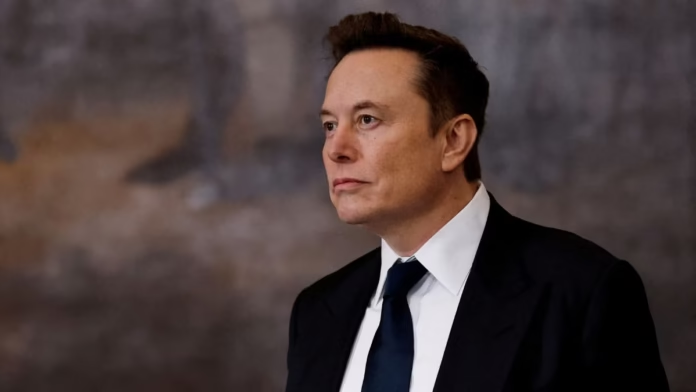

Elon Musk’s net worth today sits somewhere between $667 billion and $820 billion, depending on which financial tracker you consult. The Bloomberg Billionaires Index, as of May 20, places his fortune at approximately $667 billion, while Forbes’ real-time billionaire tracker puts the figure closer to $820 billion. That gap isn’t a mistake — it reflects genuine disagreement between the two indices on how to value Musk’s enormous private-company stakes, particularly his controlling position in the newly merged SpaceX–xAI entity.
Either way, Elon Musk remains the world’s richest person by a substantial margin, sitting well ahead of the second-place billionaire, Larry Page of Google, who is estimated to be worth around $327 billion.
Elon Musk Net Worth Today at a Glance
| Source | Estimated Net Worth |
|---|---|
| Bloomberg Billionaires Index (May 20) | ~$667 billion |
| Forbes Real-Time Tracker (May 2025) | ~$820 billion |
| Year-to-date change (Bloomberg) | +$47.6 billion |
The wide range between the two estimates exists because Musk’s wealth is unusually complex. Unlike most billionaires whose fortunes are anchored in publicly traded shares, the majority of Musk’s net worth — roughly 65% — now sits in the privately valued SpaceX–xAI combined entity. Private company valuations are partly subjective, which is why two credible sources can differ by over $150 billion.
Where Does Elon Musk’s Money Come From?
Musk’s wealth is concentrated in three primary assets: his stake in the merged SpaceX–xAI company, his holdings in Tesla, and his controlling position in X Holdings (formerly Twitter). Neuralink and The Boring Company contribute at the margins, but at this scale they are relatively minor.
SpaceX and xAI — Now the Dominant Wealth Engine
In February 2025, Musk completed a landmark all-stock merger between SpaceX and his artificial intelligence company xAI, valuing the combined entity at $1.25 trillion — the largest private corporate combination in history. SpaceX was internally valued at $1 trillion and xAI at $250 billion for the purposes of the deal. Musk holds approximately a 42–43% stake in the merged company.
Bloomberg applies a more conservative valuation of around $1.03 trillion for the combined entity, using an earlier SpaceX tender offer price as its benchmark rather than the merger’s internal figures, since no new outside capital was raised at the time of the deal.
This single asset now represents about 65% of Musk’s estimated net worth, making it the dominant driver of his wealth — a dramatic shift from mid-2025, when Tesla held that position.
Looking ahead, SpaceX has filed for an IPO reportedly targeting a $1.75 trillion valuation, expected in late 2025. Bloomberg has described it as potentially the largest IPO of the year. If the listing prices at that target, Musk’s stake in the company alone would be worth an estimated $735 billion.
Tesla
Tesla remains one of the most recognisable companies on Earth and still accounts for a meaningful slice of Musk’s fortune. He holds roughly 13–15% of Tesla shares, alongside a controversial $139 billion compensation package that was reinstated by the Delaware Supreme Court in late 2025 after years of legal battles.
Tesla’s stock has had a turbulent ride. Shares fell from nearly $400 in early 2025 to around $220 by April 2025, partly due to concerns about Musk’s political activities under the DOGE initiative and slowing vehicle sales. The stock recovered strongly before facing fresh headwinds in early 2025, closing at approximately $352 in the most recent period — still down considerably from its December 2024 peak but holding its position as the world’s most valuable automaker by market capitalisation.
In addition to the restored compensation package, Musk also holds a longer-term Tesla pay plan that could theoretically be worth up to $1 trillion over the next decade, contingent on achieving a series of demanding performance milestones.
xAI (Now Merged with SpaceX)
Before the merger, xAI raised $20 billion in private funding in January 2025 at a $250 billion valuation, a round that included investors such as Prince Alwaleed Bin Talal and pushed Musk’s overall wealth close to $780 billion at the time. The company’s flagship product, the Grok AI assistant, competes directly with OpenAI’s ChatGPT and Google’s Gemini. Following the SpaceX merger, xAI’s AI infrastructure and model capabilities are being integrated with SpaceX’s satellite and data networks.
X Holdings (Formerly Twitter)
Musk acquired Twitter in 2022 for $44 billion, rebranded it as X, and later merged it with xAI — which was then absorbed into SpaceX. At the time of the X–xAI merger, X was valued at around $33 billion (net of debt) and xAI at $80 billion. Musk is estimated to hold a controlling stake in X Holdings.
Other Ventures
Musk also leads Neuralink, a brain-computer interface company, and The Boring Company, a tunneling infrastructure firm. Both have attracted significant private investment and add to his overall wealth, though neither is a dominant contributor at current valuations.
How Has Elon Musk’s Net Worth Changed Over Time?
Musk’s wealth journey is one of the most extraordinary in financial history. He became the world’s richest person in January 2021, overtaking Amazon founder Jeff Bezos. He briefly lost the title to Bezos and LVMH CEO Bernard Arnault in 2022 and 2024, and ceded the top spot to Oracle’s Larry Ellison for a single day in September 2025 when Oracle shares surged following strong earnings.
He ended 2025 worth approximately $578 billion, having added around $187 billion to his wealth over that year alone. Then in the first months of this year, the SpaceX–xAI merger drove his fortune up by another $84 billion almost overnight, with Forbes declaring him the first person in history to surpass $800 billion.
The speed of accumulation is without historical parallel. It took Jeff Bezos over two decades to go from his first billion in 1999 to $200 billion in 2020. Musk went from $500 billion to $800 billion in approximately four months.
Could Elon Musk Become the World’s First Trillionaire?
The question is no longer whether it could happen, but when. Multiple financial analysts have pointed to the anticipated SpaceX IPO as the most likely trigger. If SpaceX–xAI prices at its targeted $1.75 trillion valuation, Musk’s stake alone would be worth roughly $735 billion — not counting Tesla, X, or his other assets.
Musk himself has acknowledged his interest in taking SpaceX public. The IPO would be a watershed moment not just for his personal fortune but for the broader financial markets. For now, the company remains private, meaning day-to-day fluctuations in Musk’s wealth are less severe than they would be for a fully public entity of that size.
How Musk’s Wealth Compares to Other Billionaires
Musk’s lead over the rest of the world’s ultra-wealthy is remarkable. As of the most recent Bloomberg update, the second-place billionaire, Larry Page, is worth approximately $327 billion — meaning Musk’s fortune is more than double that of the next richest person on the planet. Mark Zuckerberg of Meta sits at around $234 billion, and Jeff Bezos at a similar level.
Musk’s wealth also exceeds the combined GDP of many mid-size economies. To put it in automotive industry terms, his net worth is large enough to purchase Ford, General Motors, Rivian, and Toyota combined, and still have over $100 billion remaining.
The Risks Behind the Numbers
Nearly 95% of Musk’s estimated fortune consists of unrealised equity gains — meaning he is largely illiquid despite the staggering headline figures. His wealth rises and falls with stock market movements, private company fundraising rounds, and investor sentiment around artificial intelligence, electric vehicles, and space technology.
Tesla has faced real headwinds. A study from Yale University found that Musk’s involvement in the DOGE programme cost the company between 1 and 1.26 million US vehicle sales. Q1 2025 profits fell 71% year-over-year. Tesla’s stock, once a near-$400 share, has struggled to hold gains in the face of political controversy and intensifying EV competition.
The concentration risk is also significant. Musk’s personal brand, operational leadership, and regulatory relationships are spread across at least four major companies simultaneously. No publicly available succession plan exists for SpaceX or Tesla. These are factors that institutional investors are expected to scrutinise carefully when the SpaceX IPO eventually arrives.
Key Facts About Elon Musk
- Full name: Elon Reeve Musk
- Born: June 28, 1971, in Pretoria, South Africa
- Education: University of Pennsylvania (Physics and Economics)
- Current roles: CEO of Tesla, CEO of SpaceX, owner of X, CEO of xAI, founder of Neuralink and The Boring Company
- Richest person in the world since approximately January 2021 (with brief interruptions)
- Co-founder of PayPal, which was sold to eBay in 2002 for $1.5 billion
- Signed Warren Buffett’s Giving Pledge in 2012, committing to donate the majority of his wealth
Final Thoughts
Elon Musk’s net worth today stands as one of the most closely watched numbers in global finance. Whether Bloomberg’s $667 billion estimate or Forbes’ $820 billion figure is closer to the truth, the reality is that Musk occupies a category of wealth that has never existed before. His fortune grows — or falls — by billions on a single trading day, and is set to be reshaped dramatically whenever the SpaceX IPO eventually lands.
What do you think — will Elon Musk become the world’s first trillionaire by the end of this year? Drop your thoughts in the comments below and follow us for the latest updates as the SpaceX IPO story develops!