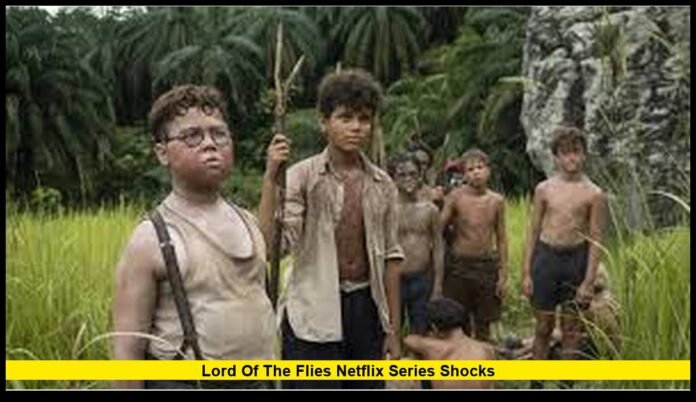

The new lord of the flies netflix adaptation is drawing major attention across the United States as viewers react to the dark survival story, emotional performances, and haunting portrayal of isolation and fear. Released as a four-part limited series, the adaptation brings William Golding’s classic novel back into the spotlight with a modern television approach that focuses heavily on psychology, power struggles, and human behavior under pressure.
The series debuted on Netflix after first airing in the United Kingdom and has quickly become one of the platform’s most discussed literary adaptations. Audiences familiar with the original novel are comparing the new version to earlier film adaptations, while younger viewers are discovering the story for the first time through streaming.
Created by acclaimed writer Jack Thorne and directed by Marc Munden, the project follows a group of schoolboys stranded on a remote island after a devastating plane crash. With no adults left to guide them, the children attempt to create order and survive. But as fear spreads across the island, rivalries intensify and civilization slowly disappears.
The adaptation stars David McKenna as Piggy, Winston Sawyers as Ralph, Lox Pratt as Jack, and Ike Talbut as Simon. Critics and viewers alike have praised the cast for delivering emotionally layered performances that give the story a deeper sense of realism and tension.
Streaming audiences continue debating the series online, especially its emotional ending and the way it handles violence, leadership, and morality in extreme conditions.
A Classic Story Returns for a New Generation
“Lord of the Flies” remains one of the most recognized novels in modern literature. First published in 1954, William Golding’s novel became famous for its disturbing examination of human nature and the collapse of social order.
The story follows a group of British schoolboys who survive a plane crash and become stranded on an isolated tropical island. Without adult supervision, the boys initially try to build a functioning society with rules, leadership, and responsibilities. However, fear and competition slowly divide the group.
The conflict between Ralph and Jack becomes the center of the story. Ralph represents structure and civilization, while Jack embraces power, hunting, and control through intimidation. Piggy acts as the voice of reason and intelligence, while Simon provides emotional depth and spiritual insight.
Over time, paranoia surrounding a mysterious “beast” pushes the boys further into violence and chaos.
The new adaptation gives audiences a more detailed version of that descent into savagery. Unlike previous film versions that condensed the story into a shorter runtime, the television format allows the emotional breakdown of the characters to unfold gradually.
That slower pacing creates a stronger emotional impact as viewers witness friendships collapse and fear take control of the island.
The Four-Part Format Changes the Story
One of the biggest differences in the Netflix adaptation is its structure.
Instead of telling the story as a straightforward survival adventure, the four-episode format gives more individual attention to key characters. Each episode reportedly focuses on different emotional perspectives and internal struggles among the boys.
This approach allows viewers to understand not only what happens on the island, but why the characters behave the way they do.
The series spends more time exploring Piggy’s loneliness and insecurity, Ralph’s growing frustration as a leader, Jack’s obsession with power, and Simon’s emotional isolation.
By slowing down the story, the adaptation creates stronger tension between the boys and makes the island feel more claustrophobic and dangerous.
Many viewers have praised this character-focused structure because it transforms the story from a simple survival drama into a psychological study of fear, group behavior, and manipulation.
The format also helps the audience connect emotionally with the boys before the story becomes increasingly violent.
David McKenna’s Piggy Is Receiving Major Praise
Among the cast, David McKenna’s portrayal of Piggy has become one of the most talked-about performances.
Piggy has always been one of the story’s most tragic characters. He is intelligent, thoughtful, and physically vulnerable, making him an easy target for bullying and ridicule. Earlier adaptations often focused mainly on his role as the outsider of the group.
This new version reportedly gives Piggy far more emotional depth.
Viewers have responded strongly to McKenna’s performance because it captures both the character’s intelligence and his emotional pain. His scenes with Ralph form the emotional foundation of the series, especially as the island becomes increasingly hostile.
Many online reactions describe Piggy as the emotional heart of the adaptation.
The series also places more emphasis on how isolation and constant humiliation affect him psychologically. Rather than presenting him only as a victim, the show highlights his resilience and humanity throughout the story.
That added emotional focus has become one of the defining features of the adaptation.
Ralph and Jack’s Rivalry Drives the Series
The growing conflict between Ralph and Jack remains the central force behind the story.
Winston Sawyers portrays Ralph as a reluctant leader trying desperately to preserve order among the stranded boys. At first, Ralph believes cooperation and rules will help everyone survive until rescue arrives.
However, maintaining control becomes increasingly difficult as fear spreads.
Jack, played by Lox Pratt, gradually transforms from choir leader into a ruthless rival who gains influence through hunting and intimidation. His obsession with power grows stronger with each episode.
The adaptation reportedly spends more time showing how Jack manipulates fear to control the group. Instead of instantly becoming violent, his transformation unfolds slowly, making the character feel more realistic and unsettling.
Critics have praised Pratt’s performance for balancing charm and menace. In several scenes, Jack appears charismatic enough to attract followers even while embracing cruelty and chaos.
The rivalry between Ralph and Jack becomes more intense as the boys split into opposing groups, creating a dangerous struggle for leadership on the island.
The Island Itself Feels Like a Character
The setting plays a major role in the series’ atmosphere.
The tropical island initially appears beautiful and peaceful, but the adaptation gradually transforms it into a frightening and oppressive environment. Dense forests, nighttime shadows, violent storms, and isolation create a constant sense of danger.
As the boys lose their connection to civilization, the island becomes emotionally suffocating.
The cinematography has received praise for capturing both the beauty and terror of the environment. Wide shots emphasize the boys’ isolation, while close-up scenes heighten the emotional tension between characters.
Sound design also contributes heavily to the atmosphere. Jungle noises, crashing waves, and eerie silence create a feeling of uncertainty throughout the series.
Viewers have noted that the island feels alive and unpredictable, reinforcing the story’s themes of fear and survival.
Violence and Fear Play a Larger Emotional Role
Violence has always been central to “Lord of the Flies,” but the Netflix adaptation reportedly handles it differently from previous versions.
Rather than relying purely on shock value, the series focuses on the emotional consequences of violence and mob mentality. Every major conflict carries psychological weight for both the victims and the perpetrators.
The story shows how fear slowly transforms ordinary children into participants in brutality.
Scenes involving the hunt for the so-called beast become especially disturbing because they reveal how paranoia spreads throughout the group.
The adaptation also spends more time exploring guilt, trauma, and emotional instability after violent events occur. Instead of moving quickly to the next plot point, the series allows viewers to see how the boys emotionally deteriorate.
This slower and more psychological approach has divided audiences in some areas, but many viewers believe it creates a stronger and more mature interpretation of the novel.
Why the Series Is Trending on Streaming Platforms
The popularity of the adaptation reflects the growing audience interest in psychological survival stories.
Streaming viewers continue gravitating toward dark dramas that explore human behavior in extreme situations. Stories about isolation, leadership struggles, and moral collapse remain highly engaging for audiences because they raise uncomfortable questions about society and human nature.
The release timing also helped the series gain momentum.
As streaming platforms compete for prestige content, literary adaptations have become increasingly important. Familiar titles attract older audiences who know the original story while introducing younger viewers to classic material.
The lord of the flies netflix release fits perfectly into that strategy because the novel already carries decades of cultural recognition.
Social media discussions have also boosted the show’s visibility. Many viewers are debating which character delivers the strongest performance, whether the adaptation improves on earlier versions, and how effectively it modernizes the themes of the novel.
The emotional ending, in particular, has sparked strong reactions online.
How the Adaptation Modernizes the Original Themes
Although the series remains faithful to the original novel’s core ideas, it updates several elements to resonate more strongly with modern audiences.
The adaptation reportedly places greater emphasis on emotional trauma, peer pressure, toxic leadership, and the psychology of fear. These themes connect strongly with current conversations surrounding power dynamics and social behavior.
The story also explores how quickly misinformation and panic can spread among vulnerable groups.
Jack’s leadership style becomes especially disturbing because it demonstrates how fear can be weaponized to gain loyalty and obedience.
At the same time, Ralph’s struggle to maintain reason and order reflects the difficulty of preserving morality during crisis situations.
The adaptation avoids turning the characters into simple heroes or villains. Instead, it presents the boys as emotionally damaged children responding differently to trauma and isolation.
That emotional complexity gives the series a more grounded and realistic tone compared to earlier versions.
The Ending Leaves a Powerful Emotional Impact
The final episode has become one of the most discussed aspects of the series.
As the conflict between the boys reaches its breaking point, the island descends into full chaos. Ralph becomes isolated and hunted while the remaining boys completely abandon the structure and morality they once tried to preserve.
The rescue sequence remains faithful to the novel’s iconic conclusion, but the adaptation reportedly adds more emotional detail and psychological aftermath.
Viewers have described the ending as emotionally exhausting, heartbreaking, and deeply unsettling.
Rather than presenting rescue as a simple happy ending, the series emphasizes the emotional damage suffered by the surviving boys.
That darker emotional focus has resonated strongly with audiences and critics alike.
Netflix Continues Expanding Prestige Drama Programming
The success of the series demonstrates Netflix’s ongoing interest in prestige drama adaptations with strong emotional storytelling.
Over the past several years, streaming audiences have shown increasing interest in darker character-driven series that combine suspense with psychological complexity.
“Lord of the Flies” fits that trend perfectly because it blends survival drama, horror elements, emotional conflict, and social commentary into a single story.
The strong reaction to the adaptation could also encourage additional literary projects in the future as streaming services search for recognizable titles with built-in audience interest.
For many younger viewers, this adaptation serves as their first introduction to William Golding’s story. For longtime fans of the novel, it offers a darker and more emotionally detailed interpretation of one of literature’s most disturbing survival tales.
As conversations surrounding the series continue growing online, the adaptation has already secured its place as one of the year’s most talked-about streaming dramas.