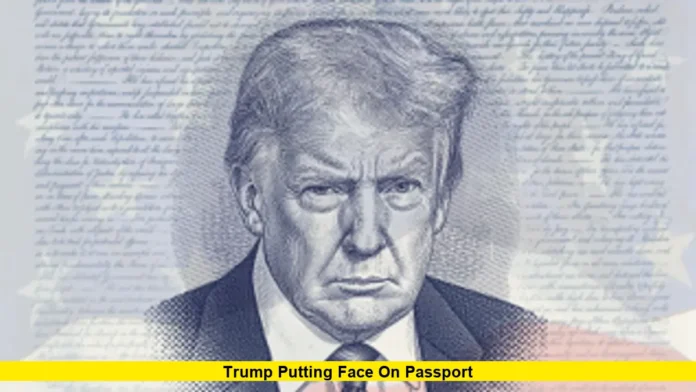

The United States government is doing something no modern democracy has ever attempted before: placing a sitting president’s portrait inside an internationally recognized travel document. The State Department made it official on April 28, 2026 — Trump is putting his face on the U.S. passport, and Americans across the country are sharply divided over what it means for national identity, democratic tradition, and the documents millions of citizens carry when they travel abroad.
This story broke fast, drew immediate reactions from historians, lawmakers, and everyday citizens, and has already become one of the most talked-about policy decisions of Trump’s second term. Here is everything you need to know.
What the New Passport Actually Looks Like
The redesigned passport features Trump’s second inaugural portrait on the inside cover, rendered in blue and white and surrounded by the full text of the Declaration of Independence. His signature appears in gold beneath the image. A second interior page displays John Trumbull’s famous 1819 painting of the Founding Fathers gathered at the signing of the Declaration of Independence.
The front cover has also been updated. The new design repositions “United States of America” to the top in larger lettering, with “Passport” moved lower on the cover. The back of the passport displays an image of the 1777 American flag, with “250” inscribed at the center of 13 stars representing the original colonies.
The current passport design, in use since 2021, features a depiction of Francis Scott Key at the bombardment of Fort McHenry along with lines from “The Star-Spangled Banner” on the inside cover. The Trump redesign replaces that imagery entirely.
Share this story with someone who needs to know — this change affects every American passport holder.
Who Will Get One — And When
The new design will serve as the default passport issued out of the Washington, D.C., passport agency for in-person renewals once it becomes available. Applicants renewing online or through other locations will continue to receive the existing design.
The State Department plans to begin issuing the commemorative passports this summer, ahead of the July Fourth celebration marking the nation’s 250th anniversary. Officials have described it as a limited-edition release, though the exact number to be printed remains unclear based on different figures cited during the rollout.
Applicants who do not want the commemorative version will have the option to request the standard design instead. That opt-out provision has done little to quiet the national debate the announcement ignited.
A First in American and Global History
The historical significance of this move is difficult to overstate. No modern U.S. passport has ever featured the portrait of a sitting president. More remarkably, no passport from any country in the world has ever placed the image of a head of state inside its pages — making this a genuinely unprecedented step not just in American history, but in the history of international travel documents.
Passport historians and scholars have noted that while older passports sometimes carried the signature of the official in whose name they were issued, American passports have traditionally been issued in the name of the Secretary of State — not the president. Adding a president’s portrait fundamentally changes the symbolic meaning of what the document represents.
A U.S. passport is an internationally recognized form of identification, typically valid for ten years. That means Americans renewing their passports this summer could be carrying a document bearing Trump’s portrait well into the next decade — a detail that has added weight to the debate surrounding the redesign.
The Official Justification: America’s 250th Birthday
The White House and State Department have framed the redesign as a patriotic commemorative effort tied to the nation’s semiquincentennial celebration. The 250th anniversary of American independence falls on July 4, 2026, and the administration has positioned the passport as one of several special items marking the occasion.
The State Department described the new passports as featuring customized artwork and enhanced imagery while maintaining the same security standards that make the U.S. passport one of the most secure travel documents in the world. The White House called the design a way for Americans to participate in the historic birthday celebration.
Congress originally established a Semiquincentennial Commission in 2016 to plan the 250th anniversary, envisioning a broad national celebration of America’s founding and democratic history. The Trump administration has used that anniversary framework to justify a series of branding decisions that have placed the president’s name and likeness across multiple official government items and institutions.
Part of a Much Bigger Pattern
The passport redesign is not an isolated decision. It is the latest step in a systematic effort during Trump’s second term to attach his name and image to American public life in ways that have no modern precedent.
His signature is set to appear on future U.S. currency. Large banners bearing his likeness have been hung on federal buildings. A government website for prescription drug pricing has been launched under the name TrumpRx.gov. A new class of U.S. Navy battleships has been named the “Trump class.” His name has been placed on the U.S. Institute of Peace and on the John F. Kennedy Memorial Center for the Performing Arts, which is now scheduled to close for two years for renovation.
The 2026 America the Beautiful national park pass was redesigned to feature side-by-side portraits of George Washington and Trump, replacing the nature photography that had been a fixture of the pass for years. That move triggered a lawsuit arguing it violated federal law governing how the pass must be designed. Visitors who covered Trump’s portrait with stickers reportedly had their passes voided by the Park Service.
A commemorative gold coin featuring Trump’s portrait has been approved by the Commission of Fine Arts, and a controversial $1 coin bearing his likeness is in production for general circulation — which would make him the first sitting president to appear solo on a circulating American coin.
Taken together, Trump’s name or face now appears on currency, park passes, a gold coin, federal buildings, government websites, a new class of warships, and — starting this summer — the U.S. passport itself.
The Opposition Voices
Critics from across the political and academic spectrum have responded quickly and forcefully. Democratic lawmakers called the passport move absurd, arguing that an official U.S. government document belongs to the American people and should not serve as a vehicle for any single individual’s image.
Nine Democratic senators wrote to the Treasury Secretary urging the rejection of the Trump coin, citing a congressional prohibition on placing the likeness of a sitting president on circulating or collectible currency. The passport announcement added a new front to that argument.
Passport historians described the decision as “wacky,” pointing out that the move has no parallel anywhere in the democratic world. Legal scholars have raised questions about whether government-issued identification documents can or should feature a sitting political leader’s portrait.
On social media, the reaction ranged from outrage to dark humor, with many Americans saying they planned to renew their passports immediately to avoid receiving the new design. Trump’s niece publicly said she was relieved to have already renewed hers.
What Supporters Are Saying
Not all Americans see the redesign as a violation of democratic norms. Supporters of the administration have embraced the 250th anniversary framing, arguing that a commemorative passport featuring the sitting president is a fitting tribute during a historic national milestone.
The White House connected the passport to a broader lineup of July Fourth events that includes a UFC championship fight on the South Lawn of the White House, a Grand Prix race on the National Mall, and a national state fair. For Trump’s supporters, the passport is one more expression of a presidency centered on visible, unapologetic national pride.
Backers also point to the opt-out provision — the fact that applicants can still choose the standard design — as evidence that the commemorative passport is an offering, not a mandate.
What This Means Going Forward
The durability of a passport makes this redesign more consequential than any coin or park pass. A passport is used at international borders, examined by foreign customs officials, and carried as a core document of personal identity for up to ten years. Millions of Americans traveling abroad will now face a choice about which version of their country’s most important travel document they want to carry.
The deeper question being raised by legal scholars, historians, and ordinary citizens alike is what it means when a sitting president’s personal brand becomes embedded in the official documents of national identity — and whether there are any guardrails left to prevent it from going further.
That question does not have an easy answer. But it is one that Americans on both sides of the debate are actively wrestling with, and the conversation is just getting started.
What do you think — would you carry the new passport or choose the standard design? Drop your thoughts in the comments and keep following for the latest updates as this story develops.