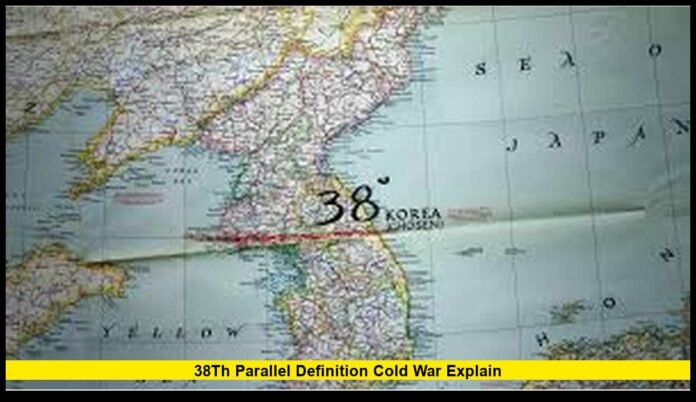

The term 38th parallel definition cold war captures a pivotal moment in modern history when a simple geographic line became a powerful symbol of division, ideology, and conflict. Drawn at the end of World War II, the 38th parallel split the Korean Peninsula into two zones that would soon evolve into rival nations—each backed by competing global superpowers. Decades later, that same divide continues to influence military strategy, diplomacy, and international relations.
Today, the Korean Peninsula remains one of the most closely watched regions in the world. Ongoing tensions, military activity, and geopolitical competition have renewed attention on how this division began—and why it still matters.
Understanding the 38th Parallel: A Simple Line With Lasting Impact
The 38th parallel is a circle of latitude located 38 degrees north of the equator. Before 1945, it held little political significance. That changed dramatically after Japan’s defeat in World War II, when Korea—previously under Japanese rule—was suddenly liberated.
In the immediate aftermath, global powers needed to decide how to manage the territory. U.S. and Soviet officials agreed to divide Korea along the 38th parallel as a temporary administrative solution:
- Soviet forces would oversee the northern half
- American forces would control the southern half
What was meant to be a short-term arrangement quickly hardened into a permanent division as global tensions escalated.
The Cold War Context Behind the Division
The late 1940s marked the beginning of a new global rivalry. The United States and the Soviet Union emerged from World War II as superpowers with opposing visions for the future:
- The U.S. supported democratic governance and market-based economies
- The Soviet Union promoted communist systems and centralized control
Korea became one of the first testing grounds for this ideological conflict. As cooperation between the two powers broke down, efforts to unify Korea failed.
By 1948, two separate governments had formed:
- A communist-led state in the north
- A democratic government in the south
The 38th parallel had transformed from a temporary dividing line into a hardened political boundary.
The Korean War: When Division Turned Into Conflict
The fragile separation erupted into full-scale war in June 1950, when North Korean forces crossed the 38th parallel and launched an invasion of the south.
The conflict quickly escalated into an international crisis:
- The United States led a multinational force under the United Nations to defend South Korea
- China entered the war in support of North Korea
- The Soviet Union provided strategic backing
The fighting was intense and unpredictable. Control of territory shifted multiple times, with forces advancing and retreating across the 38th parallel.
After three years of brutal combat, an armistice agreement was reached in 1953. While the fighting stopped, the war never officially ended with a peace treaty.
The Birth of the Demilitarized Zone
Following the armistice, a new boundary was established near the original 38th parallel. This boundary became the Korean Demilitarized Zone (DMZ), a buffer separating the two Koreas.
Despite its name, the DMZ is one of the most fortified borders in the world:
- It stretches approximately 160 miles across the peninsula
- It is heavily guarded by troops, surveillance systems, and defensive structures
- It remains a symbol of unresolved conflict
The DMZ stands as a direct legacy of the decisions made in the early Cold War years.
Why the 38th Parallel Still Matters Today
The historical significance of the 38th parallel extends far beyond textbooks. Its legacy continues to shape current global events in several key ways.
Persistent Security Concerns
North Korea’s continued development of nuclear weapons and missile technology keeps the region at the center of global security discussions. Military readiness on both sides of the border remains high.
U.S. Military Presence
The United States maintains a strong alliance with South Korea, including a significant troop presence. This partnership traces directly back to the Cold War and the defense of the southern half of the peninsula.
Regional Power Competition
The Korean Peninsula sits at the intersection of major powers, including China, Japan, and the United States. This makes it a critical strategic location in today’s shifting global order.
Diplomatic Stalemates
Efforts to formally end the Korean War or achieve reunification have faced repeated obstacles. While talks occasionally resume, lasting agreements remain elusive.
Human Stories Behind the Divide
While the 38th parallel is often discussed in political and military terms, its human impact is profound.
When the peninsula was divided, millions of families were separated—many with no opportunity to reconnect. Over time, cultural, economic, and social differences between the two Koreas grew dramatically.
- South Korea developed into a global economic leader with a thriving technology and entertainment industry
- North Korea became increasingly isolated, with strict government control over daily life
These contrasting paths highlight how a single line reshaped the lives of millions.
Economic and Political Divergence
The decades following the division produced two vastly different systems on the Korean Peninsula.
South Korea’s Rise
South Korea transformed into one of the world’s most advanced economies. It is known for innovation, global brands, and a high standard of living. Democratic institutions and international partnerships have played a key role in its growth.
North Korea’s Isolation
North Korea, by contrast, developed a closed economy with limited global interaction. Its leadership has prioritized military strength and self-reliance, shaping a unique but constrained national system.
The stark contrast between the two nations underscores the long-term consequences of Cold War-era decisions.
The 38th Parallel in Modern Strategic Thinking
For policymakers and analysts, the Korean Peninsula remains a critical area of focus. The 38th parallel definition cold war is not just a historical concept—it continues to inform modern strategy.
Military planning, diplomatic negotiations, and regional alliances all take into account the enduring division. The presence of advanced weapons systems, combined with ongoing tensions, makes the region one of the most sensitive in the world.
Comparing Korea to Other Cold War Divisions
The Cold War produced several major geopolitical divides:
- Germany was split into East and West, later reunified
- Vietnam was divided before eventually uniting
- Europe was separated by ideological boundaries
Korea stands apart because its division has never been resolved. The line established in 1945 remains, in many ways, intact today.
Recent Developments and Renewed Attention
In recent years, developments on the Korean Peninsula have drawn global attention:
- Continued weapons testing has heightened international concern
- Joint military exercises between the United States and South Korea demonstrate ongoing readiness
- Diplomatic engagements, while periodic, have yet to produce lasting breakthroughs
These events have brought renewed focus to the origins of the division and its ongoing implications.
Can the Peninsula Be Reunified?
The idea of reunification has long been discussed, but significant challenges remain:
- Political systems differ fundamentally
- Economic disparities are vast
- Security concerns complicate negotiations
While the possibility remains a topic of discussion, no clear path forward has emerged.
Why This History Still Matters to Americans
For the United States, the 38th parallel represents more than a distant historical event. It marks one of the earliest and most significant engagements of the Cold War.
American involvement in Korea helped shape decades of foreign policy, military strategy, and international alliances. Today, the U.S. continues to play a central role in maintaining stability in the region.
Understanding this history provides important context for current global challenges.
A Line That Changed the World
What began as a temporary solution in 1945 became one of the most enduring divisions in modern history. The 38th parallel not only split a nation but also symbolized the broader struggle between competing global ideologies.
Its legacy continues to influence international relations, security strategies, and the lives of millions. As tensions persist and global dynamics evolve, the importance of this historic line remains as strong as ever.
What do you think about how a single boundary can shape decades of global events? Share your thoughts and stay tuned for more updates on this evolving story.