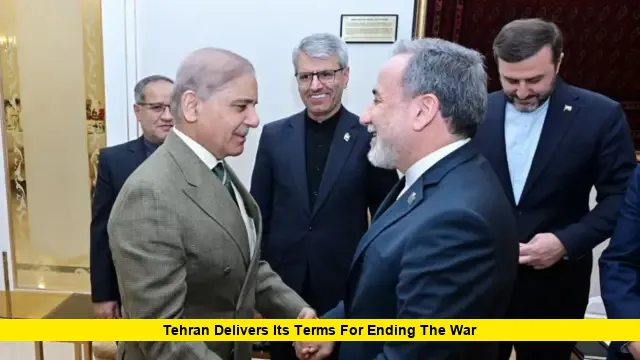

Iran’s foreign minister departed Pakistan after handing over a formal list of demands — yet refused to sit across the table from American envoys dispatched by the White House.
Iranian Foreign Minister Abbas Araghchi has left Islamabad after delivering Tehran’s formal list of conditions for ending its 57-day war with the United States and Israel. According to Al Jazeera, Araghchi held high-level meetings with Pakistani officials before departing, handing over what mediators described as a comprehensive set of demands. The departure leaves a critical diplomatic gap: Washington had simultaneously dispatched its own envoys to Pakistan, only to be told by Tehran that no direct meeting was planned.
As reported by CNN, Araghchi met with Pakistani Prime Minister Shehbaz Sharif at the Prime Minister’s House in Islamabad, with Pakistan’s Deputy Prime Minister Mohammad Ishaq Dar and army chief Asim Munir also present. Iran’s state agency IRNA noted the two sides “exchanged views on Iran-Pakistan relations” and discussed “strengthening regional cooperation, especially the ongoing diplomacy to completely stop the war.” Araghchi also thanked Pakistan for its “special efforts” in supporting ceasefire efforts in Lebanon, IRNA added.
“No meeting is planned to take place between Iran and the US. Iran’s observations would be conveyed to Pakistan.”— Esmaeil Baghaei, Iranian Foreign Ministry Spokesperson, via X · CNN
Washington says envoys are en route — Tehran says they won’t meet
According to the White House, senior US envoys Steve Witkoff and Jared Kushner were dispatched to Pakistan on Saturday to engage in direct peace talks with Iran. However, as CNN and Al Jazeera both reported, Iranian semi-official outlets Tasnim and Nournews — the latter affiliated with Iran’s Supreme National Security Council — flatly denied that Araghchi would meet the American officials.
The contradiction mirrors a pattern seen repeatedly since the conflict began. As Al Jazeera noted in its day-57 briefing, “diplomacy is not closed” between the two sides even if formal direct dialogue remains stalled. Al Jazeera’s correspondent in Tehran reported that “no talks are planned in Islamabad for now, though diplomatic efforts continue, with Araghchi touring regional capitals as Pakistan mediates.”
White House press secretary Karoline Leavitt told reporters the administration had “seen some progress” from Tehran in negotiations. Depending on outcomes in Islamabad, she said, “everyone will be on standby to fly to Pakistan if necessary,” according to CNN.
How this war began
According to the UK House of Commons Library, on 28 February 2026, Israel and the United States launched coordinated airstrikes against Iran targeting its nuclear and ballistic missile programmes — and killing Supreme Leader Ali Khamenei. Iran responded with waves of drone and missile attacks on Israel, US military bases across the Persian Gulf, and civilian infrastructure in several Arab states, while also closing the Strait of Hormuz — a critical global shipping artery carrying roughly one-fifth of the world’s oil supply.
President Trump initially demanded Iran’s “unconditional surrender,” setting — then repeatedly extending — deadlines throughout March 2026. A Pakistan-brokered conditional ceasefire was eventually declared on 8 April, with Iran’s 10-point proposal forming the basis of talks. Trump called it “a workable basis on which to negotiate,” per the UK House of Commons Library.
Iran’s 10-point ceasefire plan — key demands
- The right to enrich uranium on Iranian soil
- Lifting of all US and international sanctions on Iran
- Withdrawal of all US forces from regional military bases
- Lebanon and Hezbollah to be explicitly included in any ceasefire deal
- Iran’s sovereignty over Strait of Hormuz navigation to be recognised
Sources: BBC (citing Iranian state media), UK House of Commons Library
Pakistan: “cautiously optimistic”
Islamabad has emerged as the crucial neutral mediator, with the ceasefire itself reportedly negotiated by Pakistani army chief Asim Munir alongside US Vice President JD Vance and Araghchi. As Al Jazeera‘s correspondent Osama Bin Javaid reported from Islamabad on Saturday, Pakistani mediators described themselves as “cautiously optimistic” — seeing signs of progress, though “there is still no clarity on direct talks.”
Russia, Oman, and the broader diplomatic tour
Araghchi’s Islamabad visit is part of a regional diplomatic sweep. He posted on X that he would “closely coordinate with our partners on bilateral matters and consult on regional developments,” with stops in Pakistan, Oman, and Russia, per CNN. Moscow has been among Iran’s most consistent diplomatic allies throughout the conflict; the Kremlin has repeatedly offered to take custody of Iran’s enriched uranium — an offer Trump reportedly declined, concerned about giving Russia further leverage in global nuclear energy.
Lebanon remains a flashpoint
The conflict’s Lebanese dimension continues to complicate any peace framework. As reported by CNN, Israel has continued airstrikes on southern Lebanon despite a recently extended ceasefire, while Hezbollah has fired rockets into northern Israel in response. Iranian parliament speaker Mohammad Bagher Ghalibaf had previously stated that negotiations with the US would be “unreasonable” if fighting in Lebanon continued — a position that remains a key sticking point in Islamabad, per the UK House of Commons Library.
“Diplomacy is not closed between Iran and the US.”— Al Jazeera correspondent, reporting from Tehran, April 25, 2026
Oil markets continued to reflect the geopolitical tension. According to Al Jazeera, Brent crude futures were trading above $105 a barrel on Saturday, while the International Energy Agency warned that global LNG markets — strained by the Strait of Hormuz closure — will remain “tight” through 2027.
Disclaimer
This article is a news compilation and summary prepared for informational purposes only. It draws on reporting from third-party news organisations including Al Jazeera, CNN, Reuters, IRNA, and the UK House of Commons Library, which are credited throughout. All facts, quotes, and figures are attributed to their original sources; this publication makes no independent claim of original reporting.
The situation described is rapidly evolving. Details may have changed since the time of publication (Saturday, 25 April 2026). Readers are encouraged to consult primary sources for the most current information. The views and statements of governments, officials, or international bodies quoted herein do not represent the editorial position of this publication.
This content is provided without warranty of accuracy, completeness, or fitness for any particular purpose. The publisher accepts no liability for decisions made on the basis of this article.