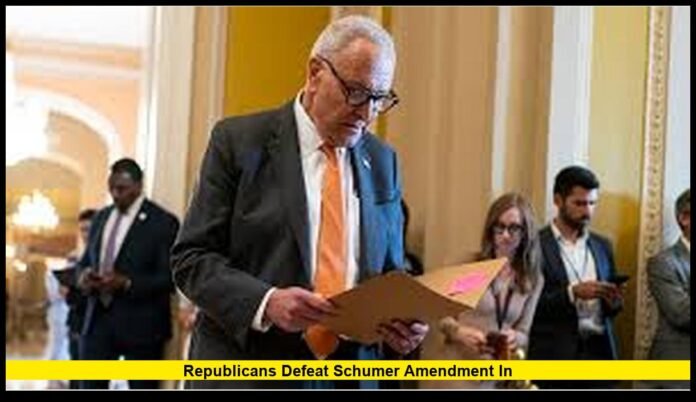

A pivotal moment unfolded on Capitol Hill as republicans defeat schumer amendment in a closely watched Senate vote, signaling a major shift in the direction of federal immigration policy and government funding priorities. The decision came during an intense legislative session centered on a broader budget framework, highlighting deep divisions between lawmakers over enforcement, oversight, and the role of federal agencies.
The amendment, introduced by Chuck Schumer, sought to place new conditions on funding tied to immigration enforcement programs. Its rejection marks a significant political setback for Democrats while reinforcing Republican momentum in shaping fiscal policy through a more unilateral approach.
A Defining Vote in a High-Stakes Senate Session
The Senate vote took place during a lengthy amendment process tied to a budget resolution. Lawmakers debated and voted on a series of proposals over several hours, a process that often tests party unity and exposes policy priorities.
In this case, the focus centered on how federal funds should be allocated to immigration enforcement agencies. Republicans pushed for a funding structure that prioritizes operational capacity and resource expansion. Democrats, meanwhile, attempted to introduce modifications aimed at increasing accountability and transparency.
The Schumer amendment became one of the most closely scrutinized proposals in the session. Its defeat reflected a disciplined Republican voting bloc that resisted changes to the underlying funding plan.
What the Amendment Aimed to Achieve
The amendment put forward by Schumer was designed to address concerns raised by Democratic lawmakers and advocacy groups about how immigration enforcement agencies operate.
Key elements of the proposal included:
- Requiring additional oversight mechanisms for enforcement agencies
- Mandating transparency in certain operational practices
- Linking portions of federal funding to compliance with updated accountability standards
- Introducing reporting requirements to Congress
Supporters argued that these measures were necessary to ensure that federal agencies operate within clear guidelines while maintaining public trust.
However, opponents viewed the amendment differently. Republican lawmakers argued that adding such conditions could complicate enforcement efforts and limit agencies’ ability to respond quickly to challenges at the border and within the interior of the country.
Republican Position: Focus on Enforcement and Efficiency
Republicans framed their opposition around the need for a streamlined approach to immigration enforcement. They emphasized that agencies require flexibility, funding stability, and operational autonomy to carry out their responsibilities effectively.
Several GOP senators argued that additional oversight provisions could create delays, increase administrative burdens, and potentially hinder enforcement operations. They maintained that existing structures already provide sufficient checks and balances.
The rejection of the amendment aligns with a broader Republican strategy to prioritize enforcement funding without attaching policy conditions that they believe could weaken implementation.
Democratic Concerns Remain Unresolved
For Democrats, the vote represents more than just the failure of a single amendment. It highlights ongoing concerns about how immigration policies are implemented and monitored.
Lawmakers on the Democratic side have consistently pointed to the need for stronger oversight, particularly in light of past controversies involving enforcement practices. They argue that funding should be tied to accountability measures to ensure that agencies operate transparently and responsibly.
Despite the setback, Democratic leaders have indicated that they will continue pushing for reforms through other legislative avenues and future negotiations.
The Broader Budget Context
The amendment vote is part of a larger legislative effort centered on a comprehensive funding package. This package includes significant allocations for immigration enforcement agencies, reflecting a priority area for Republican lawmakers.
The broader budget framework is being advanced using a legislative process that allows certain fiscal measures to pass with a simple majority. This approach has become increasingly common in situations where bipartisan agreement is difficult to achieve.
By relying on this process, Republicans have been able to move forward with their priorities despite opposition from Democrats.
Internal Party Dynamics and Voting Patterns
Although Republicans largely voted as a unified bloc against the amendment, the broader debate revealed subtle differences within the party.
Some lawmakers expressed concerns about overall spending levels and long-term fiscal sustainability. Others focused on ensuring that funds are used efficiently and effectively.
On the Democratic side, the vote reinforced a sense of urgency around advancing oversight measures. While the amendment did not pass, it served as a platform for highlighting policy concerns and shaping future discussions.
Impact on Immigration Policy Direction
The decision to reject the amendment is expected to influence the trajectory of U.S. immigration policy in several ways.
First, it clears the path for a funding approach that emphasizes enforcement capabilities. This includes resources for border security, personnel, and operational infrastructure.
Second, it reduces the likelihood that new oversight requirements will be included in the current funding package. This could lead to continued debates over accountability and transparency.
Third, it sets a precedent for how similar policy disputes may be handled in the future, particularly when one party holds a narrow majority.
House Consideration and Legislative Uncertainty
Following the Senate vote, attention now turns to the House of Representatives, where lawmakers will consider the broader funding package.
The outcome in the House remains uncertain. While Republicans hold influence, internal divisions could shape how the legislation moves forward. Democrats are expected to continue advocating for changes, including elements similar to those in the Schumer amendment.
The interplay between the two chambers will be critical in determining whether the funding plan becomes law in its current form or undergoes further revisions.
Political Implications Beyond Capitol Hill
The vote carries implications that extend beyond the immediate legislative process. Immigration policy remains one of the most prominent and debated issues in American politics.
Both parties are likely to use this moment to reinforce their positions:
- Republicans highlighting their focus on enforcement and border security
- Democrats emphasizing the importance of oversight and accountability
As election cycles approach, these themes are expected to play a central role in campaign messaging and public debate.
Public Response and Ongoing Debate
Public reaction to the vote has been mixed, reflecting the broader national divide on immigration policy. Supporters of the Republican approach argue that prioritizing enforcement is essential for maintaining order and security.
Critics, however, express concern that the absence of additional oversight measures could lead to challenges related to transparency and accountability.
The debate is likely to continue as the funding package moves through the legislative process and as policymakers revisit these issues in future sessions.
Long-Term Legislative Outlook
The phrase republicans defeat schumer amendment encapsulates a key moment in an ongoing legislative narrative. It signals a shift toward more partisan approaches to policymaking, particularly in areas where consensus has proven difficult.
Looking ahead, several factors will shape the legislative landscape:
- The outcome of House deliberations
- Future negotiations between party leaders
- Public opinion and its influence on policy priorities
- The broader economic and political environment
Lawmakers will need to navigate these dynamics carefully as they work to address complex issues related to funding, enforcement, and governance.
Why This Vote Matters Now
This Senate decision underscores how critical moments in Congress can have far-reaching consequences. It highlights the balance of power, the importance of party unity, and the challenges of crafting policy in a divided government.
For observers, the vote offers insight into how lawmakers prioritize competing goals and how those priorities translate into legislative action.
For policymakers, it serves as a reminder of the complexities involved in addressing issues that intersect with public safety, civil liberties, and fiscal responsibility.
As the legislative process continues, the implications of this vote will become clearer, shaping not only current policy but also the direction of future debates in Washington.
Share your perspective on this Senate decision and stay tuned for further developments as lawmakers continue to shape the nation’s policy agenda.