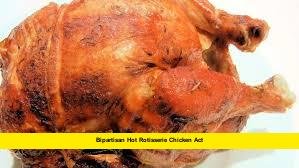

The rotisserie chicken — golden, fragrant, spinning lazily under a heat lamp at your local grocery store — has quietly become one of the most beloved and affordable meal solutions in America. For millions of families, that $5 to $7 bird is dinner, lunch leftovers, and soup stock all in one. Yet for the 42 million Americans relying on the Supplemental Nutrition Assistance Program (SNAP), grabbing one of those still-warm chickens off the shelf has been technically illegal under federal food assistance rules. That is, until Congress stepped in with a piece of legislation that is as practical as it is popular: the bipartisan HOT Rotisserie Chicken Act.
Introduced in April 2026 in both the Senate and the House, this bill has captured public attention not only because of its catchy name, but because it perfectly illustrates the kind of commonsense, no-frills lawmaking that transcends party lines. In this article, we break down everything you need to know about the HOT Rotisserie Chicken Act — what it does, who introduced it, why it matters, and what it means for American families struggling to put food on the table.
What Is the HOT Rotisserie Chicken Act?
The HOT Rotisserie Chicken Act is a bipartisan piece of federal legislation designed to amend the Food and Nutrition Act of 2008 to expand the definition of “food” eligible for purchase under SNAP benefits to include hot rotisserie chicken.
That’s it. That’s the whole bill. Simple, targeted, and long overdue.
Under current federal law, SNAP recipients are prohibited from purchasing hot prepared foods. This means a rotisserie chicken sitting under a heat lamp in the grocery store deli section is off-limits. However — and this is where the absurdity of the existing rule becomes obvious — if that same rotisserie chicken has been allowed to cool down, it becomes a legal SNAP purchase.
The HOT Rotisserie Chicken Act directly addresses this loophole by adding “hot rotisserie chicken” to the statutory definition of food under SNAP. Critically, the bill does not expand SNAP to cover all hot foods, does not increase SNAP funding, and does not change eligibility requirements. It is a laser-focused fix to a single outdated rule that has created a logistical headache for grocery stores and a real hardship for low-income families.
Who Introduced the HOT Rotisserie Chicken Act?
One of the most striking features of this legislation is the breadth of its bipartisan support. In the Senate, the bill was introduced by a group that crosses the political aisle with ease:
- Senator Jim Justice (R-West Virginia)
- Senator John Fetterman (D-Pennsylvania)
- Senator Shelley Moore Capito (R-West Virginia)
- Senator Michael Bennet (D-Colorado)
In the House of Representatives, companion legislation was introduced by Representative Gabe Vasquez (D-NM-02) on April 21, 2026, and a related House Farm Bill amendment was led by Representative Rick Crawford (R-Arkansas), which received support from both parties during markup — a signal of the bill’s cross-party appeal.
The fact that senators as politically distinct as John Fetterman of Pennsylvania and Jim Justice of West Virginia are co-sponsoring the same bill speaks volumes. This is not a political stunt. This is legislators from opposing parties recognizing a genuine and fixable problem affecting tens of millions of Americans.
The Absurd Rule the Bill Is Trying to Fix
To understand why the HOT Rotisserie Chicken Act exists, you have to understand just how strange the current SNAP rules actually are.
SNAP, formerly known as food stamps, was designed to help low-income Americans purchase food for home preparation. The program excludes hot prepared foods — a rule originally intended to prevent SNAP funds from being used at restaurants or fast food chains. The logic was sound when the rule was written: keep SNAP for groceries, not restaurants.
But the blanket prohibition on all hot foods has created situations that make no practical sense. A rotisserie chicken that is piping hot and freshly cooked is banned. The same chicken, allowed to cool to room temperature in the store’s deli case, becomes fully eligible. There is no nutritional difference between the two. There is no logical difference. The only difference is temperature — and that temperature is determined by how long the chicken has been sitting out, not by any meaningful policy distinction.
This rule has led some grocery stores to heat chickens to satisfy demand and then deliberately cool them back down just so SNAP recipients can legally buy them. The process wastes energy, degrades the quality of the food, and adds unnecessary operational cost to grocery stores — all to comply with a technicality that serves no legitimate public purpose.
As the National Chicken Council president Harrison Kircher put it, the current rule is “an outdated technicality that forces grocery stores to heat chickens and cool them back down just to comply, wasting energy, degrading quality, and adding cost.”
Why Rotisserie Chicken Matters for Food-Insecure Families
To fully appreciate the stakes of this legislation, it helps to understand what rotisserie chicken actually represents in the context of food access and affordability.
Rotisserie chicken is, calorie for calorie and protein for protein, one of the most affordable complete meals available in any American grocery store. A whole rotisserie chicken typically costs around $5 to $7, depending on the retailer. It provides multiple servings of high-quality protein, requires zero cooking, and produces almost no waste when the bones are used to make broth.
For a family of four, a single rotisserie chicken can anchor a full dinner. For a single parent who just finished a double shift and has no time or energy to cook, it’s the difference between a nutritious meal and fast food. For an elderly person on a fixed income who may have limited mobility or access to cooking equipment, it’s an accessible, dignified meal option that doesn’t require a stove.
Senator Jim Justice captured this reality directly: “We have to give people the option to put a healthy, protein-dense choice on the table that actually tastes good and doesn’t take an hour and a half to cook.”
Senator John Fetterman, who is known for his plain-spoken advocacy for working-class Americans, highlighted the economic angle: “America’s best affordability play is Costco’s $4.99 rotisserie chicken. It’s one of my family’s favorites, and I’m proud to join this bill with Senator Justice for all to try. SNAP funds would be well spent to feed our nation’s families who need it.”
Senator Bennet framed it as a matter of removing unnecessary barriers: “Congress should be making it easier, not harder, for families to put food on the table. This bill fixes an unnecessary barrier and helps Colorado families get a quick, nutritious meal when they need it.”
And Senator Capito emphasized dignity and practicality: “For seniors, working families, and those without reliable access to cooking equipment, this is about convenience and dignity.”
The Broader SNAP Context: Why This Bill Matters Now
The HOT Rotisserie Chicken Act arrives at a particularly charged moment in the debate over SNAP policy in the United States.
In 2024, SNAP served an average of 41.7 million people per month — roughly 12.3% of the entire U.S. population. The program is, for tens of millions of Americans, a genuine lifeline. It is also increasingly a political battleground.
The Trump administration has implemented a series of changes to the SNAP program during the president’s second term, including approving food restriction waivers for at least 22 states — a first after 60 years of denying such requests — which allow states to ban the purchase of certain foods deemed “sugary.” Significant funding cuts were also included in the “One Big Beautiful Bill,” with estimated reductions of around $300 billion through 2034 according to the Congressional Budget Office, alongside tightened work requirements.
Against this backdrop, the HOT Rotisserie Chicken Act stands apart. Rather than restricting SNAP or cutting its funding, it proposes a small, targeted, cost-neutral expansion that makes the program more practical for the families it serves. It does not require new appropriations. It does not change who qualifies. It simply recognizes that a hot rotisserie chicken and a cold rotisserie chicken are the same food — and that SNAP recipients deserve the dignity of buying either one.
Representative Gabe Vasquez of New Mexico put this into sharp local focus. His district includes approximately 460,000 New Mexicans who rely on SNAP. He noted that rotisserie chicken is “an excellent source of protein for a family” and argued that SNAP recipients should have the same access to affordable, ready-to-eat meals that any American shopper does.
What the Bill Does — and Doesn’t Do
Given the political climate around SNAP, it’s important to be precise about the scope of the HOT Rotisserie Chicken Act. Here is exactly what the bill does and does not propose:
What it DOES:
- Amends the Food and Nutrition Act of 2008 to add “hot rotisserie chicken” to the definition of eligible food for SNAP purchases
- Allows SNAP recipients to purchase hot rotisserie chicken at eligible grocery retailers
- Applies exclusively to authorized SNAP retailers (i.e., grocery stores), not restaurants
What it DOES NOT do:
- Does not expand SNAP to cover all hot prepared foods
- Does not increase SNAP funding or appropriations
- Does not change SNAP eligibility requirements
- Does not expand SNAP to include restaurants, fast food chains, or food trucks
This narrow scope is intentional. Proponents of the bill wanted to make a targeted, defensible change that could attract bipartisan support without opening the door to broader debates about SNAP’s scope. By limiting the expansion strictly to rotisserie chicken — a product sold at grocery stores and explicitly different from restaurant food — they created legislation that is hard to argue against on policy grounds.
Industry Support: The National Chicken Council Weighs In
The HOT Rotisserie Chicken Act has also earned the backing of the National Chicken Council (NCC), the trade association representing the U.S. chicken industry. NCC President Harrison Kircher issued a statement calling the legislation “commonsense, and long overdue” and urging Congress to pass it without delay.
The NCC’s support makes sense from an industry perspective. Rotisserie chicken is a massive retail category, and streamlining SNAP purchasing rules removes a significant operational burden from grocery stores. The current requirement to cool chickens down — or to separate SNAP-eligible cold chickens from non-eligible hot ones — adds complexity and cost to store operations. Fixing the rule benefits retailers and consumers alike.
The NCC also reinforced the nutritional argument for the bill, noting that “hot rotisserie chicken is healthy, widely available, popular in grocery stores, and aligns with the new Dietary Guidelines for Americans promoting nutrient-dense protein.”
State-Level Momentum: Arkansas and West Virginia Lead the Way
Even before the federal bill was introduced, some states had begun pushing for flexibility in this area. Arkansas Governor Sarah Huckabee Sanders submitted a waiver to extend SNAP coverage to include hot rotisserie chicken, according to a statement from the National Chicken Council cited by Representative Crawford. West Virginia was also noted as a state that had requested similar flexibility.
These state-level efforts underscore that the demand for this reform is real, widespread, and not driven by any single political agenda. Governors and state officials from Republican-led states were among the first to push for the change — which makes the bipartisan Senate coalition even more coherent and logical.
The fact that states were already seeking waivers to do what the federal bill would accomplish via statute suggests that the HOT Rotisserie Chicken Act is not a radical idea. It is, in many ways, codifying in federal law what common sense and state officials had already recognized as a reasonable and practical accommodation.
What Happens Next: The Legislative Path Forward
As of late April 2026, the HOT Rotisserie Chicken Act has been introduced in both chambers of Congress and has been referred to the relevant committees. In the Senate, the legislation falls under the jurisdiction of the Senate Agriculture Committee, on which Senator Fetterman serves — giving it a meaningful internal champion.
The path to passage for any bill is rarely straightforward, and the current political environment around SNAP makes that especially true. However, several factors give this bill a reasonable chance of advancing:
- True bipartisan support: With Republican and Democratic co-sponsors in both chambers, the bill avoids being easily dismissed as partisan.
- Zero fiscal cost: Because the bill does not increase SNAP funding or eligibility, it sidesteps the budget arguments that typically doom social program expansions.
- Narrow scope: By limiting the change strictly to rotisserie chicken, the bill avoids the broader political fight over expanding SNAP to all hot foods.
- Industry backing: Support from the National Chicken Council gives the bill allies with lobbying resources and relationships on Capitol Hill.
- Public appeal: The bill is easy to explain and hard to oppose — even critics of SNAP expansion may struggle to articulate a coherent argument against letting low-income families buy a warm chicken at Costco.
Whether the bill passes as standalone legislation or is folded into a larger farm bill or spending package remains to be seen. But its introduction marks an important step in modernizing SNAP to reflect the realities of how American families actually shop and eat.
The Bigger Picture: Food Dignity and Program Modernization
At its heart, the HOT Rotisserie Chicken Act is about something larger than one food item. It is about whether a federal assistance program designed to help people eat should be organized around the actual needs of the people it serves — or around the political assumptions and bureaucratic traditions of the 1970s and 1980s when many of these rules were written.
The existing prohibition on hot foods made sense when SNAP was designed primarily for families with a stay-at-home parent who could cook every meal from scratch. In 2026, the reality of American poverty looks different. SNAP recipients include single parents working two jobs, elderly people living alone, adults with disabilities, and millions of families caught in the gap between poverty and stability. For many of them, the ability to buy a ready-to-eat, nutritionally complete meal at a grocery store is not a luxury — it’s a lifeline.
The HOT Rotisserie Chicken Act is a small fix. But small fixes, done right, can matter enormously to the people they serve. And in a political moment defined by bitter partisanship and large-scale debates over the future of the social safety net, there is something genuinely hopeful about Republican and Democratic senators setting aside their differences to fight for the right of a struggling family to bring home a warm chicken for dinner.
Conclusion
The bipartisan HOT Rotisserie Chicken Act represents practical, commonsense policy at its best. By amending the Food and Nutrition Act of 2008 to allow SNAP recipients to purchase hot rotisserie chicken, the bill would eliminate a senseless technicality, reduce operational waste for grocery stores, and provide millions of low-income Americans with greater access to affordable, nutritious, ready-to-eat food.
Introduced by Senators Jim Justice, John Fetterman, Shelley Moore Capito, and Michael Bennet in the Senate, and by Representative Gabe Vasquez in the House, the legislation has earned support from across the political spectrum — including from the National Chicken Council — because it is simply the right thing to do.
As the bill makes its way through Congress, one thing is clear: the American rotisserie chicken has officially entered the halls of power. And for 42 million Americans on SNAP, that could make a very real difference.