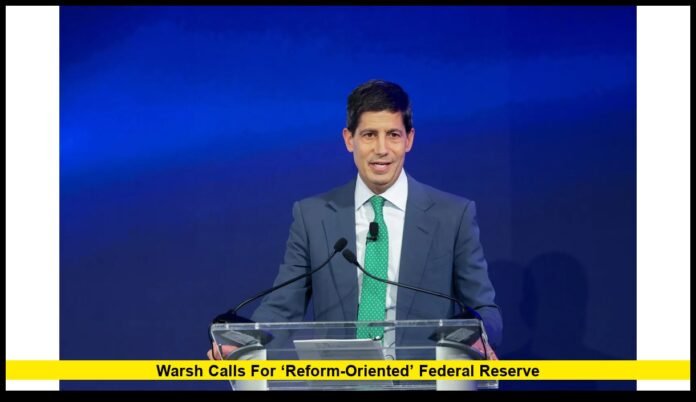

Warsh Calls for ‘Reform-Oriented’ Federal Reserve is gaining national attention as former Federal Reserve Governor Kevin Warsh pushes for structural changes aimed at improving transparency, accountability, and long-term policy effectiveness in the U.S. central banking system.
His latest remarks arrive at a critical moment for the U.S. economy. Inflation has cooled from its peak but remains a concern for households and policymakers. Interest rate decisions continue to shape borrowing costs, while public trust in institutions is under close scrutiny. Against this backdrop, Warsh is urging a reset in how the Federal Reserve defines its role and communicates its actions.
A Renewed Push for Structural Change
Kevin Warsh has positioned himself as a leading voice calling for a shift in how the Federal Reserve operates. He argues that the central bank has expanded its influence in ways that go beyond its traditional responsibilities.
In recent commentary, Warsh emphasized that the Fed should return to a more disciplined and clearly defined framework. He believes that doing so would strengthen both market confidence and public trust.
His concerns focus on three main areas:
- The growing size and influence of the Fed’s balance sheet
- Increased reliance on forward guidance to shape expectations
- A broader role in financial markets during and after crises
Warsh has suggested that these changes, while intended to stabilize the economy, may have created unintended consequences over time.
Inflation Remains Central to the Argument
Inflation continues to play a key role in the discussion around Federal Reserve reform. Although price growth has slowed compared to earlier highs, it still affects everyday expenses across the country.
Warsh has been clear in his view that earlier policy responses did not act quickly enough to contain rising inflation. He has stressed that credibility is essential for effective monetary policy.
A reform-focused approach, in his view, would include:
- Faster responses to emerging inflation risks
- Stronger emphasis on maintaining price stability
- More consistent messaging about policy direction
He has repeatedly warned that delayed action can weaken confidence in the central bank’s ability to manage economic challenges.
The Call for Rule-Based Policy
A major part of Warsh’s proposal involves shifting toward clearer and more predictable policy guidelines. He believes the Federal Reserve should reduce its reliance on discretionary decisions and adopt a more structured approach.
This would help businesses, investors, and consumers better understand how decisions are made.
What a rule-based system could include:
- Defined benchmarks for raising or lowering interest rates
- Consistent responses to economic indicators like inflation and employment
- Reduced dependence on vague forward guidance
Warsh argues that greater predictability would limit market uncertainty and improve overall economic stability.
Concerns Over the Fed’s Expanding Reach
Over the past decade, the Federal Reserve has taken on a larger role in responding to financial crises. This includes large-scale asset purchases and emergency lending programs.
While these actions helped stabilize markets during turbulent periods, Warsh believes they have also expanded the Fed’s influence beyond its intended scope.
He has identified several risks tied to this expansion:
- Increased market reliance on central bank intervention
- Potential distortions in asset prices
- Blurred lines between monetary and fiscal policy
Warsh has argued that restoring clearer boundaries would help maintain the integrity of the institution.
Market and Policy Implications
Although Warsh does not currently hold a policymaking role, his views carry weight among economists and financial leaders. His call for reform has sparked renewed discussion about the future direction of U.S. monetary policy.
Markets are paying attention to these conversations, particularly as they relate to:
- Future interest rate paths
- Inflation expectations
- Long-term confidence in central bank decisions
Even without immediate policy changes, such discussions can influence how investors interpret economic signals.
Political Pressure and Public Scrutiny
The Federal Reserve is operating in an environment of increased political attention. Lawmakers and analysts continue to question how effectively the central bank has handled recent economic challenges.
Issues under discussion include:
- The timing of interest rate increases
- The persistence of inflation
- The clarity of communication with the public
Warsh has argued that reform efforts should strengthen the institution rather than limit its independence. He believes clearer frameworks and accountability can coexist with a strong and independent central bank.
Defining a Reform-Oriented Federal Reserve
The phrase Warsh Calls for ‘Reform-Oriented’ Federal Reserve reflects a broader vision rather than a single policy change. His proposals aim to reshape how the institution operates over the long term.
Core elements of his reform vision:
- Transparency: Clearer explanations behind policy decisions
- Accountability: Measurable outcomes tied to policy actions
- Discipline: A stronger focus on core objectives like price stability
- Communication: Simpler and more consistent messaging
These principles are designed to rebuild trust and improve the effectiveness of monetary policy.
How It Affects Americans
Federal Reserve policy decisions directly impact daily life in the United States. From mortgage rates to job growth, the effects are widespread.
A more structured and transparent approach could influence:
- Borrowing costs for homes and businesses
- Credit card and loan interest rates
- Wage growth and employment trends
- Overall cost of living
Warsh’s proposals aim to create a more stable economic environment that benefits both consumers and businesses over time.
Diverse Views Among Economists
The debate over Federal Reserve reform is far from settled. While some economists support Warsh’s call for clearer rules and limits, others argue that flexibility is essential.
Supporters of the current approach point out that:
- Rapid intervention helped prevent deeper economic downturns
- Flexibility allows the Fed to respond to unexpected shocks
- Strict rules could limit the central bank’s ability to act quickly
Despite these differences, there is widespread agreement that the Fed’s role has evolved and will continue to do so.
Looking Ahead
The conversation around Federal Reserve reform is expected to continue as economic conditions shift. Policymakers and financial experts will keep evaluating how best to balance flexibility, accountability, and transparency.
Warsh’s renewed push has added momentum to this debate, bringing fresh attention to how the central bank can adapt in a changing economic landscape.
His call for reform highlights a broader question facing the nation: how to ensure that one of its most powerful institutions remains effective, credible, and aligned with its core mission.
Do you think the Federal Reserve needs reform, or should it maintain its current approach? Share your perspective and stay engaged as this debate continues to shape the U.S. economy.