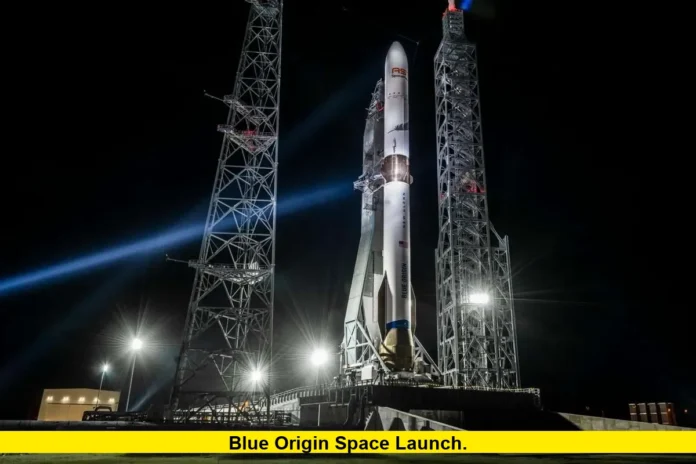

April 19, 2026, is shaping up to be one of the most important days in Blue Origin’s history. Today, the company is set to execute a blue origin space launch that goes far beyond simply putting a satellite into orbit. For the first time ever, New Glenn’s heavy-lift rocket will fly with a previously used booster — a milestone that signals a new chapter not just for Blue Origin, but for American commercial spaceflight as a whole. This is the NG-3 mission, and it has been building toward this moment for months.
Reusability is the defining economic engine of modern rocketry. Every time a booster lands, gets refurbished, and flies again, the cost of reaching orbit drops. The companies that master this cycle will dominate the next two decades of the space industry. Today, Blue Origin is proving it belongs in that conversation.
Stay updated as this mission unfolds — bookmark this page and check back throughout the day for the latest developments.
What the NG-3 Mission Is and Why It Stands Apart
According to Spaceflight Now, Blue Origin plans to launch its third New Glenn rocket from Cape Canaveral Space Force Station carrying AST SpaceMobile’s BlueBird 7 satellite into low Earth orbit, with the launch window opening at 6:45 a.m. EDT on Sunday, April 19.
As per Space.com, the mission will fly the same first-stage booster core used on the NG-2 flight, but with a completely new set of engines installed — making NG-3 the first time a New Glenn booster has ever been reflown.
That single detail changes everything. It means Blue Origin is no longer just launching rockets. It is running a rocket program — one with reusable hardware, operational turnarounds, and the kind of cadence that commercial customers actually need. This is not a one-off test. This is the beginning of a production rhythm.
A Booster Named “Never Tell Me the Odds”
The first-stage booster at the center of today’s mission has already been to space and back. According to Spaceflight Now, the booster — nicknamed “Never Tell Me the Odds” — previously launched in November 2025 and successfully touched down on Blue Origin’s ocean-going landing platform called “Jacklyn.”
That November 2025 landing was itself a watershed moment. As per Blue Origin’s official mission records, New Glenn successfully completed its second mission on November 13, 2025, deploying NASA’s ESCAPADE twin-spacecraft into the designated loiter orbit and landing the fully reusable first stage on Jacklyn in the Atlantic Ocean.
With the landing secured, Blue Origin’s engineers began preparing the booster for its second flight. The refurbishment process was far more involved than a standard inspection. According to Blue Origin CEO Dave Limp, writing on X on April 13, the company replaced all seven BE-4 engines on the refurbished booster and tested several upgrades, including a new thermal protection system on one of the engine nozzles. He also noted that the engines from the NG-2 flight are being preserved for use on future missions.
This approach reflects a mature engineering philosophy. Rather than simply re-flying identical hardware, Blue Origin used the refurbishment window to implement improvements — treating each mission as an opportunity to build a better rocket than the one that flew before.
The Critical Engine Test That Cleared the Path to Launch
Before any rocket leaves the ground, it has to prove itself on the pad. According to the American Institute of Aeronautics and Astronautics, Blue Origin’s New Glenn roared to life in a critical pre-launch engine demonstration on the morning of April 16, less than an hour after sunrise in Florida. All seven BE-4 engines fired for approximately 20 seconds at 7:45 a.m. EDT.
As per Spaceflight Now, this static fire test cleared the way for the weekend launch, keeping New Glenn firmly on schedule for liftoff on April 19.
Static fire tests are non-negotiable in rocket programs. They subject the vehicle to real propulsion loads, verify that fuel and oxidizer flow correctly through every line and valve, and give engineers the data they need to make a go or no-go decision with confidence. A clean 20-second burn from all seven engines was exactly the green light Blue Origin needed.
According to Space.com, the two-stage New Glenn stands 322 feet tall at Launch Complex 36 on Florida’s Space Coast — a striking presence on the pad and a testament to just how ambitious Blue Origin’s heavy-lift program truly is.
BlueBird 7: The Satellite That Could Connect the Unconnected
The payload riding upstairs on today’s New Glenn is not just technically impressive — it could genuinely change lives for people in some of the most disconnected corners of the planet.
According to Space.com, the NG-3 mission will deliver a Block 2 BlueBird direct-to-cellphone internet satellite to low Earth orbit for the Texas-based company AST SpaceMobile. The satellite features an antenna spanning an extraordinary 2,400 square feet, making it one of the largest commercial satellites currently in orbit.
As per Spaceflight Now, BlueBird 7 is the second satellite in AST SpaceMobile’s next-generation constellation, specifically designed to support space-based cellular broadband for both commercial and government customers. Unlike traditional satellite internet systems that require specialized dishes or terminals, the BlueBird network is built to work with standard smartphones — no extra hardware needed.
For rural communities, disaster response teams, maritime operators, and millions of people worldwide who live beyond the reach of cell towers, this technology is not a luxury. It is access. And New Glenn is the vehicle helping put it in place.
According to Spaceflight Now, AST SpaceMobile Chairman and CEO Abel Avellan stated during a March 2026 earnings call that the company remains on track to deploy between 45 and 60 satellites into low Earth orbit by the end of the year. He further indicated that the company expects the New Glenn booster to be reused on a 30-day cycle to support that launch cadence.
A 30-day reuse turnaround would be an operational benchmark that very few launch vehicles in history have achieved. It would put New Glenn in a league that reshapes expectations across the entire commercial launch market.
The sequence of events today unfolds quickly. According to Space.com, if everything proceeds as planned, New Glenn’s first stage will shut down its engines and separate from the upper stage approximately three and a half minutes after liftoff. The booster will then attempt to land on the drone ship Jacklyn in the Atlantic Ocean roughly six minutes into the flight.
That booster landing attempt will be one of the most-watched moments of the entire mission. A successful recovery today would mean “Never Tell Me the Odds” has now flown twice — and the booster’s cheeky nickname would carry a whole new layer of meaning. Blue Origin would no longer be defying the odds. It would be the one setting them.
The upper stage, meanwhile, will continue carrying BlueBird 7 toward its target orbit, where the satellite will begin the commissioning process before joining AST SpaceMobile’s growing constellation.
Blue Origin’s West Coast Expansion Changes the Game
Today’s launch is happening against the backdrop of an even larger announcement that dropped earlier this week. According to Spaceflight Now, the U.S. Space Force selected Blue Origin’s proposal to develop Space Launch Complex 14, or SLC-14, at Vandenberg Space Force Base in California.
As per the Wikipedia entry on New Glenn, Blue Origin and the U.S. Space Force announced on April 14, 2026, plans to give New Glenn polar orbit launch capabilities through a new West Coast facility at Vandenberg, to be designated Space Launch Complex 14.
Polar orbit capability is a significant strategic expansion. Missions that require coverage of the entire Earth — including environmental monitoring satellites, certain military reconnaissance systems, and some commercial imaging constellations — need to launch into polar or near-polar orbits. Cape Canaveral’s eastward launch trajectory is not suited for those missions. Vandenberg is.
According to the U.S. Space Force, U.S. Space Force Col. James Horne III, commander of Space Launch Delta 30, said the selection of Blue Origin for SLC-14 represents a critical milestone at the Vandenberg Spaceport and advances the nation’s heavy and super-heavy space launch capabilities for full-spectrum space operations.
As per Spaceflight Now, the SLC-14 site is currently described as a “green field development,” meaning there is currently no existing infrastructure at the location. Blue Origin would be building the facility from the ground up — a major investment that speaks to the company’s long-term confidence in New Glenn’s commercial prospects.
Where New Glenn Stands in the Competitive Landscape
New Glenn did not enter an empty market. It arrived into one of the most competitive launch environments in history. As per the Wikipedia entry on New Glenn, the rocket is one of only three currently operational U.S. heavy-lift launch vehicles, alongside United Launch Alliance’s Vulcan Centaur and SpaceX’s Falcon Heavy.
That is actually a strong market position. Demand for heavy-lift launches is accelerating. Mega-constellations, deep-space missions, large military payloads, and lunar exploration programs all require vehicles with serious cargo capacity. New Glenn’s liquid methane and liquid hydrogen propulsion system, combined with its growing track record of successful missions and now booster reuse, gives it a competitive profile that customers are increasingly taking seriously.
New Glenn debuted in January 2025 on a mission that reached orbit successfully — a remarkable achievement on a first flight. The NG-2 mission in November 2025 added a payload delivery and a booster landing to the record. Now NG-3 is adding reuse. The trajectory is clear and it is moving in the right direction.
The New Shepard Program Keeps Expanding Access to Space
Blue Origin’s ambitions are not limited to orbital launches. The company continues to operate the New Shepard suborbital program, which carries both research payloads and human passengers to the edge of space.
According to Blue Origin’s official mission records, the company recently completed the 37th flight of the New Shepard program — a mission that made history as the first time a wheelchair user flew above the Kármán Line, the internationally recognized boundary of space. That milestone reflects Blue Origin’s stated mission of making space accessible to more people, not just professional astronauts or billionaires.
As per Blue Origin’s records, the 38th New Shepard flight was completed on January 22, 2026, continuing the program’s steady cadence into the new year.
Why Reusability Is the Only Metric That Matters Long-Term
It is worth stepping back and understanding why today’s booster reuse milestone carries so much weight beyond the technical achievement.
The cost of reaching orbit has historically been one of the most significant barriers to expanding humanity’s presence in space. Single-use rockets are extraordinarily expensive to build and fly. When a booster splashes into the ocean after every launch, the cost gets baked into every satellite deployment, every science mission, and every crewed flight.
Reusable rockets change that equation. Not overnight, and not without continued engineering investment — but the direction of travel is unambiguous. Every reflight drives down average costs. Lower costs mean more missions become viable. More missions mean more satellites in orbit, more science being done, and eventually, more humans living and working in space.
Blue Origin’s NG-3 mission is one data point in that longer arc. But it is a meaningful one. It shows that New Glenn is not just a rocket. It is a system — one that learns, improves, and flies again.
A Company That Has Arrived
For years, Blue Origin was measured primarily against what it had not yet done. It had not reached orbit. It had not landed a booster. It had not reused a stage. Those gaps are closing fast.
Today, on April 19, 2026, Blue Origin is attempting its third orbital launch, flying a reused booster, delivering a commercial payload, expanding into a new West Coast launch site, and operating a human spaceflight program with nearly 40 missions to its name. That is not a company still finding its footing. That is a company that has arrived.
The commercial space industry is entering a decade of extraordinary activity, and New Glenn is positioning itself as one of the workhorses that will carry it forward.
🚀 What do you think — is Blue Origin’s reusable rocket program ready to take on the biggest missions in commercial spaceflight? Drop your thoughts in the comments below and keep checking back as today’s NG-3 results come in.