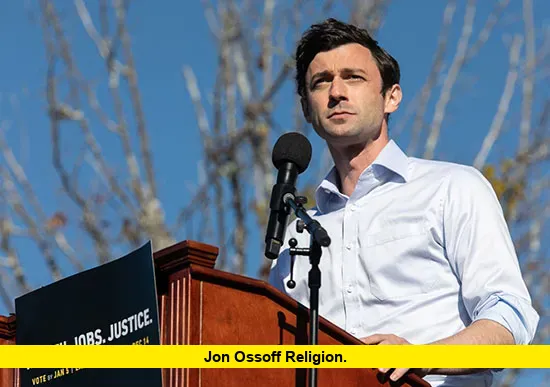

Faith is not a footnote in Jon Ossoff’s public life — it is, by his own account, the foundation of everything he does in office. According to multiple biographical sources and religious publications that have covered his background in depth, Ossoff identifies as Jewish, practicing within the Reform tradition, and traces his spiritual identity directly to his upbringing in Atlanta’s Jewish community.
As per reports from Religion News Service and various Jewish media outlets, Ossoff’s path to formal Jewish identity was not without complexity. His father is Jewish, but his mother immigrated from Australia and is not. Because traditional Judaism passes the faith through the mother’s lineage, Ossoff did not automatically qualify under Orthodox or Conservative standards. According to various sources familiar with his background, he chose to formally convert before his bar mitzvah — undergoing the ritual immersion known as a mikvah — and was subsequently bar mitzvahed at The Temple, a historic Reform synagogue on Peachtree Street in Atlanta.
That synagogue carries enormous historical weight, and as per multiple historical and religious accounts, Ossoff has spoken about its significance openly. According to widely cited reports, The Temple was bombed in 1958 by white supremacists who targeted its rabbi, Jacob M. Rothschild, for his outspoken support of the civil rights movement and his friendship with the Reverend Martin Luther King Jr. As per various sources, Ossoff has pointed to that history as something that personally shaped his sense of moral purpose. He was so moved by Rabbi Rothschild’s legacy that when he was sworn into the U.S. Senate in January 2021, according to multiple news accounts, he carried the late rabbi’s Bible into the chamber.
According to the Times of Israel and various Jewish American publications, Ossoff’s ancestors on his father’s side fled pogroms in Eastern Europe in the early twentieth century, and he grew up in a household that included Holocaust survivor relatives. As per his own statements in multiple interviews, that family history gave him an early and visceral understanding of what it means when governments fail to protect their own people — and what happens when democratic norms collapse under the weight of authoritarian rule.
As per reporting from Moment Magazine and other Jewish-focused outlets, Ossoff has described his upbringing as one deeply shaped by values of peace, justice, and collective responsibility. According to various sources quoting him directly over the years, he has said that his synagogue, his parents, and his grandparents all reinforced a worldview that compels action on behalf of the marginalized and the persecuted. In a letter he wrote to Georgia’s Jewish community ahead of his 2021 Senate run, as reported by the Atlanta Jewish Times and various other outlets, he stated that his Jewish heritage instilled in him a conviction to fight for those who are most vulnerable.
According to the American Jewish Committee and various religious media sources, Ossoff serves on the Senate Bipartisan Task Force for Combating Antisemitism and has spoken publicly about the rise of antisemitic incidents across the country. As per those accounts, he frames the fight against antisemitism not as a partisan issue but as a foundational American one — rooted in the belief, as he has said in various forums, that this country’s strength lies in its commitment to pluralism and equal dignity regardless of faith or background.
As per Wikipedia and various congressional records, when Ossoff took his Senate seat in 2021, he made history as the first Jewish senator ever elected from Georgia and the first Jewish senator from the entire Deep South since Florida’s Richard Stone held office in 1974. According to multiple sources covering that milestone, the symbolism of his swearing-in — using Rabbi Rothschild’s Bible, in a chamber that had never before seated a Jewish senator from his state — was not lost on Georgia’s Jewish community or on observers of American religious and political history.
According to various profiles published by Jewish media organizations, Ossoff has been careful to distinguish his personal faith from policy positions, particularly on matters involving Israel and the Middle East. As per reporting from the Times of Israel and the Atlanta Jewish Times, he has publicly described the U.S.-Israel relationship as ironclad while also stating that unconditional support without accountability is not a position he holds. Various sources note that this nuanced stance has drawn both praise and criticism from different corners of the American Jewish community.
As per various sources tracking his public remarks over time, Ossoff has consistently returned to one theme when discussing his religion: that faith, for him, is inseparable from the obligation to act. According to those accounts, he does not treat Judaism as a private matter kept separate from his Senate work. Rather, in his telling, the values absorbed in a Reform synagogue in Atlanta — justice, dignity, the memory of persecution, the duty to protect others — show up every day in the legislation he fights for, the hearings he conducts, and the causes he refuses to abandon even when the political calculus argues otherwise.